



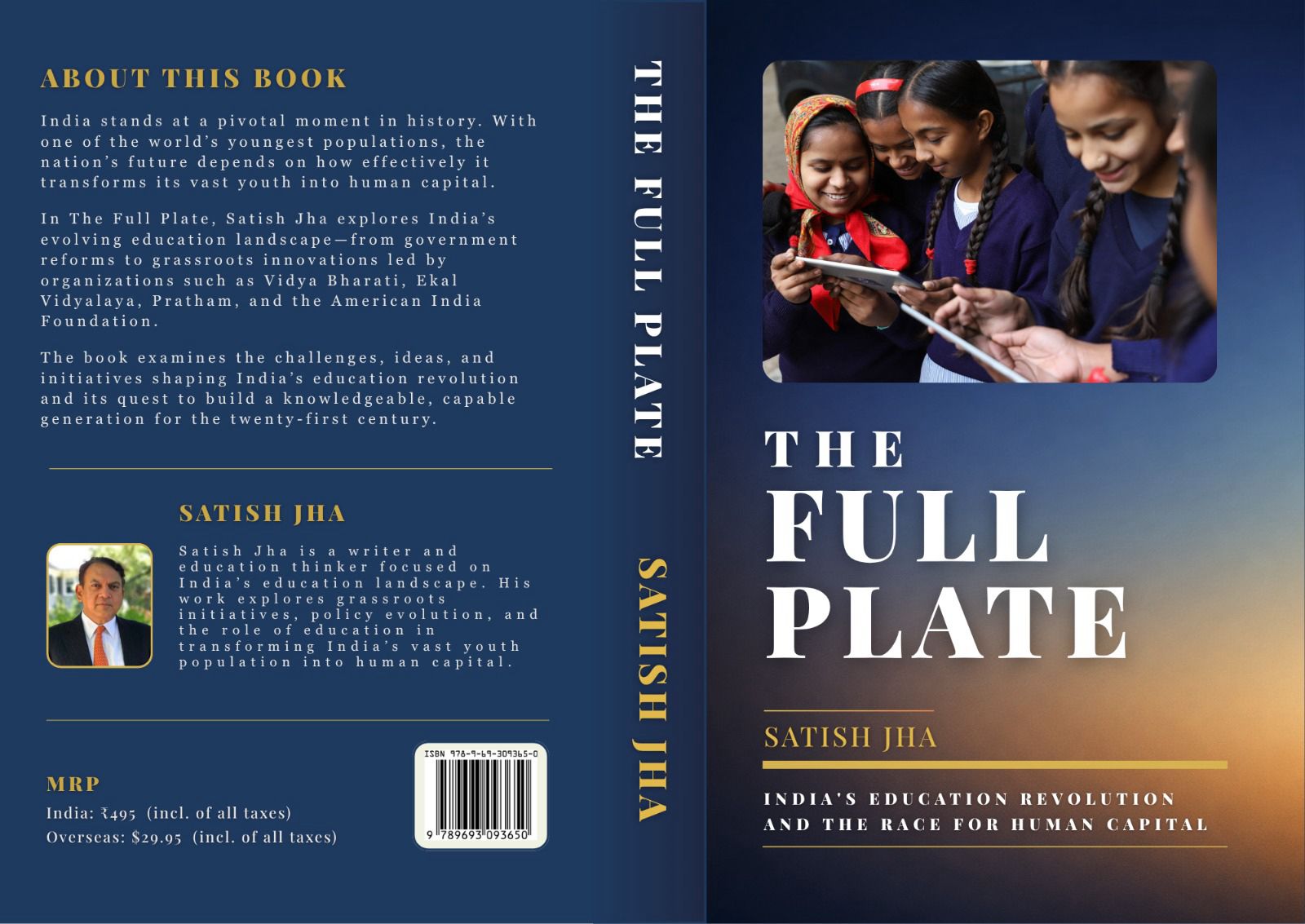
By Prof Suresh Deman
At a time when India stands at a decisive historical juncture—buoyed by demographic promise yet constrained by structural inequalities—Satish Jha’s The Full Plate offers a timely and deeply reflective examination of one of the most critical determinants of the country’s future: its education system.
This is not merely a book about schooling. It is a meditation on human capital, social transformation, and the moral economy of opportunity in twenty-first-century India.
My engagement with this book is not entirely detached. I have known Satish Jha since our days together at Jawaharlal Nehru University in 1976, during the height of the Emergency—a period marked by anxiety and intellectual unease. Even in that fraught atmosphere, he stood out as an engaged and thoughtful presence, often to be found in animated discussion over tea at the JNU canteen. Those early impressions—of intellectual curiosity tempered by quiet composure—have endured across the decades.
We lost touch for many years, only to reconnect through social media. What struck me immediately was the continuity in his character. Despite a long and distinguished career spanning journalism, technology, governance, and education, Satish’s modesty and humility remain undiminished. I later had the privilege of inviting him to deliver the K.C. Sondhi Memorial Lecture in Jaipur and the Prof. Devendra Kaushik Memorial Lecture.
Our conversations since—on education, technology, and the futures of children—have deepened my appreciation of the intellectual journey that animates this book. His foundational role at Jansatta and Dinman, and his contributions to The Indian Express, speak to the breadth and seriousness of his engagement with public life.
READ: ‘The Full Plate’ and the kindness of readers (March 26, 2026)
Jha begins by foregrounding the central paradox of India’s educational landscape: unprecedented expansion in access coexists with a persistent crisis of quality. Millions of children are enrolled in schools, yet learning outcomes remain uneven and frequently inadequate. Rather than rehearsing familiar critiques of the state, the book turns its attention to the dynamic role of non-state actors who have moved in to reshape the educational ecosystem.
Through rich case studies—Vidya Bharati, Ekal Vidyalaya, Pratham, and the American India Foundation—Jha illustrates how meaningful innovation frequently emerges from the margins. These initiatives, driven by civic commitment and adaptive pragmatism, represent a parallel and often more responsive architecture of education. They challenge rigid institutional models and demonstrate that localized, community-rooted solutions can yield results that formal systems have struggled to achieve.
What distinguishes The Full Plate is its deeply human perspective. Jha does not merely analyze systems; he brings to life the lived experiences of learners, teachers, and communities. The book is animated by stories of resilience and aspiration—children discovering the transformative power of learning, teachers working against formidable odds, communities striving to overcome entrenched disadvantage. It is this quality that gives the analysis its moral weight.
In this respect, Jha’s work invites a productive comparison with Amartya Sen’s Development as Freedom. Where Sen conceptualizes development as the expansion of human capabilities and freedoms, Jha grounds this philosophical abstraction in the concrete realities of Indian education. If Sen furnishes the framework, Jha traces the institutional and societal pathways through which such freedoms may be realized—or foreclosed. Education, in Jha’s telling, is not merely one capability among many but the foundational capability that makes all others possible.
Importantly, Jha avoids technological romanticism. He acknowledges the genuine potential of digital tools while insisting that technology can only ever be an enabler, never a substitute for institutional integrity and human engagement. This measured stance is particularly valuable at a moment when policy discourse is prone to uncritical enthusiasm for technological solutions.
The book is equally attentive to the broader political economy of education, situating it within demographic trends, labor markets, and global shifts. It raises—implicitly yet forcefully—the question of whether India can truly harness its demographic dividend without a corresponding revolution in educational quality and ambition.
READ: The Full Plate: A powerful argument for grassroots change in India’s classrooms (March 25, 2026)
If there is one limitation worth noting, it lies in the relatively limited interrogation of the state’s evolving role. The non-state initiatives are compellingly presented, but a more sustained engagement with the political and institutional constraints bearing on public systems would have strengthened the analysis further. This is less a criticism than an invitation for the conversation to continue.
Nevertheless, The Full Plate represents a significant contribution to the literature. It resists simplistic binaries and instead offers a layered narrative—one that honestly acknowledges both progress and persistent challenge. Jha writes with clarity, accumulated experience, and a quiet moral conviction that suffuses the text without ever tipping into polemic.
In the final analysis, this is both a diagnosis and a call to action. It reminds us that education is not a sectoral concern but the very foundation of an equitable and progressive society. Education, in my own view, is the most powerful asset one can possess—once acquired, it cannot be taken away. It expands horizons, deepens freedom, and anchors dignity across a lifetime.
The Full Plate embodies this conviction. It is a thoughtful, humane, and intellectually grounded work that enriches our understanding of India’s educational challenge and inspires a deeper commitment to its transformative potential.