



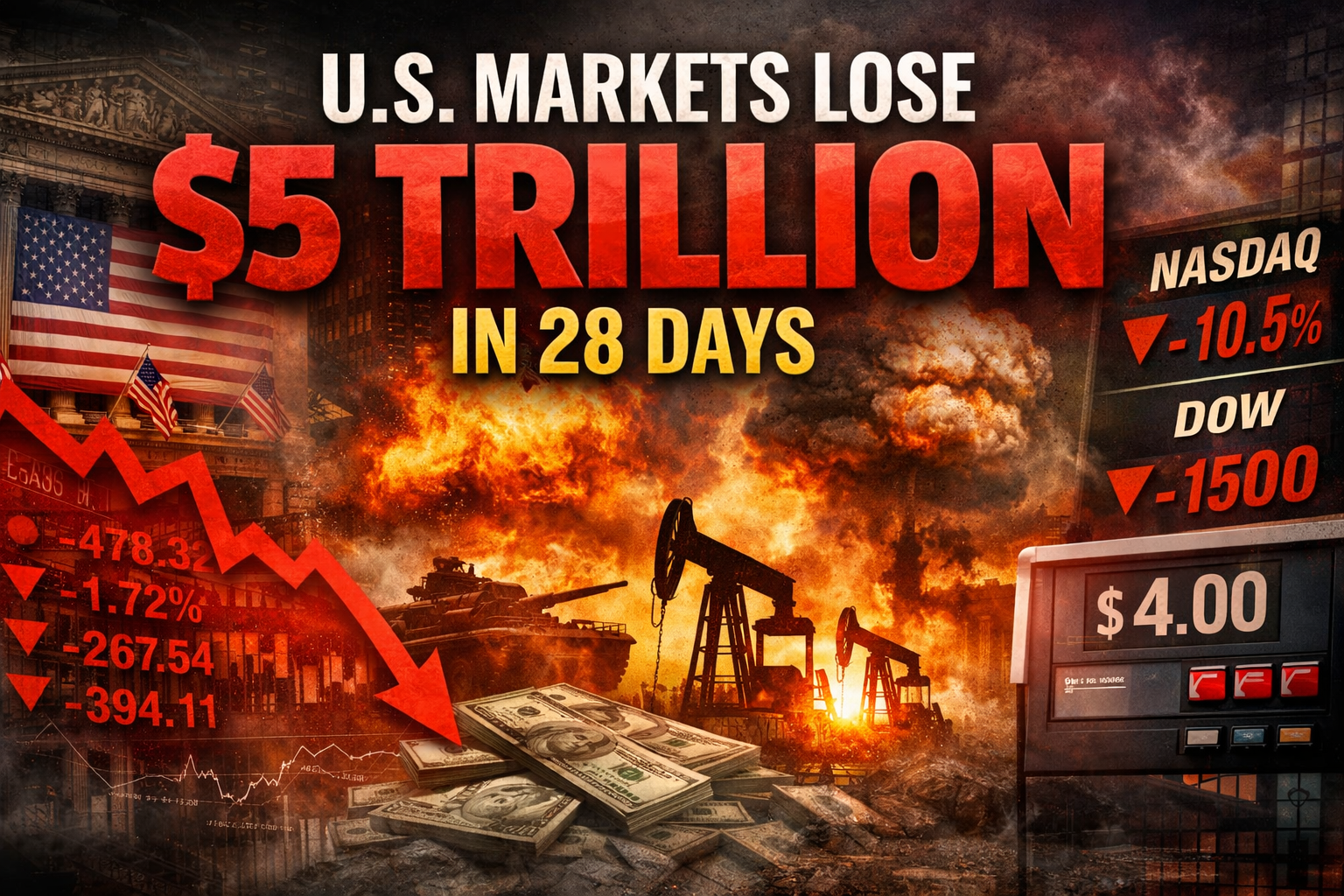
In the four weeks since the conflict with Iran escalated at the end of February, the U.S. stock market has gone through a steady and deeply unsettling slide. What stands out is not a single dramatic crash, but the sheer persistence of the decline.
Taken together, the erosion is massive. Estimates based on index declines and total market capitalization suggest that roughly $4 trillion to $5 trillion in market value has been wiped out over this 28 day stretch. The losses have unfolded gradually, but their cumulative impact now rivals some of the sharper corrections of recent years.
The downturn has been driven by a familiar mix of geopolitics and economics. As tensions intensified, oil prices surged, inflation fears returned, and investors began pulling back from risk. The result has been a broad shift in sentiment across Wall Street.
The Nasdaq 100 has fallen more than 10 percent from its recent peak, officially entering correction territory. The S&P 500, meanwhile, has logged five consecutive weeks of losses, its longest such stretch since 2022.
Energy markets tell the other half of the story. Brent crude has climbed to around $110 a barrel, while West Texas Intermediate is hovering close to $100.
These are not just numbers on a commodities screen. They feed directly into inflation, consumer sentiment, and expectations around interest rates.
In fact, consumer confidence in the U.S. has already taken a hit. Surveys show sentiment slipping to a multi month low as households react to rising fuel costs and broader economic uncertainty.
For much of his presidency, Donald Trump managed to keep markets relatively resilient despite frequent shocks. Trade tensions, tariff threats, and policy reversals created volatility, but investors grew accustomed to a pattern where sharp moves were often followed by quick recalibration. That pattern even picked up a nickname in financial circles, reflecting the belief that policy shocks would rarely be sustained.
READ: Gas prices jump in the US, and drivers are going the extra mile to save (March 10, 2026)
This time feels different.
The war has introduced a level of uncertainty that cannot be managed through messaging alone. Oil supply risks, particularly around key shipping routes, are rooted in physical constraints, not policy signaling. Markets are reacting accordingly.
The economic impact is also showing up beyond equities. Over the same 28 day period, U.S. households have absorbed an estimated $100 billion to $115 billion in additional costs, driven largely by the spike in gasoline and energy prices. Gas prices have risen sharply, nearing $4 per gallon nationally, forcing consumers to spend significantly more on everyday fuel.
This acts like a silent transfer of wealth. Money that might have gone into discretionary spending or savings is now being redirected toward energy costs. Economists often describe this as a hidden tax, one that is immediate and difficult to avoid.
What makes this moment particularly striking is the combination of forces at play. Markets are dealing not just with falling stock prices, but with rising costs in the real economy. Wealth is being eroded on balance sheets at the same time as expenses are rising on household budgets.
That dual pressure helps explain why the past month has felt heavier than a typical correction.
The question now is whether this remains a prolonged adjustment or deepens into something more severe. Much will depend on how the conflict evolves and whether energy prices stabilize. For now, the market is not in freefall, but it is clearly under strain.
And after 28 days of steady losses, that strain is becoming harder to ignore.