



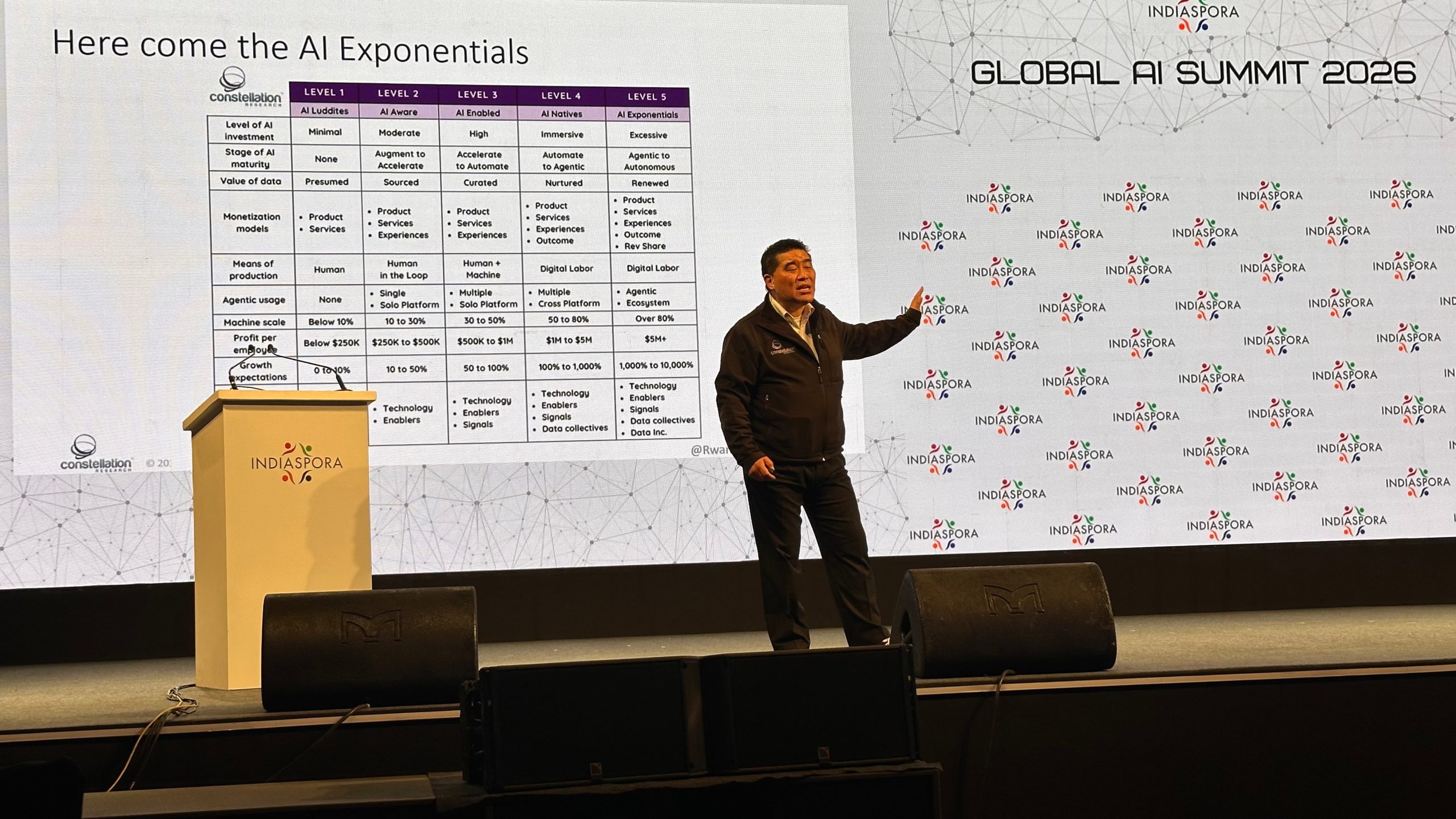
At the closing day of the Indiaspora Global AI Summit in Bengaluru, Ray Wang, principal analyst and founder of Constellation Research, delivered a high-energy keynote that cut through the hype surrounding artificial intelligence. He urged businesses to focus on outcomes, velocity, and strategic clarity in what he described as a “winner-takes-all” moment.
A prominent Silicon Valley-based analyst and author, Wang is known for advising Global 2000 companies on disruptive technologies, digital transformation, and enterprise software. His keynote brought that global perspective to the Indiaspora stage, blending historical analogies, sharp market insights, and a clear warning: the AI revolution will reward only those who move decisively—and fast.
Wang opened with an unexpected analogy, the artificial refrigeration revolution, to illustrate a critical point about technological change. “Just like in other technology revolutions, you have to have a business outcome. You have to have a business purpose. And when you do that, you’re going to do miracles,” he said.
While companies like GE and Carrier were pioneers in refrigeration, Wang pointed out that the real winner was Coca-Cola, which leveraged the technology to build cold supply chains and transform its business. “The first movers who adopt this AI revolution… these are the ones that are going to drive massive change,” he emphasized.
READ: Neeraj Aggarwal outlines India’s AI playbook at Indiaspora Global AI Summit (March 28, 2026)
Drawing a parallel to today’s AI boom, Wang argued that success will not come from simply adopting AI tools, but from applying them with clear commercial intent.
Wang described the current AI landscape as one where market concentration will be extreme. “We are in an era… it’s a winner takes all market, where the first person that wins gets 60% of the market, the next person comes in at 20%, and then it’s scattered from there.”
Unlike the open, decentralized growth of the internet era, AI, he argued, is currently capital-intensive and centralized, dominated by a handful of players. However, he expects this dynamic to evolve over time.
“The problem with AI is it’s capital intensive… there are very few players at this moment… and more importantly, it’s a little bit more expensive right now. But that is all going to change.”
Despite this, he noted strong early signs of return on investment. “We spent a week with 120 public CEOs… and I can tell you, 80% of them are seeing that. It is there. It is happening in this marketplace.”
A central theme of Wang’s keynote was what he called “margin compression”—a reality businesses are already grappling with due to inflation, tariffs, and rising costs. “We are in an era of the 10X role. Things are 10 times harder… do you feel like… you’re actually working 10 times harder only to stand still?”
READ: War, diaspora and India’s growth: Gita Gopinath outlines global outlook at Indiaspora Forum 2026 (March 24, 2026)
He warned that most large companies are stuck in low-growth cycles just as AI begins to reshape industries.“Most companies on the Fortune 500 are growing in single digits… and we are just about to hit the AI revolution.”
AI, he argued, will fundamentally alter workforce structures. “AI and automation is turning the pyramid into a diamond… knowledge work is probably going to be reduced.”
While he stopped short of predicting immediate mass job losses, Wang made it clear that white-collar work will face significant transformation over the next decade. One of the most striking parts of Wang’s keynote was his focus on “exponential scale”—where small teams generate outsized impact.
Citing examples of startups generating tens or hundreds of millions in revenue with just a handful of employees, he highlighted how AI is redefining productivity. “That is exponential scale… they are doing 200,000 in revenue per employee… that is the question everyone’s gonna ask.”
He contrasted global cost structures, from aerospace to payments, to show how competitiveness is increasingly defined by scale efficiency. “You have to operate in a scale that works in other markets… how do you compete with zero?” he asked, referencing India’s UPI system.
Wang emphasized that in a world of “infinite possibilities,” strategy becomes more important. “If you can build everything… the number one question… is what you’re not going to do.” He pointed to examples like Apple choosing not to pursue certain markets despite having the resources, underscoring the importance of focus and sequencing. “This is not an issue of speed. This is an issue of velocity. You have to be there first.”
READ: In conversation with Ray Wang: ‘You have to decide what not to do’ in the AI era (March 27, 2026)
In his view, the competitive divide is simple: “There are only two types of companies… fast and slow. There is nothing in between.”
A key concept Wang introduced was “decision velocity,” the ability of organizations to make faster, more precise decisions using AI. “Machines are making hundreds… thousands of decisions per second. And the companies that can make faster, more precise decisions are going to win in the AI world.”
Rather than chasing AI for its own sake, he urged businesses to focus on specific outcomes, whether operational efficiency, revenue growth, or cost reduction. “If don’t have any outcomes, don’t care.”
He outlined a framework for integrating AI into business processes, emphasizing the importance of deciding when to automate fully and when to retain human involvement. “When do I trust full intelligent automation? When do I augment the machine with a human? … and when do I go for human touch?” Despite his focus on automation, Wang underscored that humans would remain central, especially in areas requiring judgment, creativity, and trust.
Using the example of AI in healthcare, he illustrated a hybrid future:
“The answer isn’t either, we’re going to see our family physician and… get a second opinion with the AI doctor.” He stressed that the real design challenge for organizations is determining “when and where you insert a human.”
Reflecting on his experience at the summit and in India, Wang struck an optimistic note about the country’s prospects. “The short answer is yes,” he said when asked whether this could be India’s century. “Population dynamics are in your favor… the technology revolution is new… the brain trust is here… and more importantly, there is an ecosystem… you haven’t seen before.” He pointed to the role of the diaspora and returning talent as a critical advantage in building the next generation of AI-driven companies.
Wang concluded with a broader reflection on the kind of talent needed in the AI age. “Expertise is a commodity. Experience is not.” He urged individuals and organizations alike to combine technical skills with broader intellectual depth.
“Math and science are still important but take the time to learn the classics. Take the time to learn the history. We need AI artisans, left brain, right brain. You put them together; you get polymaths like this.”