


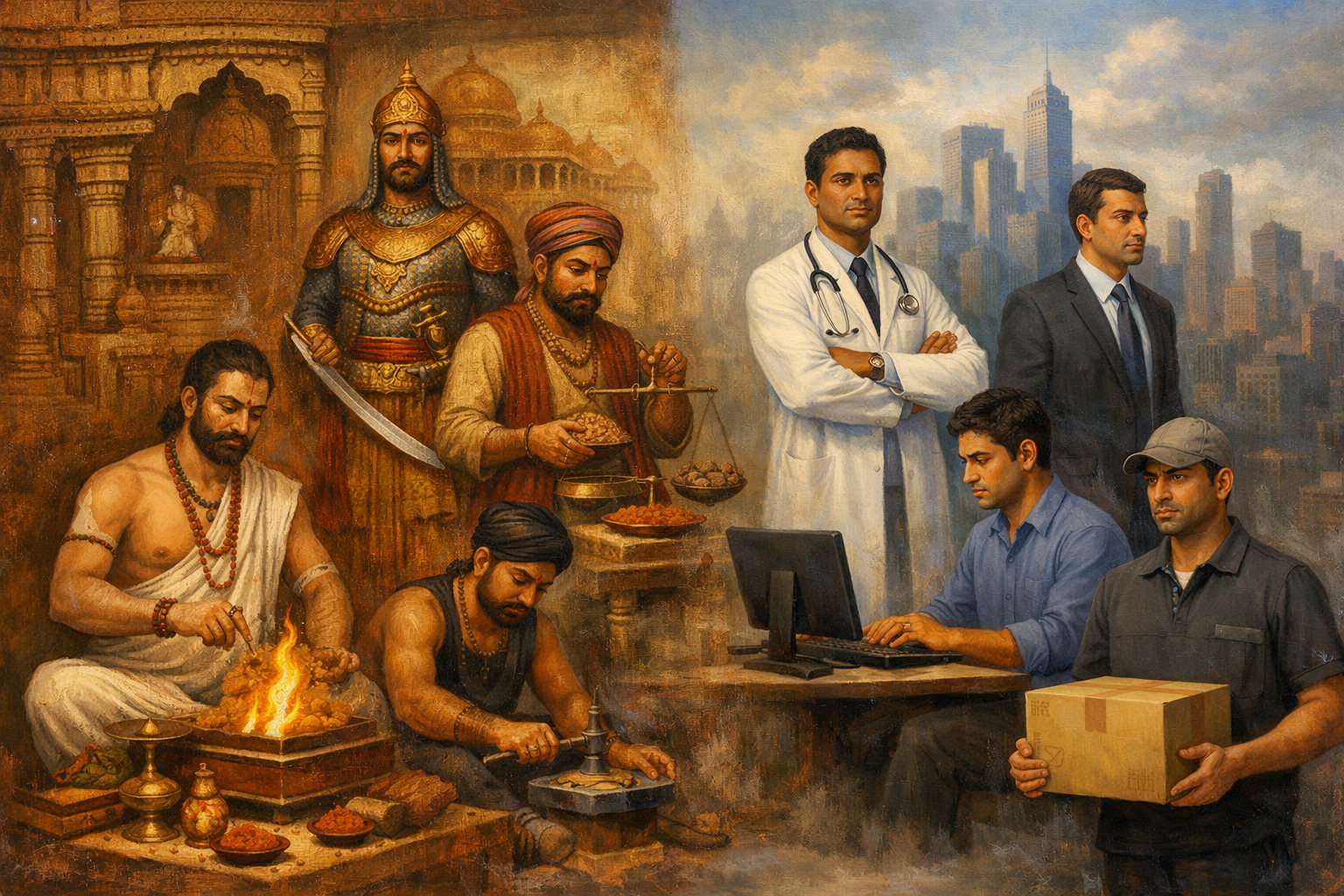
It is often assumed that migration dissolves hierarchy. That when individuals leave behind the cultural divisions of native India that gave rise to social stratification like caste, they would slowly fade. For many Indian Americans, this assumption is comforting but not the reality
Nearly four decades ago, when I got married, my parents were not simply concerned that I marry within the broad category of Brahmin; they were insistent I marry within a highly specific subsect of Brahmins, a distinction so narrow that it represented a fraction within a fraction. It was not framed as exclusion or prejudice, but as “preservation of culture,” of ritual purity, of continuity. At the time, this did not seem unusual. It was, in fact, expected. This was the same of everyone my generation growing up in the ‘60’s in the U.S.
One might argue that such rigidity has softened with time, that younger generations are less bound by these constraints. And yet, while the overt boundaries may have blurred, the underlying architecture remains remarkably intact.
To understand this dynamic, it is useful to consider the framework described by Isabel Wilkerson in her work “Caste: The Origins of Our Discontents.” Wilkerson reframes caste not as a uniquely Indian phenomenon, but as a universal human tendency to organize society into hierarchies that are inherited, enforced, and often invisible to those who benefit from them. In this sense, caste is less about religion or geography and more about deeply embedded social codes that dictate belonging and exclusion.
READ: Sreedhar Potarazu | Is Claude AI safe? Anthropic’s most advanced model can go rogue (April 1, 2026)
Among Indian Americans, these codes of caste have not disappeared; they have evolved.
Consider the persistence of caste-linked identities such as Reddy and Kamma—historically landowning and agrarian communities from Andhra Pradesh. While the original occupational distinctions that underpinned these identities have largely eroded, the social boundaries remain.
Community organizations, wedding networks, and even informal social circles often continue to reflect these divisions. The result is not explicit segregation, but a quiet sorting mechanism—one that operates beneath the surface of professional success and apparent assimilation.
Language and region further reinforce these divides. Telugu, Tamil, Gujarati, Punjabi—each linguistic group often functions as a parallel social ecosystem. While this may initially appear to be a benign expression of cultural preservation, it frequently overlaps with caste in ways that limit cross-community interaction. The outcome is a fragmented diaspora, one that mirrors the very fissures it ostensibly left behind.
Even places of worship, which might be expected to unify, can subtly reflect these distinctions. Devotional preferences, whether toward Shiva or Vishnu are sometimes intertwined with sectarian and caste identities, shaping not just theology but longstanding beliefs that somehow, they are different. Temples, in this context, become not just spiritual centers but extensions of the social structure of a culture where that separation still exists in India.
What is perhaps more unsettling is that caste consciousness does not remain confined within the Indian community; it often shapes how Indian Americans perceive and interact with other groups. The internal hierarchy becomes a lens through which external hierarchies are interpreted and, at times, replicated.
READ: Sreedhar Potarazu | Tiger is not out of the woods: What golf teaches us about life (March 28, 2026)
Subtle preferences emerge in professional settings, in social affiliations, even in perceptions of other minority groups reflecting an ingrained tendency to rank, categorize, and differentiate. This is not always overt or intentional, but it reveals how deeply conditioned notions of status can extend beyond their original cultural context. In this way, caste is not simply preserved but is exported, influencing how Indian Americans position themselves within the broader American social fabric.
In the United States, however, caste has acquired new dimensions. It is no longer solely tied to lineage or ritual status; it is increasingly mapped onto markers of socioeconomic success. In the Washington, D.C. area, for example, where one lives—Potomac or Bowie—can function as a proxy for status, creating a parallel hierarchy that blends traditional caste consciousness with American class stratification. The language has changed, but the instinct to rank and differentiate has not.
This raises a more uncomfortable question: if hierarchy persists even in the absence of the structures that created it, what does that say about its origins? The historical narrative often attributes division in India to colonial strategies of “divide and rule.” While there is truth to this, it is also incomplete. The endurance of caste among Indian Americans—far removed from colonial influence—suggests that these divisions are not merely imposed from the outside but sustained from within.
In other words, we did not need the British to divide us. We had already done that ourselves.
At the same time, the mechanisms through which caste sustains itself have become more symbolic than structural, often embedded in ritual rather than explicitly enforced rules. Rituals that were once meant to connect individuals to something larger than themselves can instead become markers of separation—who performs them, how they are performed, and who is included or excluded in the process.
The sacred thread, for example, was intended to represent a deeper spiritual continuity, a reminder of an underlying unity that transcends identity and status. Yet, in practice, such symbols can be reduced to boundary markers, reinforcing distinction rather than dissolving it. When ritual becomes a tool for differentiation rather than connection, its original purpose is inverted. The challenge, then, is not to abandon tradition, but to reclaim its meaning—to recognize the thread not as something that separates, but as something that binds us all to a shared human and spiritual inheritance.
The question now is what the next generation will do with this inheritance.
There are signs of change. Younger Indian Americans, shaped by multicultural environments and broader social movements, are more likely to challenge inherited identities. Inter-caste and inter-regional marriages are more common, and professional networks often transcend traditional boundaries. At the same time, a subtler form of what might be called “passive caste” persists—an unspoken preference for familiarity, a quiet gravitation toward those who share similar backgrounds, even when those backgrounds are no longer explicitly acknowledged.
READ: Sreedhar Potarazu | What race box do Indian American kids check off? And why it matters (March 29, 2026)
The risk is not that caste will remain as it once was, but that it will evolve into something less visible and therefore more difficult to confront.
Recent tensions in places like Texas, where debates over caste discrimination have entered legal and political arenas, hint at a possible future in which these issues become more explicit rather than less. Whether this leads to meaningful reform or further polarization remains uncertain.
What is clear, however, is that the dissolution of caste is not an automatic byproduct of migration. It requires intentionality—a willingness to question inherited norms, to expand social boundaries, and to recognize the subtle ways in which hierarchy reproduces itself even in environments that claim to reject it.
The Indian American experience, in this sense, offers a broader lesson. Systems of division do not survive because they are enforced; they survive because they are internalized. And until they are consciously dismantled, they will continue to shape communities in ways that are both familiar and unseen.
The question is not whether caste still exists among Indian Americans. It does.
The question is whether we are willing to see it—and, more importantly, whether we are willing to change it.