



The frustration amongst India’s tech talent can also be seen on community app Blind. Recently A user from Microsoft wrote, “Most Indians succeed not because of India but despite India.
At the India AI Impact Summit held in New Delhi, Indian Prime Minister Narendra Modi proclaimed India as a key player in the global artificial intelligence ecosystem. The inaugural edition of the February summit in India was a first for any country in the global South and was attended by the likes of French President Emmanuel Macron, UN Secretary General Antonio Guterres and Google CEO Sundar Pichai.
Modi also shared his vision that India should be among the top three AI superpowers globally, not just in the consumption of AI but in creation.
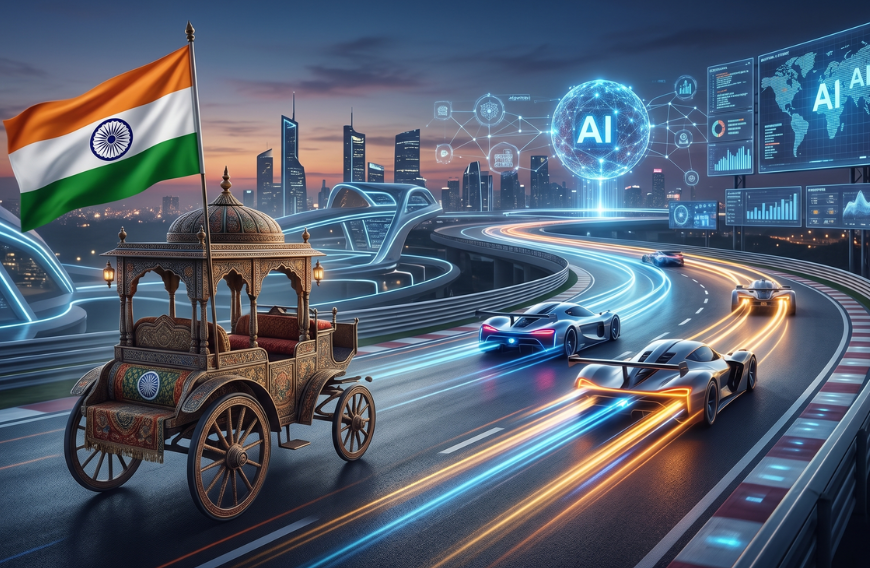
While India is seeing AI as a transformative opportunity in the country’s vision towards “Viksit Bharat 2047,” a just released survey shows that a majority of tech elite believe India is already “behind” in the global AI race.
READ: Neeraj Aggarwal outlines India’s AI playbook at Indiaspora Global AI Summit (March 28, 2026)
A new survey by Blind, an anonymous professional community headquartered in the Bay Area, reveals a stark disconnect between official rhetoric and on-the-ground sentiment. Just 5% of respondents viewed India as a global leader in the field.
The report also highlights a fragmented landscape: while the government emphasizes infrastructure development, 62% of respondents said the lack of homegrown R&D remains a critical bottleneck.
Respondents indicated that this gap fuels concern that India may remain dependent on foreign technology.
The survey, conducted between March and April 2026, gathered responses from 1,723 India-based professionals on the country’s competitiveness in AI. While 53% said India is lagging behind global peers, 16% believed it is catching up, 13% were unsure, and another 13% described the country as mid-tier.
The survey findings are particularly important given the Indian government’s aggressive push to position the country as a global AI superpower. On why those on the ground remain unconvinced about India’s AI trajectory, the survey offers further insight: 53% of tech professionals believe India is “behind” global leaders in the AI race.
The findings come at a precarious time for the “Digital India” mission. Despite Modi’s calls for India to lead global AI development and high-profile investment pledges—including Microsoft’s $17.5 billion and Google’s $15 billion commitments—only a meager 5% of the workforce believes the country is currently “leading.”
READ: AI moment is not about technology. It’s about institutions. (February 22, 2026)
The survey by Blind—which counts 13 million verified professionals worldwide engaging in candid conversations across companies and industries—also suggests that India’s ambitious infrastructure push is failing to convince its own tech elite. While the government recently outlined plans to attract $200 billion for data centers and AI infrastructure at the 4th AI Impact Summit, many professionals believe hardware investments alone will not bridge the gap.
Beyond funding, the findings point to deeper structural challenges—most notably a perceived lack of innovation. In the survey, 62% of respondents cited the absence of homegrown AI R&D and intellectual property (IP) as the primary barrier. Another 12% pointed to a shortage of long-term risk capital, while 11% flagged policy and regulatory uncertainty.
Concerns about long-term consequences are equally pronounced. A majority—55%—identified dependence on foreign AI systems as the biggest risk if India fails to catch up, while 24% warned of diminished global influence. A smaller share, 5%, cited the potential rise in fraud and deepfakes.
Taken together, the responses reflect a growing anxiety that India could remain a “consumer hub” for Silicon Valley technologies rather than evolve into a center of original innovation—perpetuating an outsourcing dynamic that major firms like TCS and Infosys have long sought to move beyond.