


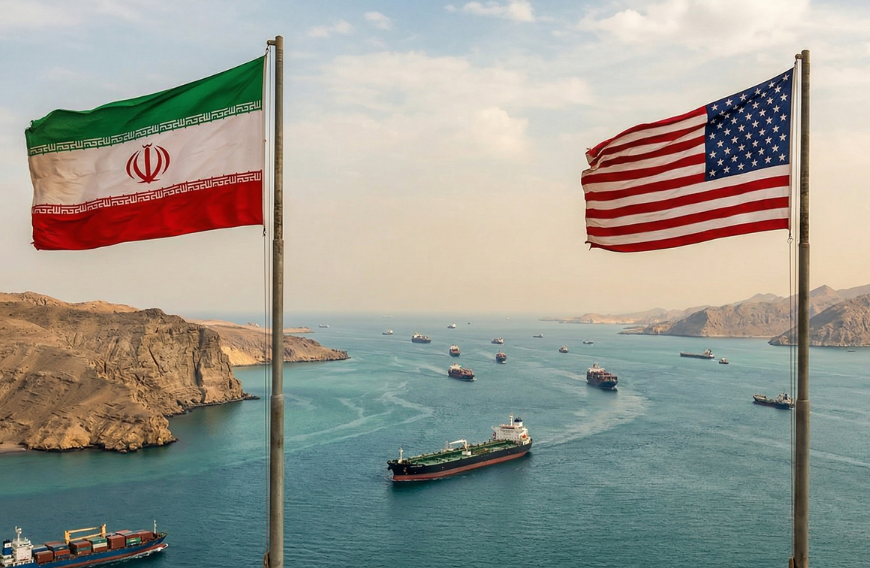
President Donald Trump’s temper tantrum regarding the Strait of Hormuz could make things much worse on a global scale. Analysts warn that Trump’s planned naval blockade of Iran would further cripple international shipping, exacerbating the energy crisis roiling the global economy.
As per Al-Jazeera, oil prices surged above $100 a barrel on Monday after Trump announced that the U.S. Navy would blockade the Strait of Hormuz and “interdict every vessel in international waters that has paid a toll to Iran.”
“Iran will not be allowed to profit off this Illegal Act of EXTORTION,” Trump said on Truth Social.
“Anything that currently takes more oil off the market will push prices up, which in turn will push gas prices further,” Trita Parsi, cofounder of the U.S.-based Quincy Institute for Responsible Statecraft, told Al Jazeera.
When a critical chokepoint becomes contested, it introduces uncertainty into markets, discourages investment, and forces countries to rethink their economic and security strategies. Nations heavily dependent on imported energy or global supply chains would likely accelerate efforts to diversify sources, build reserves, or seek alternative routes, though these adjustments take time and resources.
READ: Iran refuses to open Strait of Hormuz amid Trump threat (April 6, 2026)
Diplomatically, a blockade could strain alliances, as partners of the United States may not uniformly support such an aggressive posture. It could also push neutral or non-aligned countries to take sides, potentially fragmenting global cooperation at a time when coordination is crucial for stability.
As per Al-Jazeera, Deborah Elms, head of trade policy at the Hinrich Foundation in Singapore, said the situation for global supply chains could get “much worse” under the blockade.
“Some of the problems are obvious, but many are not. As an example, fabrics will get more expensive,” Elms told Al Jazeera.
“Packaging is already a challenge for firms. Many can’t get blister packs for pills or lids for consumer goods. We can expect consequences for food production later this year and into next year with fertiliser disruptions and lack of supply,” Elms said.
The blockade crisis developed after months of rising tensions, including military incidents, disputes over maritime security, and disagreements surrounding Iran’s regional actions and nuclear ambitions.
READ: Countries turn to Saudi port as Strait of Hormuz closes (March 24, 2026)
A key factor was Iran’s growing assertiveness in the strait, where it was accused of interfering with shipping and possibly imposing informal controls or toll-like practices on vessels. The United States framed these actions as a threat to international navigation and global economic stability.
“Disruptions to shipping and elevated risk in the region were already well established due to the conflict,” Chad Norville, president of the oil and gas industry news site Rigzone told Al Jazeera.
“This threat doesn’t create that baseline. It amplifies it by reinforcing uncertainty around one of the world’s most critical chokepoints.”
Efforts to resolve the crisis diplomatically, ultimately failed, prompting a shift toward stronger measures. Trump’s announcement of a blockade followed this breakdown, signaling a move from negotiation to coercive strategy.
The situation around the Strait of Hormuz illustrates how fragile global stability can become when strategic chokepoints are drawn into political or military disputes. Even when actions are framed as temporary measures, they can reshape expectations about the reliability of international trade routes and encourage long-term changes in global logistics and energy planning.