



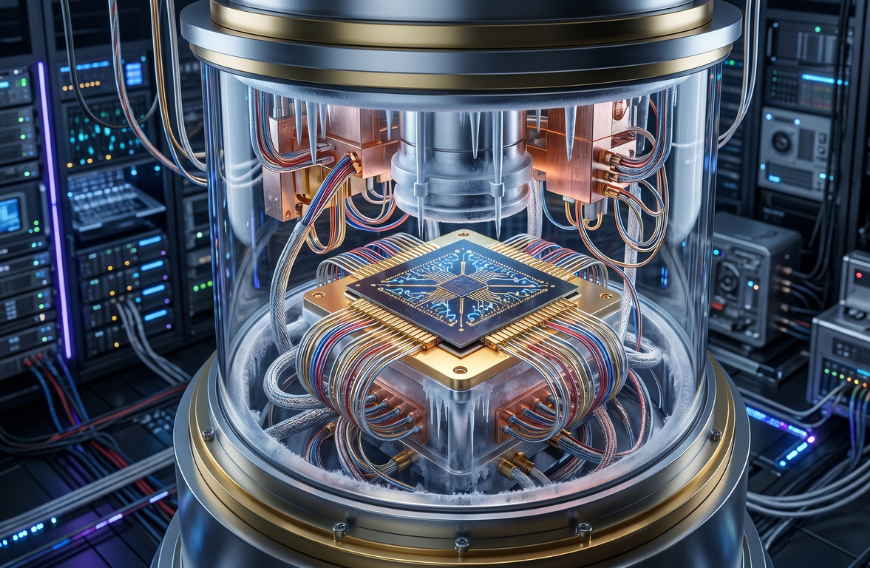
Quantum stocks surged on Tuesday after Nvidia announced a quantum-focused AI advancement. The chipmaker had unveiled Ising, an open-source family of AI models that uses quantum computing technology to address processor calibration and error-correction issues.
“AI is essential to making quantum computing practical,” Nvidia CEO Jensen Huang said, adding “With Ising, AI becomes the control plane — the operating system of quantum machines — transforming fragile qubits to scalable and reliable quantum-GPU systems.”
The surge in stocks was especially notable for Asian software and information-technology companies. In South Korea, shares of several software and cybersecurity firms including Axgate Co. and ICTK Co. briefly hit their daily trading limit of 30%. China’s GuoChuang Software Co. and QuantumCTek Co., along with Japan’s Fixstars Corp., each rose at least 8%.
READ: Quantum computing startup PsiQuantum valued at $6 billion in latest fundraise (March 25, 2025)
“Quantum Processor Units (QPUs) are likely to become the next important co-processor in data centers, sitting alongside CPUs and GPUs,” Berstein analysts told clients.
“CPUs will remain the workhorse for general-purpose computing, while GPUs dominate highly parallel workloads such as AI. QPUs, in turn, could become essential for a set of problems that are too complex or too costly for classical processors to solve efficiently,” the analysts said.
They used the example of QPUs searching a 100-million-page phone book all at once while CPUs search page by page.
Ramsey Theory Group CEO Dan Herbatschek told Business Insider why Nvidia’s Ising is important for the quantum space.
“This is significant because NVIDIA is taking what is a principle from quantum physics and making it actually usable … NVIDIA just brought quantum-like computing to hardware already in existence that organizations have — allowing them to benefit with real business value now,” he added.
Still, “while these tools can potentially help accelerate developments, the deployment of practical, large-scale quantum computing remains a long way off,” according to Bloomberg Intelligence Analyst Robert Lea.
READ: Microsoft unveils its first quantum computing chip (February 20, 2025)
According to Business Insider, the technology is expected to eventually revolutionize areas like medical research and energy efficiency, prompting interest from tech giants and governments. The space is a largely speculative trade for investors, given that real-world applications are still some time away.
The gains in the stock market came as AI shares rebounded across the region, helped by signs of the U.S. and Iran reviving peace talks.
According to the Stratistics Market Research Consulting, the global quantum computing market is projected to jump to more than $11 billion by 2030 from nearly $1.7 billion in 2024.