



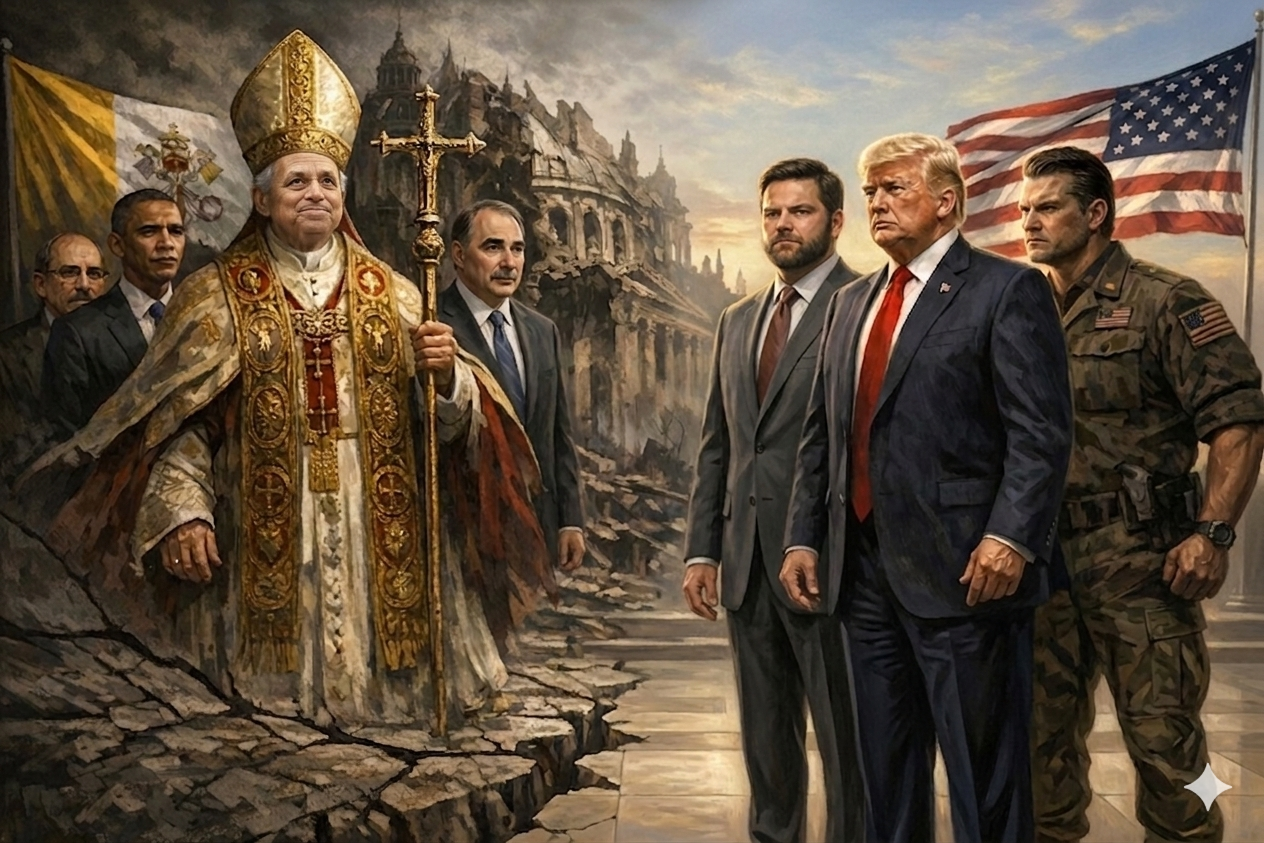
The moment moral authority begins to fracture
There are moments in the life of the Church when uncomfortable questions can no longer be postponed. This is one of those moments.
Is the Pope speaking as a spiritual shepherd, or is he stepping into the arena of politics?
That question is no longer theoretical. It is playing out in front of us.
The first American Pope, Leo, is increasingly coming across not as a distant moral authority, but as someone all too eager to insert himself into contemporary political debates. This shift has not been subtle. It has been rapid, visible, and deeply troubling. The issue is not that he speaks on moral matters. Every Pope has done that. The issue is that his voice is beginning to sound less like the voice of Saint Peter and more like one more political voice in a crowded and noisy world.
That is a dangerous humiliation of the papacy.
The Iran war and a one-sided moral frame
Pope Leo XIV has been firm and public in condemning the war involving Iran. He has said that God does not bless conflict and warned against what he called the delusion of power that drives nations into war. He has also criticized the use of God in justifying military action.
READ: ‘Be careful’: JD Vance joins Trump in butting heads with the Pope (April 15, 2026)
On the surface, these statements sound elevated, compassionate, and morally serious. But the problem begins the moment one asks a very basic question. Where was this same moral urgency when the Iranian regime was brutalizing its own people for years?
Iran is not some innocent actor caught in a storm it did not create. It is a regime with a long and ugly record of suppressing its own citizens. Thousands of protesters have been killed in crackdowns. Women have been beaten, imprisoned, and humiliated for demanding the most basic dignity. Religious minorities have lived under fear. Generations have grown up under a regime that crushes dissent and poisons public life.
Yet somehow, when war enters the picture, the strongest moral outrage suddenly appears only against those confronting that regime. That is not moral clarity. That is selective emphasis dressed up as moral seriousness.
A Pope who speaks loudly about war while saying far less about the evil that made such conflict possible invites a simple and devastating question. Is he really defending justice, or just choosing the safer side of a fashionable argument?
Trump’s criticism and the question beneath it
President Trump, in his usual blunt style, said the Pope should focus on being a great Pope and not a politician. He called him weak on crime and misguided on foreign policy.
Many people will react first to Trump’s tone. That is predictable. But tone is often how people avoid dealing with substance.
Because behind Trump’s words is a question that is becoming harder and harder to dismiss. Has this Pope begun to sound more like a participant in political debates than a guide above them?
That question is no longer being asked only by partisans. It is being asked by Catholics who can plainly see what is happening. They do not need a briefing memo to recognize when the papacy is losing altitude.
Faith, war, and a deeper theological problem
The statement that God does not bless any conflict may sound emotionally satisfying, but it does not reflect the full depth of Christian teaching. It sounds more like a slogan than theology.
The Bible does not present life as a neat moral cartoon. There is a time for peace and a time for war. Legitimate authority does not bear the sword in vain. Even Christ’s words acknowledge sacrifice, defense, and the tragic burdens of life in a broken world.
For centuries, the Church wrestled with this reality and developed the doctrine of just war. Not because Christians love violence, but because Christians understood something modern moral posturing often refuses to admit. Evil is real, and sometimes evil is not stopped by slogans.
When centuries of moral theology are reduced to one sweeping line that flatters modern sentiment, the result is not spiritual depth. It is theological shallowness.
God is not owned by anyone
There is another glaring inconsistency here.
When people like Pete Hegseth speak about faith in the context of defending their country, they are quickly scolded for invoking God. But all over the world, violent Islamic extremists invoke God constantly while committing atrocities, terrorizing civilians, and driving ancient communities from their homes.
Where is the same direct, repeated, unmistakable outrage then?
God is not the property of America. God is not the property of the Vatican. God is not the property of any politician, soldier, or cleric. But neither can the language of faith be treated as outrageous in one context and practically background noise in another.
That kind of unevenness does not go unnoticed. People see it. They measure it. And they draw conclusions from it.
Silence where it matters most
Across parts of Africa, Christian communities continue to be attacked, displaced, and slaughtered. In the Middle East, some of the oldest Christian populations on earth have been pushed to the edge of disappearance. In China, religious expression remains under heavy state pressure and manipulation.
These are not side issues. These are central moral issues for any Pope who claims to speak for a global Church.
And yet, at this moment, the loudest and most visible energy has been directed elsewhere. That contrast is impossible to miss.
The diplomatic shift: Why JD Vance’s possible Pakistan mission signals a turning point in the Iran conflict (March 27, 2026)
When the Church’s voice is thunderous in one arena and cautious in another, the faithful are not wrong to ask why. Why here and not there? Why is one kind of suffering enough to summon immediate, repeated public passion, while another seems to live in the background?
A Pope does not need to say everything every day. But when the pattern becomes this obvious, silence itself begins to speak.
Following the money and the direction of influence
There is also a practical side to this story, and it deserves far more attention than it gets.
The Catholic Church in the United States has been deeply involved in refugee and migration programs. Much of this work has indeed been humanitarian and worthy. But it has also been heavily supported by government funding. Over the years, hundreds of millions of dollars have moved through these efforts.
That does not automatically mean corruption. But it does mean dependency, and dependency changes institutions.
When large systems are built around continuing streams of public money, they develop incentives. When public moral positions align very comfortably with those incentives, suspicion is not irrational. It is natural.
So the question arises. Is the voice we are hearing purely moral, or is it also being shaped by institutional interest, financial dependence, and political alignment?
Even the appearance of that problem is enough to damage trust. And once trust is damaged, moral authority begins to rot from within.
The Axelrod meeting and the optics of power
The Pope’s meeting with David Axelrod, President Obama’s close confidant and the most influential Democratic Party strategist, added another layer to this already troubling picture. On its own, such a meeting might be described as routine. But nothing exists on its own. Context gives events their meaning.
When the spiritual head of the Catholic Church appears in close conversation with one of the best-known architects of modern American liberal politics, and does so in the middle of visible political commentary, people are not crazy to notice. In fact, they would be foolish not to.
Leadership at that level is not only about intention. It is about optics, judgment, and the discipline to avoid creating doubt where none needs to exist.
The Pope is not a cable news analyst. He is not a party elder. He is not a global activist in white robes. If he begins to look like any of those things, then he is diminishing the office he occupies.
JD Vance and a simple warning
When JD Vance suggested that the Pope should be cautious about stepping into political debates, the reaction from some bishops and commentators was swift, offended, and predictable. But what exactly was so scandalous in what he said?
That the Pope should remain above politics?
That is not an insult. That is common sense.
In truth, what Vance said was less an attack on the Pope than a defense of the papacy. Because once the Pope starts sounding like a political actor, Catholics everywhere are forced to hear him through political filters. At that point, the damage is already done.
History has already given us this lesson
None of this is happening in a vacuum. The Church has walked too close to worldly power before, and history has not been kind in its judgment.
READ: Trump shares AI image of him as Jesus after calling the Pope ‘weak’ (April 13, 2026)
During World War II, the Church’s silence in the face of monstrous evil became one of the most troubling moral questions of the modern age. That shadow was serious enough that Pope John Paul II later acknowledged it and sought reconciliation.
Long before that, the Crusades blurred the line between faith and military ambition. Later, colonial expansion often tied the mission to the empire in ways that remain deeply debated.
The lesson is not complicated. When the Church gets too close to power, its moral voice becomes less clear, less trusted, and less holy.
That lesson should have been learned by now. Apparently, it was not.
What is at stake now
This is not about one remark, one war, one meeting, or one policy disagreement. It is about direction. It is about whether the papacy still understands what gives it authority.
If the Pope starts sounding like a political figure, then everything changes. His words are no longer received as universal guidance. They are interpreted as positions. They are weighed against party lines, media narratives, and ideological loyalties. They become one more contribution to the noise.
That is how moral authority dies. Not in one dramatic moment, but through repeated compromise, misjudgment, and loss of spiritual seriousness.
A personal reflection
As a devout Catholic originally from Kerala, India, now living in the United States, I write this with respect for the Church, but with a concern that can no longer be ignored.
The Church endured for centuries not because it aligned itself with power, but because it stood apart from it. That distance gave it credibility. That distance made its voice different. That distance allowed it to correct the world instead of echoing it.
That is what must be protected.
A moment for reflection and responsibility
For the good of the Church, it may be time for new leadership in the Catholic Church that is clearly rooted in faith and free from political influence. The Church deserves leadership that is unmistakably spiritual, not political. At this point, many of us are left asking whether a change in the leadership of the Catholic Church is necessary to restore trust and moral clarity.
2 Comments
So according to this Vinson Palathingal, the papacy has apparently “collapsed” because it dared to comment on… the world. Shocking, I know. Next thing you’ll tell me is that spiritual leaders sometimes talk about morality, which brace yourself occasionally overlaps with politics.
popes of the past floated above politics? Really? like serene, holy drones, untouched by earthly concerns. because nothing says “apolitical” like centuries of papal involvement in empires, treaties, crusades, diplomacy, and the occasional strongly worded letter to world leaders. Truly, a spotless record of political silence.
You also claim that believers become “confused” when the Pope comments on global issues. Right—because people who navigate jobs, families, taxes, and modern life apparently lose all cognitive function the moment a religious leader mentions climate change or migration. Total meltdown. Wi‑Fi down. Brain buffering. Not about abortion or issues that you care about.
And the big finale? That the papacy should stick to “pure spirituality,” as if moral teachings come pre‑washed, fragrance‑free, and guaranteed not to touch anything remotely controversial. Because nothing says moral leadership like refusing to comment on anything that actually affects human beings. So the Pope should be inspirational but only in ways that never inconvenience MAGA worldview. A truly bold stance.
What ever happened to the supposed, ‘ separation of Church and State ‘ …?
Now, Dondolf Twitler and his Nutzi Party are playing god?