



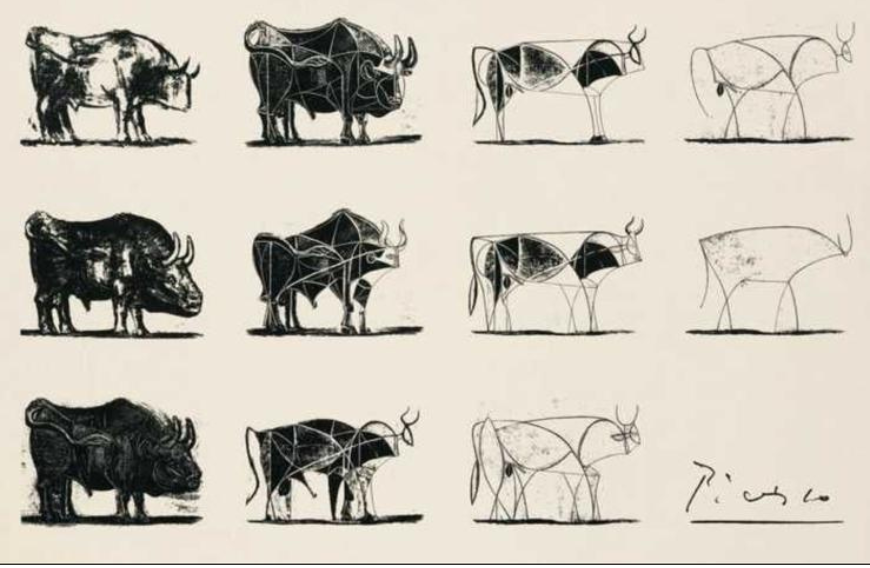
Tim Cook exemplifies the spirit of Picasso’s Beast. Allow me to explain.
When Picasso picked up a lithography stone in December 1945, he was after something most artists would never attempt: the destruction of their own complexity. On April 20, as Tim Cook announced he is stepping down as Apple’s CEO, he completed a fifteen-year act of the same radical faith, that the world would always reward those who understood what to take away.

Morning, December 5, 1945: Picasso’s Beast
Pablo Picasso walked into the Paris workshop of master printmaker Fernand Mourlot, off the Rue de Chabrol, and began drawing a bull. Picasso was drawing neither a symbol nor making a statement. He was drawing a bull, heavy, muscular, completely real. Mourlot watched as the master worked in confident, fluid strokes. “I thought to myself,” Mourlot later recalled, “that that was that.” He was wrong. Picasso had barely begun.
Over the next six weeks, working sometimes twelve hours a day, Picasso returned again and again to the stone, drawing and redrawing the same animal. Each iteration stripped something away. The musculature dissolved first, then the hooves, then the shadow beneath the belly, then the snout. Until the eleventh and final lithograph, what became known as Le Taureau, “The Bull,” held the animal in just twelve lines. Twelve lines, and yet unmistakably a bull. Picasso was not simplifying the drawing. He was searching for its soul.
More than six decades later, a man in a black turtleneck began showing Picasso’s eleven lithographs to engineers and designers in Cupertino, California. Steve Jobs had founded Apple University in 2008, a secretive internal training program designed to do something unprecedented in corporate America: transmit a philosophy, not just a playbook. And at its center, reproduced in slides and in spirit, lived Picasso’s Bull. The message was monastic in its simplicity. The goal was to iterate toward essence, to have the discipline to destroy the beautiful thing you just made, in pursuit of the more beautiful thing beneath it. Logic: complexity is cowardice dressed as effort.
What Apple University actually taught
The course that made Picasso’s Bull famous inside Apple was called “What Makes Apple, Apple,” taught by a former dean of Yale’s business school, Joel Podolny, who ran Apple University for years after Jobs founded it. In one session, instructor Randy Nelson, a former Pixar employee, showed employees a slide of the Google TV remote control. It had 78 buttons. Then, without commentary, he showed the Apple TV remote: a thin aluminum wand with just three. No lecture was needed. The comparison did all the teaching. That was the whole point. Apple’s design decisions were not aesthetic preferences. They were moral commitments.
READ: Chess between Xi and Trump: Games within the game (April 18, 2026)
The Apple Remote, a circle and four directional arrows, nothing more, represents one of the most audacious product decisions in consumer electronics history. The audio-visual industry had spent decades building remotes of baroque complexity, devices that required instruction manuals, that sat in living rooms like unsolved puzzles. Apple looked at that landscape and did not compete with it. They replaced it. One remote, universally legible, operable by a child or a grandparent in complete darkness. Not because it was easier to design that way. Because it was infinitely harder, and therefore infinitely more honest.
A fifteen-year stewardship ends
On April 20, Tim Cook published a letter and announced the most anticipated succession in Silicon Valley history. Beginning September 1, John Ternus, Apple’s 51-year-old Senior Vice President of Hardware Engineering, who joined the company in 2001, will succeed Cook as Apple’s CEO. Cook will become Executive Chairman. The board voted unanimously. The markets barely flinched. Apple’s stock slipped half a percent in after-hours trading, which is perhaps the most eloquent commentary on the transition: the institution is more durable than the individual who runs it. That is the rarest kind of legacy.
Cook inherited the company from a dying genius. Jobs formally handed him the title in August 2011, and was gone six weeks later. He received an institution inseparable from its founder’s persona, a company that critics genuinely believed could not survive the man who made it. What Cook built over fifteen years was something Jobs never had time to construct: proof of concept. Proof that the philosophy was transferable, that the culture was teachable, that the institution could outlast the prophet.
The numbers are staggering in their quiet way. When Cook took the helm, Apple’s market capitalization sat at roughly $350 billion. He leaves it at $4 trillion, a compound annual growth rate of approximately 18.4%, sustained for fifteen years, crushing the S&P 500’s comparable returns by a magnitude that would embarrass most hedge funds. Annual revenue grew from roughly $108 billion to over $416 billion. Net income for the fiscal year ending September 2025 reached $112 billion, eight times what Apple earned in 2010. Services revenue alone, the business Cook methodically constructed from scratch, exceeded $109 billion annually by 2025, becoming Apple’s second-largest revenue pillar with margins that tower over hardware.
These numbers, impressive as they are, miss the deeper truth. Cook did not succeed Jobs by being Jobs. He succeeded him by understanding what Jobs was actually doing, and then doing it differently, with different tools, at a different scale. Jobs was a singular product visionary who happened to build a company. Cook was a singular operational architect who happened to inherit a philosophy. What they shared was the Picasso instinct: the knowledge that what you remove defines you more than what you keep.
The line that remains a bull
Consider what the iPhone eliminated in 2007. Not a keyboard, though it eliminated that too. What Jobs and Jony Ive eliminated was the assumption that a telephone had to feel like a tool. They replaced function-labeled complexity with a single glass surface and one button. The entire computing world had spent thirty years adding. Apple spent those same years learning how to subtract. “Innovation,” Jobs famously said, “is saying no to a thousand things.” That sentence is Picasso’s eleventh lithograph, translated into English.
READ: The Vice President flies to Islamabad (
The first iMac G3 in 1998 removed the floppy drive, the most reliable storage device of its era, before Wi-Fi made the move intuitive to everyone outside Cupertino. The first MacBook Air in 2008 removed every port that engineers and users insisted was essential, and then waited for the market to agree, which it eventually did, on Apple’s terms. The first AirPods in 2016 removed the wire. Each time, the same pattern: identify the thing everyone has accepted as necessary, question whether it is actually essential, remove it, and defend the subtraction with a better product.
Was this minimalism as aesthetic pose? Or, minimalism as epistemology? I believe the latter, a claim about what is real and what is ornament. Picasso was not making a simpler drawing of a bull. He was making a more accurate one, because he had come to understand that weight and musculature were not the bull’s essence. The bull’s essence was its energy, its posture, its insistence on taking up space. Twelve lines. All truth, no decoration.
What Cook elevated, what Ternus inherits
Cook’s great contribution to the philosophy was to prove it at civilization scale. Under Jobs, Apple was a cult. Under Cook, it became an ecosystem. 2.3 billion active devices, App Store revenues that sustain entire creative economies, a services flywheel that generates recurring revenue with margins exceeding 70%. Cook expanded Apple’s global retail network by roughly 200 stores. He built the Apple Watch into the world’s most popular wearable and, incidentally, the most widely adopted cardiac monitoring device in history. He committed Apple to $600 billion in U.S. manufacturing investment through 2030, negotiated with governments from Beijing to Brussels, and navigated a pandemic, a chip shortage, and a geopolitical reshaping of global supply chains without a single quarter that didn’t demonstrate operational mastery.
The man who will now inherit this is a hardware engineer. John Ternus helped lead the Apple Silicon transition, the decision to replace Intel chips with Apple-designed processors across the entire Mac line, one of the most technically audacious and commercially successful platform transitions in computing history. He oversaw the design of AirPods, the iPad line, and the very chips that made the iPhone Pro camera system capable of rivaling professional cinema equipment. He is, in the Picasso sense, a man who knows how to find the spirit of the beast inside the engineering constraints, not despite them.
The challenge Ternus inherits is real. Apple’s AI development fell behind during the Cook years, a lag that became embarrassing after ChatGPT’s arrival in late 2022 exposed the distance between where Apple was and where the industry had moved. The company’s wearables revenue declined 4% in fiscal 2025. The Vision Pro, for all its technical ambition, failed to find the mass-market inflection point that Cook had championed. These are the unsimplified portions of the lithograph, the extra lines that the next iteration must resolve.
But what the Picasso lesson actually teaches us is that the eleventh lithograph is not the endpoint. It is the beginning of a new bull. Every simplification creates space for a new complexity that demands a new round of stripping away. The iPhone replaced the Nokia. The AirPod replaced the wire. Whatever is next, smart glasses, a health pendant, an AI companion device that has not yet been named, will require the same discipline. The willingness to destroy your own previous answer in pursuit of the true one beneath it.
What simplicity actually costs
There is a reason people wait in line. Not lines formed by hype, though hype participates. Lines formed by the cellular memory of previous disappointment, the phone that crashed, the software that confused, the remote that required a user manual. Consumers stand outside Apple Stores in weather that would dissuade a reasonable person because they have learned, empirically, that the object inside will do what it promises and look the way it looks without apology. That trust is not bought with advertising. It is earned through the thousand subtractions that never appear in a press release, through the features that were designed and then removed because they added noise to the signal.
READ: Autopsy of a liquidity event. Biopsy results for the crypto trade (
Blaise Pascal, or perhaps Mark Twain, the attribution remains contested, wrote: “I apologize for such a long letter. I did not have time to write a short one.” Apple has spent fifty years writing the short one. The long one is what everyone else makes. Da Vinci reached the same conclusion from the sculptor’s direction: “Simplicity is the ultimate sophistication.” Einstein from the physicist’s: “Everything should be made as simple as possible, but not simpler.” Picasso from the artist’s, in eleven lithographs that begin with a bull and end with truth.
Tim Cook understood this when he walked into Apple in 1998, and he has understood it across fifteen years of running the most consequential consumer technology company in human history. He understood it not as a design principle but as a moral one, that clarity is a form of respect for the person who has to use the thing you made. That complexity, too often, is not a feature, but a failure of thinking dressed up as generosity.
Picasso arrived at Mourlot’s workshop that December morning in 1945 with everything he knew about bulls. He left, six weeks later, with twelve lines. Steve Jobs arrived at Apple’s campus with a Picasso print and a philosophy he could not fully articulate but could not stop applying. Tim Cook arrived with a supply chain and left with a civilization-scale proof of concept. John Ternus arrives now, carrying the weight of all of this, with a hardware engineer’s instinct for what is essential and what is not.
Meanwhile, the bull endures, the lines change and the spirit of the beast remains constant.