



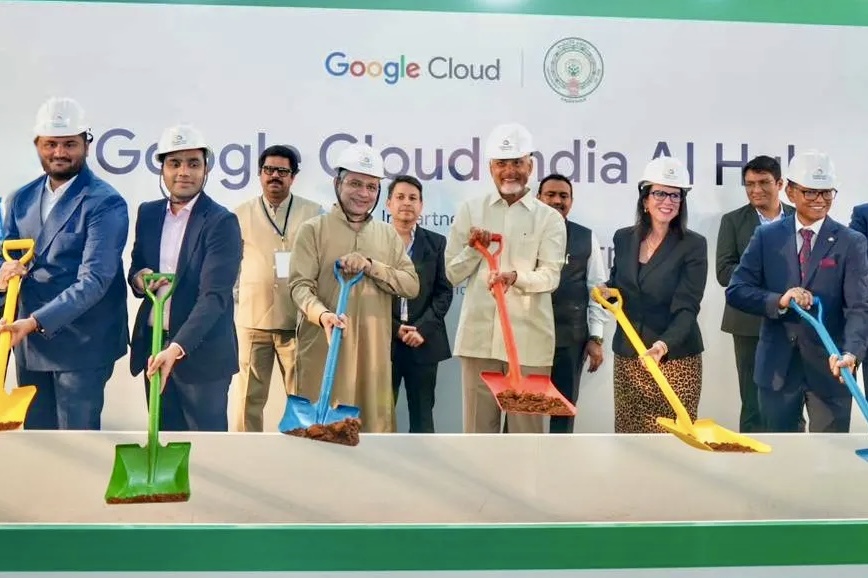
Google has broken ground on its new AI hub in Visakhapatnam (Vizag), Andhra Pradesh marking the construction phase of a $15 billion investment to provide the foundational infrastructure for India’s growing digital economy.
“By bringing our full AI stack to Visakhapatnam, we are building an ecosystem designed to accelerate transformation across every sector,” Bikash Koley, Vice President, Global Infrastructure, wrote on Google India blog.
Being built with its partners AdaniConneX and Nxtra by Airtel, this facility will provide the gigawatt-scale compute necessary for startups and large enterprises to scale AI solutions.
Beyond the data center, the America-India Connect initiative establishes a major subsea gateway in Vizag. Landing multiple international cables on the eastern coast creates essential route diversity, strengthening India’s global connectivity.
Scaling digital infrastructure requires a commitment to environmental responsibility, Koley wrote. “As we build our AI hub in Andhra Pradesh, we are prioritizing the delivery of new transmission lines, clean energy generation, and energy storage systems.’
Read: Merck and Google Cloud partner to scale AI in pharma
These efforts contribute to India’s national goal of reaching 500 GW of non-fossil fuel capacity by 2030 and help ensure that the growth of the AI economy supports a sustainable future for the region.
A core principle of this investment is a community-first, long-term approach, ensuring that infrastructure development aligns with the needs of the local region, he wrote.
Google has conducted a community impact assessment to ensure this project drives multi-generational impact through resource stewardship and economic security, Koley stated.
In partnership with Sponge Collaborative, Google plans to launch an integrated watershed management and community empowerment plan, that addresses hydrological stress and coastal sensitivities near the campuses; restoring local ecosystems and providing clean drinking water systems like reverse osmosis plants and ‘Water ATMs.’
Together with the Sambhav Foundation, Google is launching a new program to equip 1,000+ members of the local fishing community with GPS navigation and weather-forecasting tools to enhance safety and operational efficiency, alongside training in cold-chain management and value-added processing.
Working with ChangeX, the Google Udaan India Fund provides direct grants to local schools and social enterprises to advance community projects, which include AI-led skilling labs, digital literacy programs, local entrepreneurship, and climate-focused interventions.
In addition, the NARI Shakti program, in collaboration with the Learning Links Foundation, will help 10,000+ women from low-income backgrounds transition home-based work into sustainable micro-enterprises.
Read: Google in the talks with Marvell for AI chip design
The Skills Trade and Readiness (STAR) program and a partnership with the ICT Academy will equip over 1,000 local workforce participants and 1,200+ students and educators respectively with hands-on training in fields ranging from facility operations and construction to generative AI.
Alongside the groundbreaking, Google also held the Bharat AI Shakti Conclave in partnership with the Government of Andhra Pradesh. The Conclave served as a platform to translate this anchor investment into a tangible economic value chain for the region.
The strategy centers on developing an “AI Corridor” where local-first procurement prioritizes vendors for vital infrastructure activities, Koley wrote. “By integrating local small and medium enterprises (SMEs) into our global safety and operational frameworks, the project aims to build regional capacity and increase the competitiveness of local industry for future large-scale infrastructure work.”
As the development of the hub progresses, these industrial and community programs will continue to scale in response to the region’s evolving needs.
“The Google AI hub combines world-class infrastructure with deep community partnership, all working together to build India’s AI-powered future,” Koley wrote.