



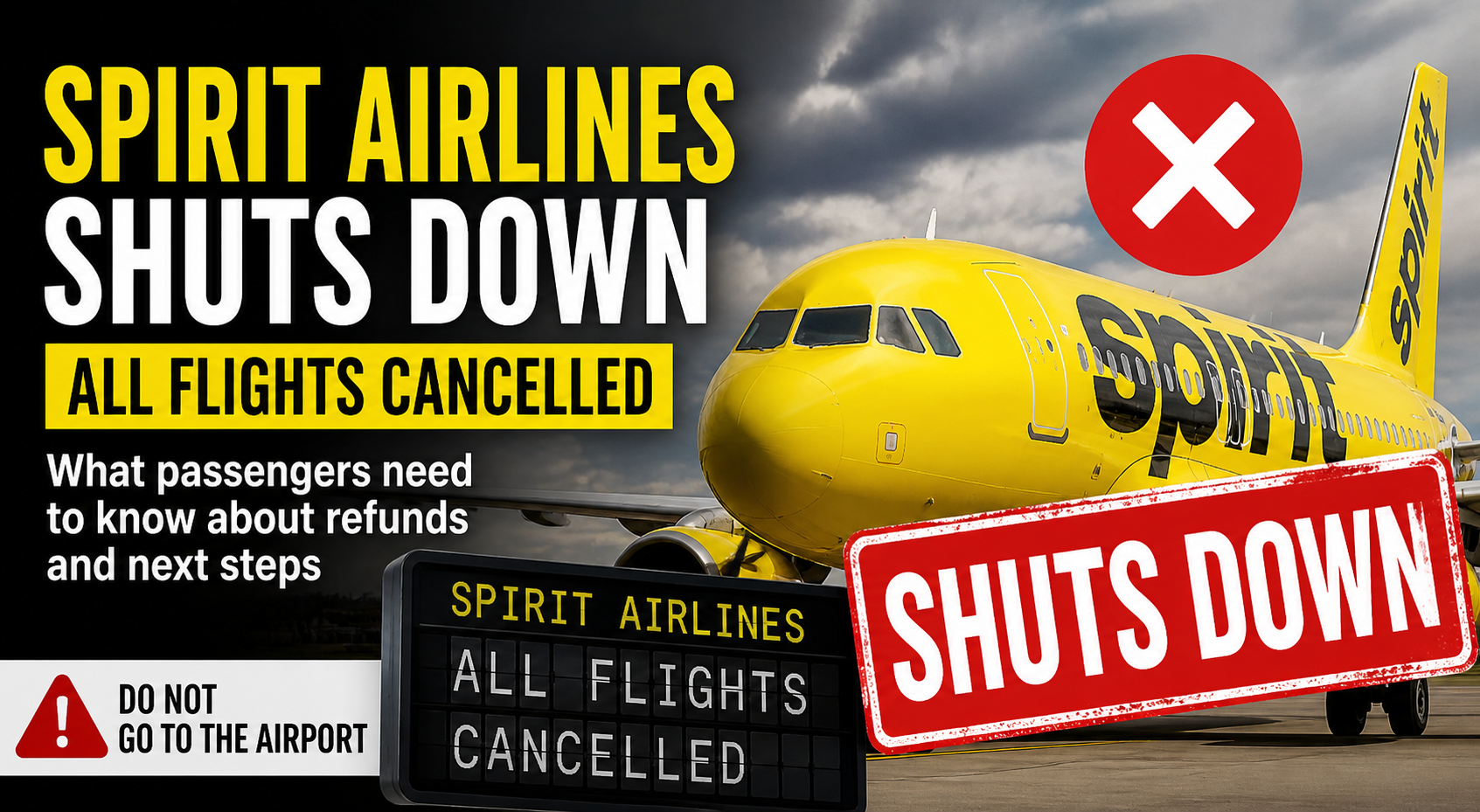
In a sudden and sweeping move, Spirit Airlines has announced it is shutting down operations, bringing an abrupt end to more than three decades of low-cost flying in the United States and beyond. Its parent, Spirit Aviation Holdings, confirmed that the wind-down has begun with immediate effect, leaving passengers stranded and all flights cancelled.
The company said, “the Company has started an orderly winddown of operations, effective immediately. All Spirit flights have been cancelled, and Spirit Guests should not go to the airport.”
The message was stark and left little room for ambiguity as travelers across its network scrambled for alternatives.The shutdown follows months of attempts to salvage the airline’s finances. Spirit pointed to “extensive and comprehensive efforts to restructure the business and pursue transactions to strengthen Spirit’s financial position and create a sustainable path forward.” But those efforts ultimately fell short in the face of mounting pressures.
At the center of the collapse is a sharp spike in fuel costs. The airline acknowledged that “the recent material increase in oil prices and other pressures on the business have significantly impacted Spirit’s financial outlook.” With funding options exhausted, it added that “with no additional funding available to the Company, Spirit had no choice but to begin this wind-down.”
READ: Jobs AI can’t replace yet: What a new report finds (
Spirit’s President and CEO Dave Davis reflected on the airline’s legacy while acknowledging the setback. “For more than 30 years, Spirit Airlines has played a pioneering role in making travel more accessible and bringing people together while driving affordability across the industry,” he said.
He pointed to a restructuring plan that nearly kept the airline alive. “In March 2026, we reached an agreement with our bondholders on a restructuring plan that would have allowed us to emerge as a go-forward business. However, the sudden and sustained rise in fuel prices in recent weeks ultimately has left us with no alternative but to pursue an orderly wind-down of the Company.”
Davis added that survival would have required massive liquidity. “Sustaining the business required hundreds of millions of additional dollars of liquidity that Spirit simply does not have and could not procure. This is tremendously disappointing and not the outcome any of us wanted.”
He also acknowledged efforts by the U.S. government and industry stakeholders. “I want to thank the Administration, in particular Secretary Howard Lutnick and the U.S. Department of Commerce, for their extraordinary efforts to try to preserve jobs and service across the country, along with the U.S. Department of Transportation for their assistance to minimize the disruption to our Guests in the days and weeks ahead.”
Gratitude extended across the airline’s ecosystem. “Many stakeholders have stepped up for Spirit through our restructuring. We are grateful to our labor union partners, aircraft lessors, other business partners and our financial stakeholders including Citadel, Cyrus Capital and Ares Management Corp, for working with us on tangible solutions to restructure our business.”
The human toll was not lost on leadership. “Most of all, we are grateful to our relentless Spirit team for their tremendous effort during our restructuring,” Davis said, adding that employees “have tirelessly provided a safe, affordable and award-winning option to the traveling public.”
For passengers, the immediate concern is refunds and next steps. Spirit said it “will automatically process refunds for any flights purchased through Spirit with a credit or debit card to the original form of payment.” Those who booked through agents have been asked to reach out directly, while compensation for vouchers and loyalty points will be determined later through bankruptcy proceedings.
In a post on X, the airline reiterated the scale of the shutdown. “It is with great disappointment that Spirit Airlines has started winding down its global operations, effective immediately. All flights have been cancelled, and customer service is no longer available.” The post quickly gained traction, drawing millions of views as the news spread.
The collapse of Spirit marks a significant moment for the aviation sector. Once known for redefining budget travel and pushing fares lower across the industry, its exit now leaves a gap in the ultra low cost segment, raising fresh questions about the sustainability of no-frills carriers in an era of volatile fuel prices and tightening financial conditions.