



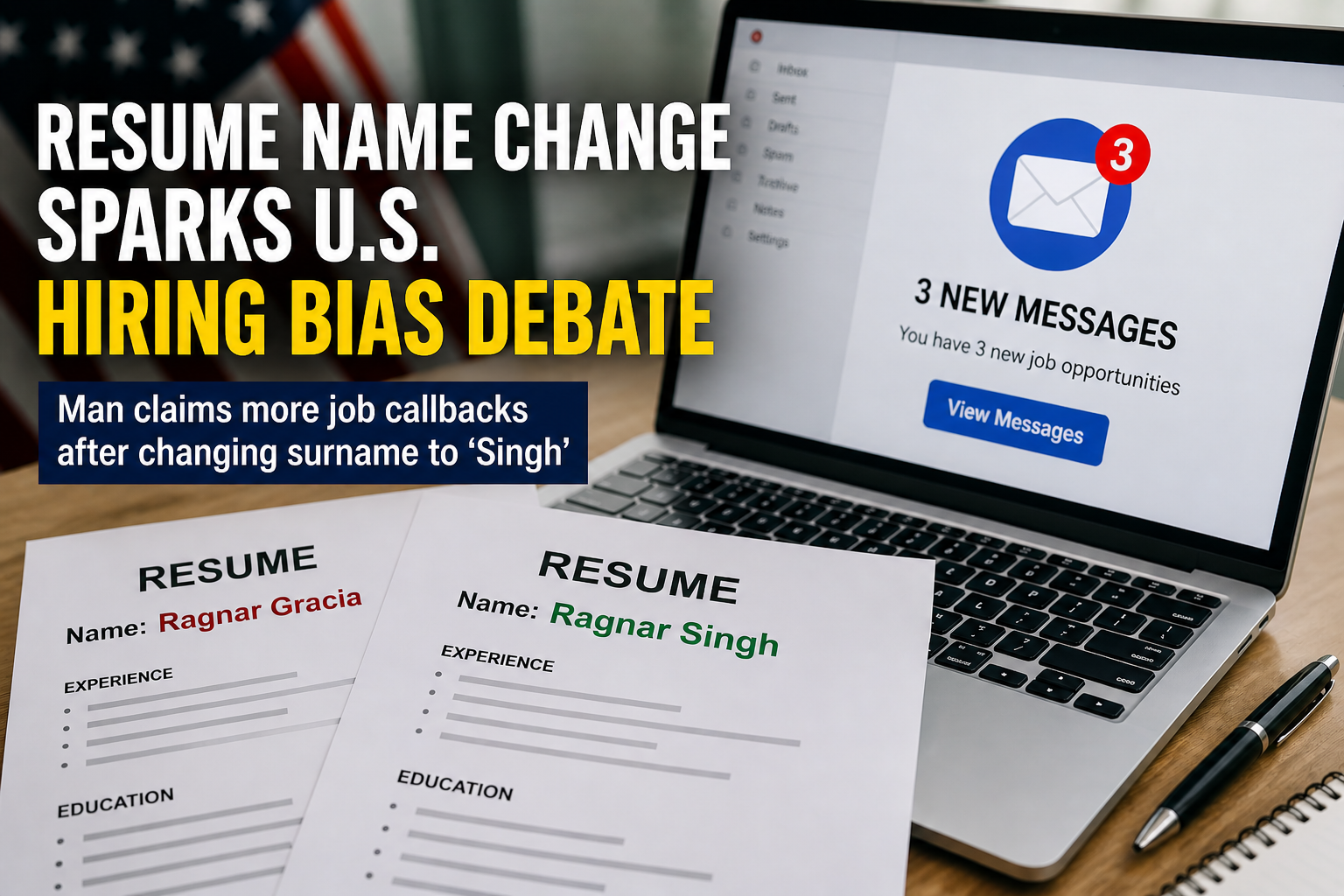
A viral social media post has reignited debate over hiring bias in the United States after a man claimed he received multiple job callbacks only after changing his surname on his resume to “Singh.” The anecdote has sparked widespread discussion about whether names influence hiring decisions and how deeply bias may be embedded in recruitment processes.
The post, widely shared online, reads: “Applied to 300+ jobs… zero callbacks. Changed my last name to Singh on the exact same resume… Got 3 callbacks in 24 hours.” The claim quickly gained traction, drawing attention to longstanding concerns about discrimination based on race, ethnicity, or perceived identity in hiring practices.
The individual’s “resume name change test” has become a focal point in the broader hiring bias debate. While some users viewed the sudden increase in responses as evidence of systemic bias, others urged caution, noting that a single experience does not establish a broader pattern. Still, the post has fueled renewed scrutiny of how employers screen candidates.
READ: New US bill proposes 3-year H-1B visa freeze (April 26, 2026)
Supporters of the claim argue that it highlights real challenges faced by job seekers with certain names. The statement, “Applied to 300+ jobs… zero callbacks,” underscores the frustration many candidates experience in a competitive labor market. Recently, multiple academic studies have suggested that resumes with names perceived as non-white or foreign may receive fewer responses, lending context to such claims and amplifying their relevance in today’s diversity-focused workplace discussions.
On the other hand, the follow-up line, “Changed my last name to Singh on the exact same resume… Got 3 callbacks in 24 hours,” has prompted debate about anecdotal versus empirical evidence. Critics emphasize that hiring outcomes can vary due to timing, industry demand, or algorithmic screening systems. They argue that while the experience is compelling, it should not be treated as definitive proof without broader data.
Social media reactions have been sharply divided. Some users shared similar experiences, reinforcing concerns about bias, while others questioned the methodology behind the experiment. The discussion reflects broader hiring concerns in the U.S., where companies increasingly emphasize diversity, equity, and inclusion, yet continue to face scrutiny over actual practices.
Ultimately, the viral claim serves as a reminder of the ongoing tension between anecdotal experiences and measurable evidence. While it has intensified conversations about fairness in hiring, experts say more comprehensive research is needed to determine the true extent of bias and to guide meaningful reforms in recruitment systems