



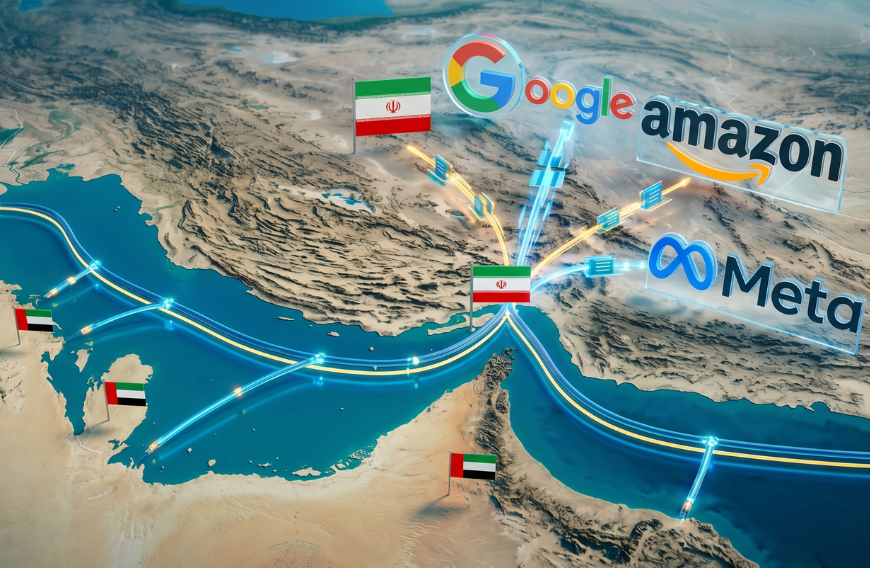
Iran is planning to charge big tech companies such as Google, Amazon and Meta for using its subsea in the Strait of Hormuz, according to a CNN report. This comes following its successful wartime blockade of the strait, which affected the global energy supply.
“We will impose fees on internet cables,” Iranian military spokesperson Ebrahim Zolfaghari declared on X last week. Iran’s Revolutionary Guards-linked media said Tehran’s plan to extract revenue from the strait would require companies like Google, Microsoft, Meta, and Amazon to comply with Iranian law while submarine cable companies would be required to pay licensing fees for cable passage, with repair and maintenance rights given exclusively to Iranian firms.
READ: US appeals to other countries to help reopen Strait of Hormuz (April 30, 2026)
While some of these companies have cables running through the Strait of Hormuz and the Persian Gulf, it is not clear if those cables traverse Iranian waters. It is also unclear how the Iranian regime could make the tech giants comply, as they are barred from making payments to Iran due to strict U.S. sanctions. It is likely that those companies would view Iran’s statements as posturing.
Still, Iranian state-affiliated media has mentioned such threats. Subsea cables play a major role when it comes to internet connectivity, carrying most of the world’s internet and data traffic. Targeting them would impact not just internet speeds, but also a lot of other systems like banks, military communications, AI cloud infrastructure, gaming and streaming services, and more. These threats underscore the importance of the Strait of Hormuz beyond energy exports.
Dina Esfandiary, the Middle East lead at Bloomberg Economics said that Iran’s threats are part of a strategy to demonstrate its leverage over the Strait of Hormuz and ensure the survival of the regime, a core objective for the Islamic Republic in this war.
“It aims to impose such a hefty cost on the global economy that no-one will dare attack Iran again,” she said.
READ: Iran and US to negotiate amid Strait of Hormuz blockade (April 14, 2026)
Several major intercontinental subsea cables pass through the Strait of Hormuz. Because of long-standing security risks with Iran, international operators have deliberately avoided Iranian waters, instead clustering the majority of the cables in a narrow band along the Omani side of the waterway, said Mostafa Ahmed, a senior researcher at the United Arab Emirates-based Habtoor Research Center, who published a paper on the effects of a large-scale attack on submarine communications infrastructure in the Gulf.
However, according to Alan Mauldin, research director at TeleGeography, a telecom research firm, there are two cables, Falcon and Gulf Bridge International (GBI), that pass through Iranian waters. While Iran has not explicitly threatened to sabotage the cables, it has repeatedly declared through officials, lawmakers and state-linked media of its intent to punish Washington’s allies in the region.