



By Phil Cruver
As AI data centers face rising power demands, abandoned oil wells are being repurposed into long-duration energy storage systems that could stabilize electric grids and create new economic value.
The recent analysis “The Borehole Battery: From Liability to Long Duration Storage Asset” by Gilles Chaspierre, highlights an emerging reality in the global energy transition: legacy oil and gas infrastructure may become one of the most valuable clean-energy assets of the next decade.
For Geo2Watts (G2W), the article validates a thesis the company has been advancing for years — that idle oil wells can be transformed from environmental liabilities into dispatchable, long-duration energy storage systems capable of strengthening the electric grid while creating new economic value.

This article arrives at a critical moment for California and the broader U.S. power sector. Utilities, grid operators, and regulators are urgently searching for scalable long-duration energy storage solutions as renewable penetration accelerates and grid instability worsens. California alone faces growing evening peak demand, wildfire-related shutoffs, aging transmission infrastructure, and a multiyear interconnection backlog. Conventional lithium-ion battery systems have provided an important first step in renewable integration, but policymakers increasingly recognize that short-duration battery systems are not sufficient to support a fully decarbonized and resilient grid.
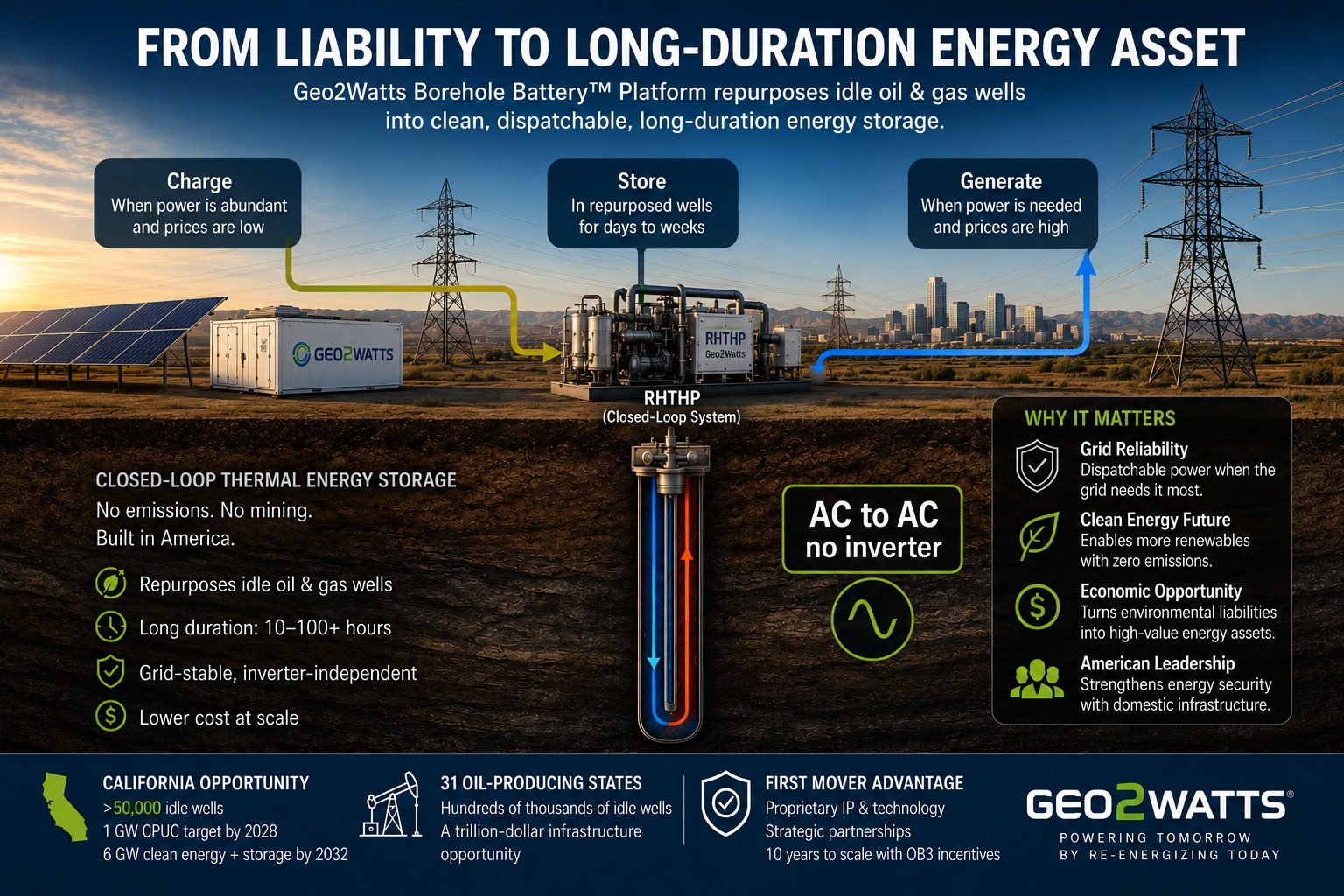
The G2W Borehole Battery™ Platform (BBP) offers a fundamentally different approach. Rather than relying on electrochemical storage, the BBP repurposes idle oil and gas wells into closed-loop underground thermal energy storage systems capable of generating dispatchable AC electricity during periods of high demand. According to G2W’s recently submitted proposal to the U.S. Department of War (DOW), the BBP leverages existing well infrastructure, advanced thermal engineering, and real-time digital control systems to create long-duration energy storage using repurposed brownfield assets.
READ: The rise of ‘efficient’ or ‘green’ AI: How the world can keep the lights on during the AI boom (March 6, 2026)
As Chaspierre noted in his analysis of the BBP, utilities and grid operators are becoming increasingly cautious about large inverter-based resources due to their unpredictable behavior in weak-grid conditions and during transient events. This concern has intensified following several major grid disturbances in North America and Europe involving inverter-dominated renewable systems.
Unlike conventional battery storage, the G2W approach is designed around synchronous thermal power generation pathways that can potentially provide more grid-stabilizing characteristics. This positions the proposed G2W/California Resources Corporation (CRC) THUMS Island pilot projects and other planned deployments as a differentiated and potentially more grid-compatible pathway for large-scale energy storage deployment in California.
This distinction may prove especially important as California moves toward aggressive procurement mandates for long-duration energy storage. The California Public Utilities Commission (CPUC) has already established procurement targets that could require roughly 1 GW of long-duration storage deployment by 2028, while Assembly Bill 1373 proposes an additional 6 GW of clean energy generation and storage resources by 2032. These mandates represent one of the largest emerging clean-energy infrastructure markets in the United States. G2W believes its BBP technology is uniquely positioned to participate in this buildout because it leverages existing oilfield infrastructure already connected to the electric grid.
The market opportunity extends far beyond California. According to the U.S. Energy Information Administration (EIA), approximately one million oil and gas wells in the United States are idle or underperforming and could be repurposed as BBP assets and this addressable inventory is expected to grow as additional wells reach the end of their productive life. California alone has more than 50,000 idle and marginal wells that could eventually support deployment of its BBP for converting stranded hydrocarbon infrastructure into long-duration energy storage as one of the most underappreciated opportunities in the global energy transition.
G2W is operating in a largely uncontested market segment. While numerous companies are competing in lithium-ion batteries, compressed air storage, hydrogen, and pumped hydro, only G2W is specifically targeting the repurposing of legacy oilfield infrastructure into thermal energy storage systems. G2W’s early mover advantage is strengthened by patent-pending intellectual property, proprietary thermal-management designs, advanced modeling, and a growing portfolio of strategic industry relationships.
The economics behind the BBP strategy are becoming increasingly attractive because of federal clean-energy incentives included in the Inflation Reduction Act and the “One Big Beautiful Bill” (OB3) framework. G2W projects qualify for up to a 50% Investment Tax Credit while simultaneously benefiting from premium electricity pricing opportunities in California’s evening peak markets. This combination of federal incentives and high-value dispatchable and distributed power markets provides a decade-long runway for rapid deployment and scaling.
Recent G2W blog post examines how the BBP can capture “premium pricing” by charging during periods of low-cost renewable oversupply and generating electricity during California’s evening peak demand periods when electricity prices can rise dramatically. Another blog focuses on the growing limitations of conventional lithium-ion battery systems, emphasizing fire risk, degradation, mineral supply-chain dependence, and increasing grid operator concerns regarding inverter-based resources. A third article explores how California’s idle-well crisis could become a trillion-dollar infrastructure opportunity by converting abandoned hydrocarbon assets into clean-energy infrastructure rather than paying solely for costly decommissioning.
READ: Geo2Watts leverages IRA incentives to transform idle oil wells into clean energy assets (January 23, 2025)
The credibility of the G2W effort is reinforced by the depth of the technical and scientific team assembled around the project. The recent DOW proposal outlines research partnerships involving the National Laboratory of the Rockies (NLR), Savannah River National Laboratory, and Colorado School of Mines.
What makes the BBP particularly compelling is that it addresses multiple national challenges simultaneously. It offers a pathway for grid-scale clean-energy storage, creates productive reuse opportunities for aging oil infrastructure, reduces long-term environmental liabilities associated with idle wells, strengthens grid resilience, and potentially lowers electricity costs. At the same time, it provides oil-producing states with an economic transition pathway that preserves existing workforce expertise and industrial infrastructure.
Chaspierre’s latest article captures why this concept is attracting increasing attention from investors, regulators, utilities, and energy researchers. The global energy transition will require enormous amounts of long-duration storage, but it will also require practical solutions capable of scaling quickly using existing infrastructure.
If California succeeds in establishing long-duration energy storage as a foundational element of grid reliability policy, the state’s idle oil wells may ultimately become some of the most strategically valuable clean-energy assets in America. For G2W, the race is now about proving the technology at commercial scale before competitors emerge and leveraging a potentially decade-long first-mover advantage supported by intellectual property, federal incentives, and one of the largest untapped infrastructure opportunities in the modern energy economy.
(Phil Cruver is co-founder and CEO of Geo2Watts™ and a veteran entrepreneur in renewable energy and aquaculture. He previously founded Catalina Sea Ranch, the first aquaculture facility in U.S. federal waters offshore California, and International Dynergy, a wind energy company that installed 500 turbines in Palm Springs.)