



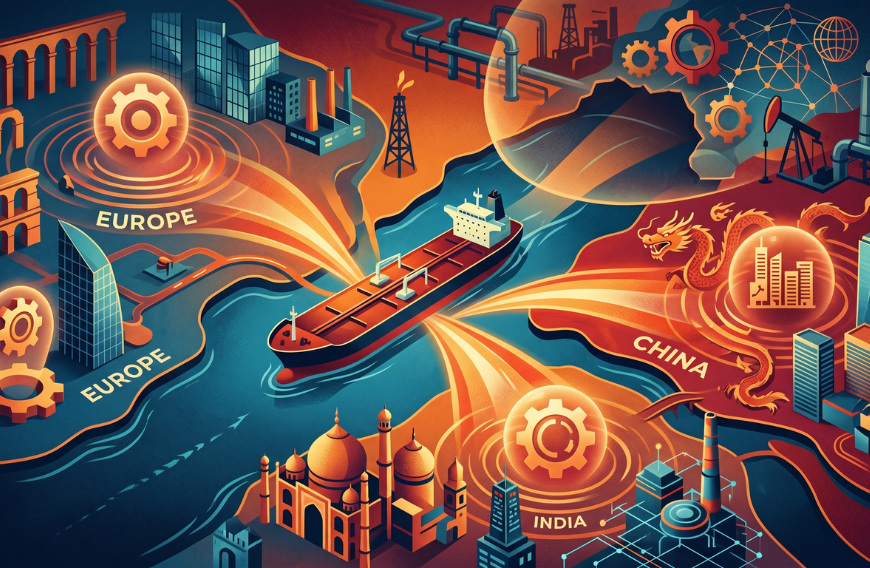
The conventional reading of the American naval blockade of Iranian ports is that it is a pressure instrument aimed at Tehran — a mechanism to force a nuclear deal or extract a capitulation. That reading is wrong, or at least incomplete. The blockade is better understood as a multilateral coercion device, one that simultaneously squeezes Iran, disciplines European energy dependence, neutralizes Indian strategic autonomy, and gives Donald Trump a pressure dial he controls unilaterally. Iran is the occasion. Everyone else is the target.
Start with the energy architecture. Europe spent the years after 2022 rebuilding its supply chains away from Russian gas, largely into American LNG. That transition was expensive, politically painful, and structurally irreversible — Nord Stream is destroyed, alternative contracts are signed, new terminals are built. Europe now depends on American energy goodwill in ways it never depended on Russian energy goodwill, because at least Russian gas was cheap. The blockade tightens that dependence further. Every week Hormuz stays contested, every barrel that cannot move freely through the strait, is a week Europe has no alternative but Washington. This is not incidental. It is the point.
Now layer in the China dimension. The Trump-Xi summit in Beijing produced what analysts called stabilization — not breakthrough, not transformation, stabilization. China agreed to purchase American agricultural goods, Boeing aircraft, and oil. Trump got the headline. Xi got time. But underneath the choreography, something more consequential is taking shape. China needs energy. The blockade disrupts its Hormuz-dependent supply chains. The logical resolution — already visible in the margins of the summit communiqué — is that China gets Venezuelan oil, perhaps Russian oil with American sanctions selectively eased, and reduces its Hormuz exposure entirely. In exchange, China stays neutral on Iran, buys American soybeans, and gives Trump the farm-state optics he needs before November.
READ: India’s electoral roll crisis: How democracies fight back (May 17, 2026)
Now layer in the China dimension. The Trump-Xi summit in Beijing produced what analysts called stabilization — not breakthrough, not transformation, stabilization. China agreed to purchase American agricultural goods, Boeing aircraft, and oil. Trump got the headline. Xi got time. But underneath the choreography, something more consequential is taking shape. China needs energy. The blockade disrupts its Hormuz-dependent supply chains. The logical resolution — already visible in the margins of the summit communiqué — is that China gets Venezuelan oil, perhaps Russian oil with American sanctions selectively eased, and reduces its Hormuz exposure entirely. In exchange, China stays neutral on Iran, buys American soybeans, and gives Trump the farm-state optics he needs before November.
The political geometry is equally precise. Trump’s core electoral coalition — midwestern farmers, energy state workers, domestic manufacturers — benefits directly from Chinese agricultural purchases, Venezuelan oil deals that revive American diplomatic relevance, and lower interest rates that ease rural borrowing costs. The blockade, paradoxically, is the mechanism that makes all of this possible. Without the pressure, there is no deal. Without the deal, there is no rate cut. Without the rate cut, the midterms are in danger.
What makes this analytically significant is that it does not require Trump to have designed it consciously. Xi and Putin — both operating without electoral pressure, both thinking in decades rather than news cycles — identified this destination before Trump did. They have been patient extractors throughout. Every summit where Trump claimed a historic victory, they banked the structural concession. The trade war de-escalation left China’s rare earth leverage intact. The Ukraine ceasefire locked in Russian territorial gains. The Iran blockade now positions China to receive alternative energy supply while remaining publicly committed to Hormuz staying open. They get the outcome. Trump gets the credit. This is the transaction that has defined the relationship from the beginning.
Europe and India occupy a different position in this framework — not rivals to be negotiated with, but problems to be managed. Europe’s strategic autonomy project, its resistance to NATO subordination, its continued attachment to multilateral institutions, reads in Washington not as an allied disagreement but as a civilizational betrayal. India’s refusal to abandon Russian oil, its maintenance of BRICS commitments, its careful equidistance — similarly registers as ingratitude rather than rational statecraft. Both will continue to be squeezed. Neither has sufficient leverage to resist.
READ: The coming reversal: Why America may ultimately pay the price for a crisis‑driven market boom (May 14, 2026)
The prediction that follows from this analysis is not complicated. Over the next sixty days, expect the following sequence: Venezuelan sanctions relief framed as a humanitarian gesture. Quiet expansion of Russian oil re-entry into global markets framed as energy stability. A softening of oil prices into the $70-80 range. A Federal Reserve rate cut in September framed as a response to cooling inflation. A Chinese agricultural purchasing announcement timed for October. Trump will present each of these as independent victories. They are a single strategy.
The Iran blockade will not formally end. It will simply become irrelevant as alternative supply routes absorb the pressure and the strait’s closure stops moving oil prices. Tehran will be left holding a closed strait that nobody needs anymore — isolated, economically strangled, without the leverage the closure was supposed to provide.
Markets at current all-time highs have priced in managed tension. They have not priced in this resolution sequence. When it arrives — if it arrives — the initial reaction will be euphoric and brief. What follows will be a liquidity contraction as the war-spending impulse fades, petrodollar recycling slows with lower oil prices, and the Fed’s cuts prove shallower than hoped.
The blockade was never about Iran getting a deal. It was about Trump getting a second term. The distinction matters.