



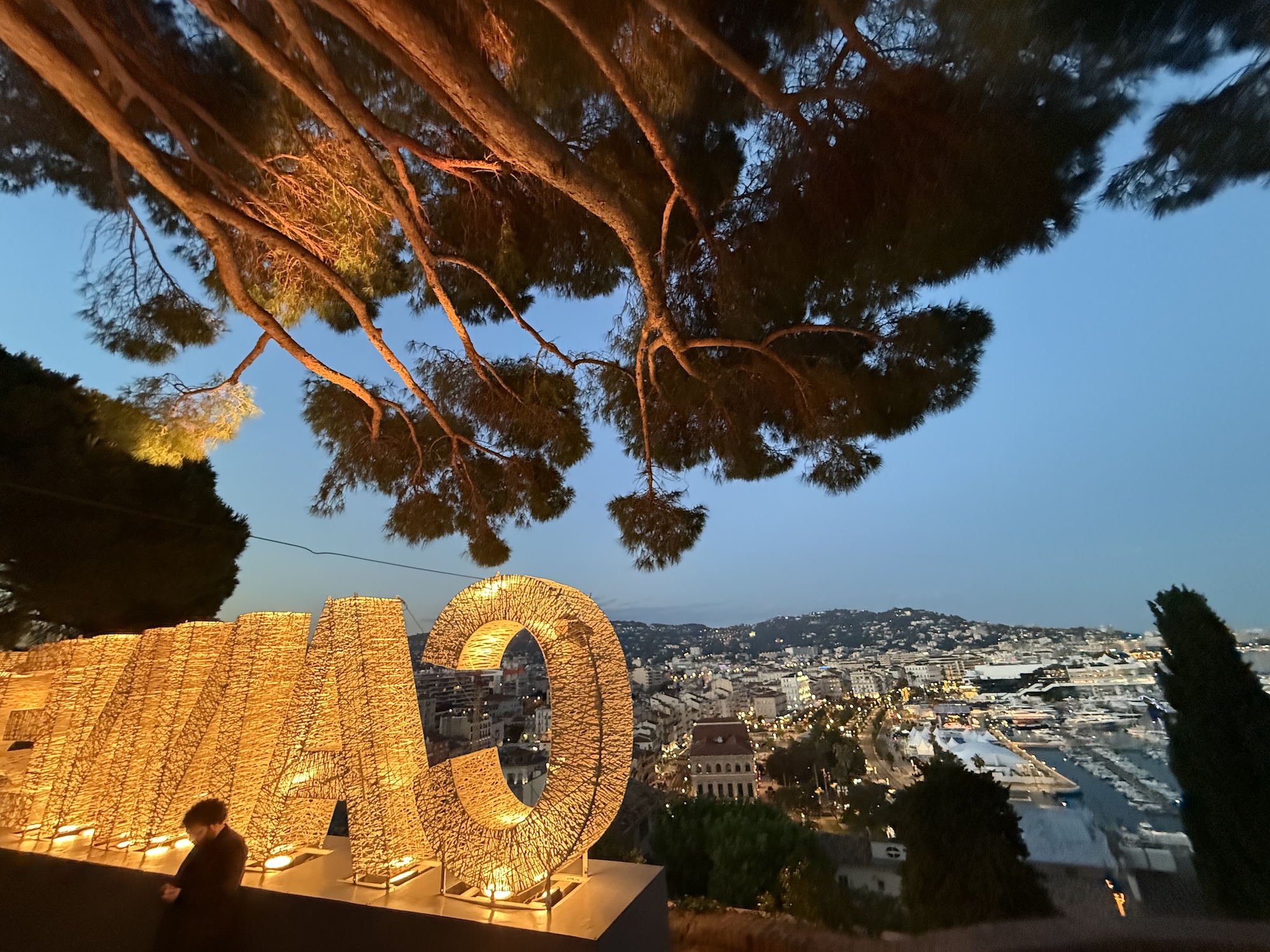
A week of films, parties, industry deals, WhatsApp invites, yacht culture, and the realization that Cannes is far more than a film festival
By Chandrani Ghosh
I’m writing this on my flight home from my first Cannes — a week that felt part film festival, part networking Olympics, part some sort of extremely elegant endurance sport. I arrived with helpful veteran connections, vague intentions, and absolutely no real understanding of what Cannes actually is. Naturally, a number of rookie mistakes followed.
The mistake first-timers make is thinking Cannes is a film festival. It is actually several parallel universes happening simultaneously on the same stretch of Mediterranean coastline.
There are the films. There is the Marché, the festival’s enormous industry marketplace. There is the social ecosystem — parties, dinners, yachts, the friend-of-a-friend WhatsApp invite chain. There is Cannes itself, the city, fully committed to playing its role in everyone’s French Riviera fantasy. And finally, there is the shadow-festival ecosystem orbiting all of it — what a friend of mine has christened “the Scannes.”
How much of each you experience is essentially a choice, and most people make it without realizing they’re making it.
First, get accredited
This is the gate. Without accreditation, you can’t really do any of it (other than the parties, which have their own selection criteria based on the whims of the hosts).
The good news: the application form isn’t onerous, and they generally come back within two or three days. You upload, you wait, you get a badge category, and from there your life in Cannes is largely defined by what color lanyard is hanging around your neck.
The films
It is, after all, a film festival. If watching cinema is your jam, you can do that from 8 a.m. until past midnight at theaters all within walking distance of each other.
The catch is the ticketing system.
READ: Chandrani Ghosh’s ‘Heartlines’: A literary romance that dares to speak (February 15, 2026)
Tickets drop at 7 a.m. French time, four days before each screening. By 7:03, the in-demand ones are gone. Then it becomes a game of refresh. Refresh. Refresh. As the screening approaches, all those nimble-fingered early bookers realize they have a conflict, or a hangover, or a yacht thing, and they release their tickets back into the system. Returned tickets reappear all day. The serious cinephiles keep a tab open more or less permanently.
The other route is standby. Show up at the venue, get in line, and hope. For a red-carpet premiere, the standby line begins forming four to six hours before showtime — and remember, the red carpet has a dress code: black tie, no exceptions. If you don’t own a tux, several shops in town will rent you one; this is a well-worn part of the local economy.
You could, very plausibly, make movie-watching your entire festival. Some people do exactly that: 8 a.m. to midnight, six straight days. Others figure out somewhere around day two that they’d much rather watch the movies back home after their theatrical release, and quietly begin optimizing for something else entirely.
The real currency is people
Call it networking if you have to, but that isn’t quite what it is. It’s something more like temporary intimacy.

Everyone in Cannes is strangely open. At the first party I attended, within minutes of getting out of my Uber and trying to figure out whether the entrance was the château on the right or the one with the tucked-away gate, I had made “friends” with two women heading to the same event. We walked in together. Within minutes we had each other’s numbers. By the end of the week, one of them had introduced me to a screenwriter potentially interested in adapting my book, along with a talented film producer.
Cannes runs on lines. Lines for films. Lines for parties. Lines for coffee. Entire friendships begin while waiting to be allowed into somewhere neither of you is entirely sure you actually want to enter. The line becomes its own salon.
By day three, shared exhaustion creates instant familiarity. The conversations start happening everywhere: in party queues, on the red carpet, in hotel lobbies, in the back of taxis, in the espresso line at 8:30 a.m. when both of you are pretending you slept. Over the week, you meet actors, producers, investors, cinephiles, startup founders, and at least three people who describe themselves as “financing European co-productions” in a way that does not invite follow-up questions.
Some of those WhatsApp exchanges will not survive June. A few will turn into something real. You won’t know which is which until much later, which is fine.
The Marché — Cannes as industry trade fair
Most outsiders imagine Cannes as glamour. A huge portion of Cannes is actually business.
Behind the tuxedos and flashbulbs is essentially the world’s most glamorous convention center. Once you’re accredited, you can walk into almost any session. There are hundreds of panels across the week, and every niche of the industry is represented: film financing, distribution, streaming, sales, audience fragmentation, the slow-motion remaking of theatrical release windows, and — this year more than in previous years, according to frequent attendees — AI.
The AI conversations are everywhere, and they are not the breathless hype-cycle versions you get at tech conferences. These are people whose livelihoods depend on what tools are usable today, what’s coming next year, what their unions and lawyers will let them deploy, and what audiences will actually tolerate. You learn more in forty-five minutes of a Marché panel than in a month of reading Substacks on the same topic.
The country pavilions are their own subculture. France, Germany, Korea, the UK, India, the Gulf states — each one a small embassy of national film policy ( Saudi Arabia is offering a 60 percent rebate on local spending to attract global producers, and Tunisia hands out a glossy book on gorgeous filming locations), complete with espresso, sticky national branding, and a constant churn of small meetings. If you want to understand how the global film industry actually works, walk slowly through the pavilions for an afternoon.
Nights in Cannes
Then the sun starts to drop and everything shifts.
Every night in Cannes contains at least one conversation where someone says, very casually, “There’s a small thing on a yacht,” as if this is a normal sentence.
RELATED: There is an autobiographical element to my storytelling: ‘Heartlines’ author Chandrani Ghosh on her debut novel (February 27, 2026)
The geography of the nights goes roughly like this: cocktail hour at one of the big hotels, dinner somewhere, a party at a beach club along the Croisette, and, if the WhatsApp gods have smiled on you, a hillside villa in Mougins after midnight. The yacht is its own category and operates by its own logic.
You will spend a non-trivial amount of time hustling for guest lists. You will accumulate — and lose — an absurd number of wristbands. You will, at some point, find yourself in a long velvet-roped queue, looking at the people being waved through ahead of you. Everyone in Cannes is pretending they casually got in. Almost no one casually got in.
Fashion is its own commentary track. The dress code on the Croisette by 7 p.m. is roughly: try harder than you would anywhere else. People do. And sometimes they don’t even wait until 7 p.m.
Where to stay
The four big hotels along the Croisette — the Majestic, the Martinez, the JW Marriott, and, a little farther down the strip, the Carlton — function less as hotels and more as horizontal office buildings stacked on top of fancy lobbies and restaurants.
By day, they are meeting rooms. Producers, sales agents, financiers, lawyers, agents, and their clients move between them on a loose loop, coffee cup to coffee cup. The entire French film industry appeared, when I was there, to be operating out of the fifth floor of the JW Marriott.
At night, the same lobbies become the unofficial after-after-party of whatever the official after-party was. People drift through until 3 or 4 a.m. The ecosystem doesn’t really stop; it just changes texture.
You don’t need to stay in one of these hotels to use them. Most of the people I met during the festival weren’t actually sleeping in the buildings where they spent half their day. The hotels are the agora; the bed is somewhere else.
Eat. Seriously. Eat.
Here is the strangest thing about Cannes: you will be in France, surrounded by some of the best food in the world, and you will forget to eat.
Cannes creates the illusion that espresso is a food group.
You’re racing between a 10 a.m. screening and an 11:15 panel and a 1 p.m. coffee and a 3 p.m. meeting at a pavilion and a 5 p.m. cocktail and a 7 p.m. screening and an 8:30 dinner that ends up being canapés and an 11 p.m. party and a 1 a.m. yacht thing, and at some point around day three you realize you haven’t had a real meal in forty-eight hours. The cocktail-hour canapés begin to feel structurally important. France, of all places, becomes the country where you accidentally stop eating.
So: eat. Block out a long lunch at least every other day. Sit down. Order more than one course. The week is much, much better if you do.
Beware of “Scannes”
Cannes attracts cinema. It also attracts people hoping to orbit cinema.
Around the actual festival there is a thick ring of side events — mini-festivals, “global cinema forums,” international award ceremonies you’ve never heard of, networking summits, pay-to-pitch panels, and a steady supply of trophies handed out in hotel ballrooms to people who paid for the privilege. Not all of it is a scam, exactly. But a lot of it is a vanity ecosystem: badge inflation, access theater, photo ops dressed up as recognition.
A few practical notes: check the legitimacy of anything you’re being asked to pay meaningful money to attend. Be wary of any “award” with a registration fee and a hotel block. Not every yacht invite matters; some of them are essentially LinkedIn in floating form. And remember that some of the best moments of the actual festival happen well outside the spaces presenting themselves as important.
The signal-to-noise ratio in Cannes is, in the end, what you make of it. The films are real. The Marché is real. The temporary intimacies are real. And every one of them is optional. Pick what you want, but know you can’t do it all.
(Chandrani Gosh is the author of the recently published “Heartlines: A Love Triangle” (Bloomsbury). She lives in the Washington, DC, area.)
1 Comment
These days, we have the opportunity to read very authentic articles on VARIOUS subjects in American Bazaar Online! Still, a primer on Cannes Universe? I didn’t expect it! But it was a welcome subject even for me who will never ever dream of attending it!
And, Ms. Ghosh along with the introduction of various nuggets of the festival, told us two universal truths–
1] check the legitimacy of everything and 2] Pick what you want but know you can’t do it all.
Thanks Ms. Ghosh and thanks American Bazaar!