



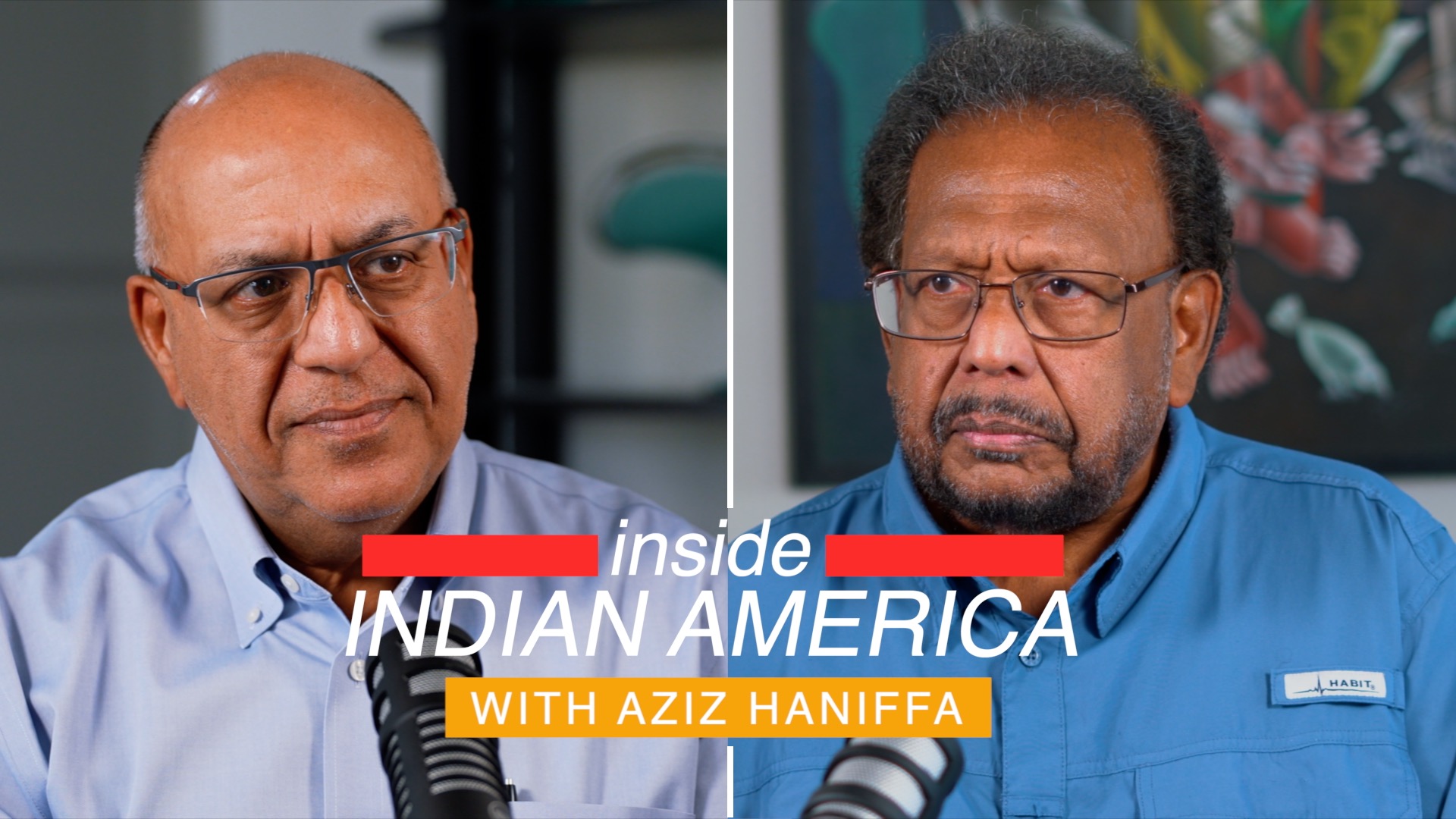
For Jay Sehgal, philanthropy was never just writing checks or funding projects from a distance. His journey became deeply personal—rooted in his family’s tradition, memory, identity, and the desire to give back to the country he left as a teenager.

In the latest episode of “Inside Indian America with Aziz Haniffa,” Jay Sehgal, chairperson of the S M Sehgal Foundation and executive vice president of Sehgal Foundation, reflects on decades of work in rural India, the evolution of Indian American philanthropy, and the principles that have guided one of the earliest diaspora-led organizations focused on development in India.
Throughout the conversation, Sehgal repeatedly returns to one idea: impact matters more than scale. “We need to run a nonprofit organization as a business,” he says, “not in terms of profit generation, but in terms of discipline, ethics, systems, accountability, and measurable outcomes. The philosophy traces back to his uncle, Dr. Suri Sehgal, the pioneering agricultural scientist and philanthropist who founded the organizations with his wife Edda Sehgal, and whose influence permeates nearly every aspect of the work.
Watch the podcast on YouTube
Listen to it on Spotify
A journey that began with dissatisfaction
Jay Sehgal’s story began in the late 1970s, when he arrived in the United States as a teenager. Living in Iowa, he recalled finding himself uncomfortable with how people around him spoke about India, “People talked about so much poverty in India and how India would never get anywhere.” Fresh from India and closely connected to his roots, Sehgal felt uneasy hearing such narratives. Even then, he imagined returning to India someday and contributing in a meaningful way. He said, “I had it in my mind, that one day I’ll go back and do good for the country.”
READ: Building change from the ground up: How the Sehgal Foundation is empowering rural India (October 28, 2025)
However, life intervened. School, work, and building a future in America pushed that dream into the background. After high school in Iowa, he studied management information systems and computer science at the University of Iowa, and later entered the technology sector. But then, in 1992, an opportunity emerged. Dr. Suri Sehgal invited him to work with Proagro Seed Company in India. And the decision to do that altered the trajectory of his life. What began as a technology assignment soon evolved into something much larger. Traveling through villages in India, and spending time with farming communities, reignited his earlier intentions. Sehgal recalled thinking, “This is what I need to do.”
The villages became the classroom
At the time, Proagro was among the first organizations introducing computers into rural areas, connecting seed production operations. Sehgal traveled extensively, visiting villages and spending days observing daily realities as he installed the tech equipment. Those experiences on the ground offered lessons no classroom could provide. “You don’t just install a computer and leave,” he said. Instead, he witnessed firsthand the fundamental challenges confronting farmers and rural communities: water shortages, low agricultural productivity, poverty, and lack of infrastructure.
READ: The contrarian investor: Himanshu Shah’s global playbook for risk, returns, and the future of markets (March 13, 2026)
When Proagro was eventually sold, the Sehgal family shifted substantial resources toward philanthropy, and Dr. Sehgal asked Jay whether he would join the foundation full-time. And he accepted. Although he admitted knowing little about social sciences, he saw an opportunity to learn while contributing to something meaningful. What followed were eight years spent deeply embedded in the rural villages. Sehgal described waking before dawn, traveling to communities, and working directly alongside residents to help solve rural challenges. The work was demanding, but the rewards proved immediate and visible. He said, “When villages did not have clean water and then, suddenly people say, ‘Now we have water in our wells,’ such an intervention had a tremendous impact.”
Starting with water
The foundation’s work initially focused on agriculture and water management—an approach that reflected Dr. Suri Sehgal’s background as an agricultural scientist. The reasoning was simple. “There is no agriculture without water,” Dr. Sehgal explained.
Agriculture continues to employ a majority of India’s population in some form, yet contributes a comparatively smaller share to the GDP. Many small farmers operate on tiny plots of land and survive at subsistence levels. Improving agricultural outcomes therefore meant addressing water. The foundation developed integrated approaches to water conservation and management, emphasizing rainwater harvesting, groundwater recharge, watershed development, and more efficient irrigation systems.
Their philosophy became straightforward: “Stop water where it falls.” Rainwater, Sehgal argued, should be captured and retained at every level—homes, villages, farms, and communities. He described efforts involving check dams, recharge structures, water purification systems, and conservation techniques intended to maximize every drop.
He also stressed that water challenges extend beyond farming. Women often bear the burden of collecting water, walking long distances daily. That burden creates secondary consequences. Girls frequently stay home to care for younger siblings or help with household responsibilities, limiting educational opportunities. Water, therefore, becomes more than an environmental issue. It becomes a social issue.
Building trust brick by brick
One of the earliest lessons the foundation team learned was that communities needed to feel trust in them. Initially, the organization functioned primarily as a grant-maker, funding outside organizations. But over time, village leaders concluded they wanted greater involvement and accountability.
READ: India needs to harvest water to end drought crisis: Indian American philanthropist Suri Sehgal (May 6, 2016)
The transition toward direct implementation brought challenges. Villagers were understandably skeptical. “Who are you?” they asked. Sehgal remembered hearing concerns from communities that had experienced outside organizations arriving briefly, making promises that were not carried out, and disappearing.
The response was simple but powerful. The foundation teams worked alongside villagers physically. “We went ourselves to the villages, picked up bricks,” Sehgal recalled. When communities saw staff members laboring beside them to build check dams and other projects, attitudes shifted. Eventually villagers joined in.
Then the results came. When rains arrived and water remained available, trust followed. Word spread from village to village.
Transforming schools
Education gradually became another major focus as research conducted by the organization found that many girls were leaving schools early due to the inadequate infrastructure. The issue was not necessarily teaching quality. Rather, schools often lacked basics: functioning toilets, clean drinking water, and adequate facilities.
The foundation launched what became known as “Transform Lives one school at a time.” Rather than running schools directly, the initiative aimed to strengthen existing systems. Communities were encouraged to take ownership. Schools received improved infrastructure, upgraded classrooms, rainwater harvesting systems, sanitation facilities, and digital learning tools.
The results surprised even the organization. Government schools that had once struggled began attracting students from private institutions, because facilities had improved significantly. Digital learning became an important addition. Schools incorporated computer labs, solar-powered systems, touchscreen technology, and digital libraries.
For Jay Sehgal, some of the most meaningful outcomes appear in small moments. He recounted hearing about a girl whose father required heart surgery. Because she had developed digital literacy skills, she used computers and online resources to identify medical options and obtain the help he needed. “Stories like that,” he said, “illustrate how education alters futures.”
Women as catalysts for change
Throughout the conversation, Sehgal repeatedly emphasized women as central drivers of community transformation. He credited much of that emphasis to Edda Sehgal, who insisted that women be included in every major initiative. “She always tells us, without all people, you don’t have anything,” Sehgal said.
Programs involving women’s leadership groups, agricultural initiatives, and animal husbandry support produce unexpected outcomes. Women who once owned one or two goats expanded into larger enterprises. Women launched soap-making operations and other small businesses. “What started happening was entrepreneurship,” Sehgal observed. The process became self-sustaining. One woman’s success inspired another.
The evolution of diaspora philanthropy
Beyond discussing the foundation’s work itself, Sehgal reflected on broader changes occurring within Indian American philanthropy. For years, diaspora giving remained fragmented. Questions persisted about whether donations truly reached the intended beneficiaries. But Sehgal has seen that trust has increased significantly. As organizations have become more transparent and more focused on measurable impact, the result has been dramatic growth. Indian American philanthropy directed toward India has expanded substantially over recent years.
Sehgal also observes younger generations playing a critical role. Second- and third-generation Indian Americans increasingly seek meaningful connections with India through internships, service projects, and philanthropy. Programs such as youth essay competitions and educational exchanges help expand those connections. “They continue to understand their links to India,” Sehgal observed.
Looking ahead
Today the foundation in India has expanded from four people to roughly 450 employees. The work spans thousands of villages across multiple Indian states. But Sehgal insists that scale alone is not success. Impact remains the central measure. “We have to be impact-driven,” he said.
READ: From Delhi classrooms to C2 Technologies: Dolly Oberoi’s journey of grit, vision, and reinvention (April 11, 2026)
For Jay Sehgal, the purpose of philanthropy is not to spend money—it is to change lives. Village by village. Family by family. Community by community.
And after decades of work, that mission continues to evolve. Sehgal Foundation remains rooted in the same principles that guided its beginnings: trust, accountability, sustainability, and the belief that small interventions create profound change.
(Editor’s note: This post has been updated.)