



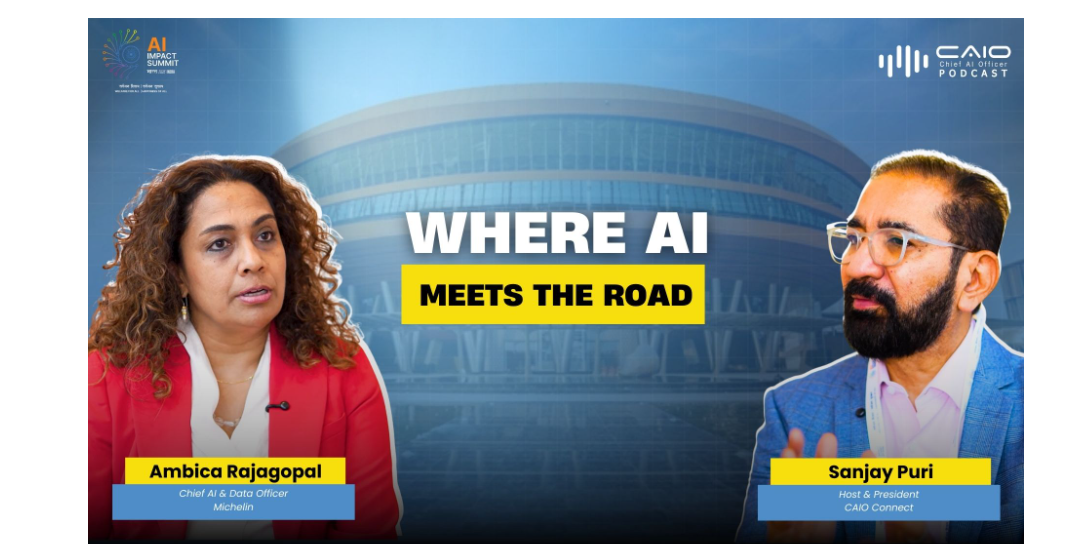
Editor’s note: This article is based on insights from a podcast series. The views expressed in the podcast reflect the speakers’ perspectives and do not necessarily represent those of this publication. Readers are encouraged to explore the full podcast for additional context.
In a compelling episode of the “CAIO Connect” podcast hosted by Sanjay Puri, Michelin’s Chief AI & Data Officer Ambica Rajagopal shared her perspective on leadership, India’s AI potential, and the responsibility enterprises carry in shaping the future of artificial intelligence.
Recently recognized among the Top 100 Leaders in AI, Rajagopal described the honor as a genuine surprise. But beyond the accolade, what stood out was what it represented: India’s growing presence in global AI conversations, women stepping into influential tech leadership roles, and her representing Michelin on a prestigious global platform. For her, recognition isn’t about prestige, it’s about responsibility.
When asked whether the recognition adds pressure to her future goals, Rajagopal offered a refreshing perspective. She describes herself as a “journey person” rather than a “goal person.” Instead of rigid milestones, she focuses on evolution of AI within her organization, of her team, and of herself.
READ: ‘I tend to use AI openness’: Amanda Brock on why open source AI is about transparency (June 1, 2026)
This mindset feels especially relevant in AI, where change is constant and linear planning rarely works. It’s less about chasing fixed outcomes and more about continuously adapting, learning, and building responsibly.
One of the most powerful moments in the conversation came when Ambica spoke about India’s AI future over the next three years.
Her view? The most critical shift India needs is not technological, it’s psychological.
India must recognize its own strength: its talent, its intellectual capital, its energy, and its entrepreneurial drive. For too long, the country has positioned itself primarily as a global service provider. In AI, Rajagopal argues, it’s time to reframe that narrative, not just serving the world with AI, but serving India with AI.
That means building AI solutions for domestic challenges, empowering local industries, and investing in indigenous innovation with confidence.
Interestingly, Rajagopal doesn’t see AI leadership as belonging to any single sector. However, she emphasizes that enterprises, especially large multinational organizations currently play an outsized role.
In a historically unique shift, enterprises today often understand AI’s practical implementation more deeply than governments or research institutions. With that sophistication comes responsibility.
For companies, this means being thoughtful, ethical, and above all, human-centric in deploying AI systems. Scale without responsibility, she suggests, would be a missed opportunity.
READ: How did the role of Chief AI Officer evolve? EY’s Hari Balaji on AI leadership (May 22, 2026)
If given two minutes with every leader at an AI summit, Rajagopal would focus on two priorities, “number one is to invest for countries for enterprises in research.”
The AI story is far from over. Continued investment in foundational research and diverse perspectives will determine how inclusive and powerful future models become.
She further added, “the second thing is to really focus on human centric AI to make sure that the AI that we develop are in fact, augmenting our lives as humans augmenting our experiences.”
The conversation ultimately underscored a larger theme: India stands at a defining moment in AI.
The country has the talent. It has ambition. What it needs now is belief and a commitment to build not just for global validation, but for meaningful local impact.
As Rajagopal’s insights make clear, the future of AI won’t just be shaped by technology. It will be shaped by mindset, leadership, and the courage to build responsibly.