



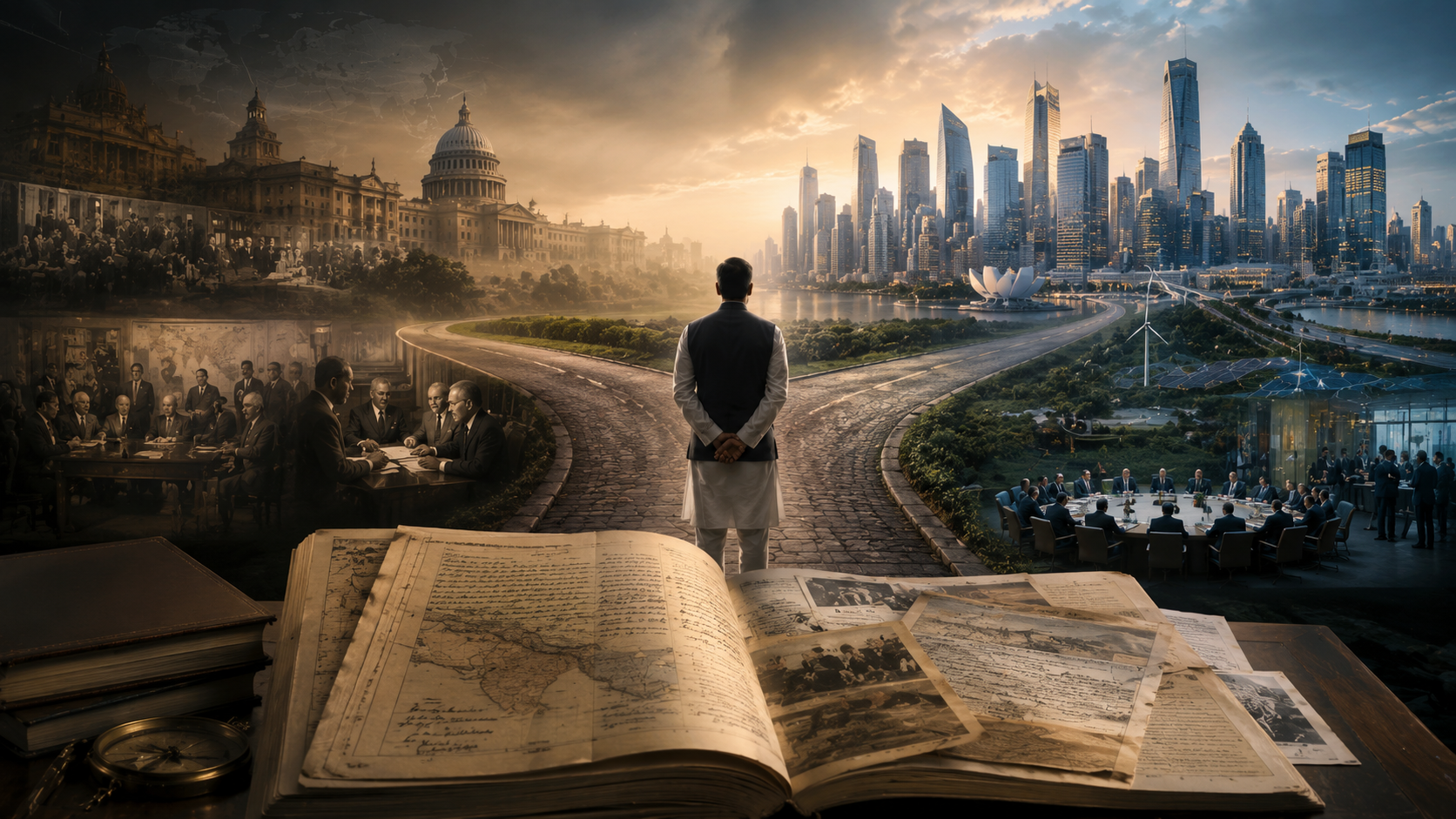
The most dangerous moment in the life of a nation is not defeat.
Defeat is visible. Defeat clarifies. Defeat forces self-examination.
The more dangerous moment arrives after success — when a nation begins to enjoy the benefits of strength accumulated over decades and gradually loses the ability to distinguish between the wealth it inherited and the wealth it created.
That confusion has ruined empires, corporations, political parties, and civilizations. It can ruin foreign policies as well.
A family that spends an inheritance often mistakes the size of its bank account for evidence of its own earning power. The distinction becomes clear only later, when the inherited capital has been consumed and there is nothing left to replenish it. Something similar happens in statecraft.
Nations inherit assets every bit as real as money. They inherit credibility. They inherit alliances. They inherit trust. They inherit institutions. They inherit reputations built across generations of restraint, consistency, and sacrifice.
These assets rarely appear in economic statistics, yet they often matter more than military budgets or diplomatic communiqués. They determine who takes a country’s phone calls. They determine whose warnings are heeded. They determine whose judgment is trusted when crises break. Most importantly, they determine how much room a nation possesses to act independently.

For nearly seventy-five years, India accumulated precisely this kind of strategic capital. The achievement did not belong to any single leader or party. It was built gradually, often imperfectly, across governments that disagreed about almost everything except one fundamental proposition: India should remain free to make its own choices.
Jawaharlal Nehru understood that a poor postcolonial nation could not compete with the great powers on their terms. He therefore sought influence through independence. Critics have spent decades debating the successes and failures of non-alignment, but they often overlook its deeper purpose. Non-alignment was not an exercise in moral vanity. It was a structural refusal to become strategically dependent upon any external bloc.
Indira Gandhi inherited that framework and translated it into a harder language. During the Bangladesh crisis of 1971, India demonstrated that autonomy meant little unless it could withstand pressure. The lesson was not that India should oppose the West or embrace the Soviet Union. The lesson was that India’s decisions would be made in New Delhi — and nowhere else.
READ: Satish Jha | The wrong question about Rahul Gandhi (June 7, 2026)
The same instinct survived the Cold War. Narasimha Rao opened the economy while preserving diplomatic flexibility. Atal Bihari Vajpayee tested nuclear weapons while simultaneously building relations with Washington. Manmohan Singh negotiated a historic civil nuclear agreement without abandoning India’s tradition of independent judgment.
These leaders made mistakes. Some made very serious mistakes. Yet each contributed to a strategic inheritance whose value is difficult to exaggerate.
By the turn of the century, India possessed something that many countries with greater wealth and stronger militaries lacked. It possessed credibility.
Countries disagreed with India, often intensely. Yet they rarely doubted that its positions were genuinely its own. Friends could not take India for granted. Rivals could not easily predict it. Neither side assumed that India’s foreign policy would simply mirror someone else’s priorities. That reputation was one of the republic’s greatest strategic assets.
At the same time, another form of capital was accumulating beyond India’s borders. The Indian diaspora was undergoing one of the most remarkable ascents in modern history. Across the United States, Europe, the Gulf, Africa, and Asia, people of Indian origin were becoming physicians, entrepreneurs, academics, scientists, investors, and public servants. They entered institutions that shape modern societies and earned influence not through lobbying but through performance.
Generations of immigrants created networks of trust that no government could have manufactured. By the second decade of this century, India found itself in possession of an extraordinary inheritance: diplomatic credibility abroad, strategic flexibility among major powers, and a global diaspora whose influence far exceeded the country’s formal power.
No previous generation of Indian leaders had inherited a stronger hand. Which brings us to the question that matters most.
Has India used this inheritance to create new strategic capital — or has it merely spent inherited capital while presenting the expenditure as evidence of strength?
The dominant narrative of the past decade is familiar. India is more visible than ever. Its leaders command attention. International summits revolve around its participation. Foreign governments seek engagement. None of this is imaginary. India is unquestionably more visible. The question is whether visibility and influence are being confused.
Visibility is not power. Recognition is not leverage. Attention is not autonomy. The history of international relations is filled with countries that commanded headlines while exercising surprisingly little influence over events that mattered most to them.
The test of statecraft is not whether the world notices you. The test is whether the world must account for you. Measured by that standard, the achievements of contemporary diplomacy appear more ambiguous than either its supporters or critics are willing to admit.
India’s growing international profile owes much to factors larger than any government. The rise of China increased India’s strategic importance to the West. Supply-chain anxieties increased interest in India as an economic partner. The country’s market size became too significant to ignore. The diaspora created goodwill across multiple continents.
These developments are real. But they are also largely inherited. A wise government converts inherited advantages into durable strategic gains. A less wise government mistakes inherited advantages for evidence of its own brilliance.
READ: Satish Jha | The myth of the statistical exception: Dismantling India’s factory of unrealized potential (June 1, 2026)
The distinction matters because inherited capital can be spent. Indeed, it often is.
A nation can consume diplomatic credibility by becoming more predictable. It can consume strategic flexibility by allowing itself to be identified too closely with one camp in a multipolar world. It can consume goodwill by treating long-cultivated relationships as permanent assets rather than living investments that require constant tending. Most dangerously, it can consume realism itself.
For realism begins with an honest accounting of assets and liabilities. It asks what a nation has actually gained — not what it has announced.
The problem with modern politics is that it increasingly rewards narration over measurement. A summit becomes a success because it generated headlines. A visit becomes historic because it trended online. A relationship becomes strategic because it is described as strategic.
The distinction between performance and outcome begins to blur. Foreign policy gradually migrates from the realm of statecraft into the realm of political communication. The cover page becomes more important than the balance sheet. This tendency is not unique to India. It is one of the defining temptations of our age.
Yet it poses a particular danger for rising powers — because rising powers often possess enough genuine success to obscure emerging weaknesses.
India today is stronger than it was twenty years ago. Its economy is larger. Its military is more capable. Its technological capacities are deeper. Its global visibility is greater.
All of this is true. Yet none of it answers the question that ultimately matters.
Is India accumulating leverage at the same rate that it is accumulating attention? Has its freedom of action expanded proportionately to its visibility? Can it shape outcomes, not merely attend the rooms where outcomes are shaped? Can it disappoint powerful friends without fear? Can it preserve independent judgment when external pressures intensify?
These are the questions that determine whether strategic capital is being created or consumed. They are also the questions that receive the least attention — because they cannot be answered through publicity. They can only be answered through results.
History is unsentimental in this regard. It does not care how many summits were attended, how many speeches were delivered, how many photographs were taken, or how many declarations were issued.
History opens the ledger. It asks what was inherited. It asks what was spent. It asks what was created. And it records the difference.
That is why the most important foreign policy question facing India today is not whether the country is rising. It clearly is. The question is whether its diplomacy is adding to the inheritance it received — or quietly living off it.
One path produces a great power. The other merely produces the appearance of one. The difference is invisible for years. Until suddenly it isn’t.