



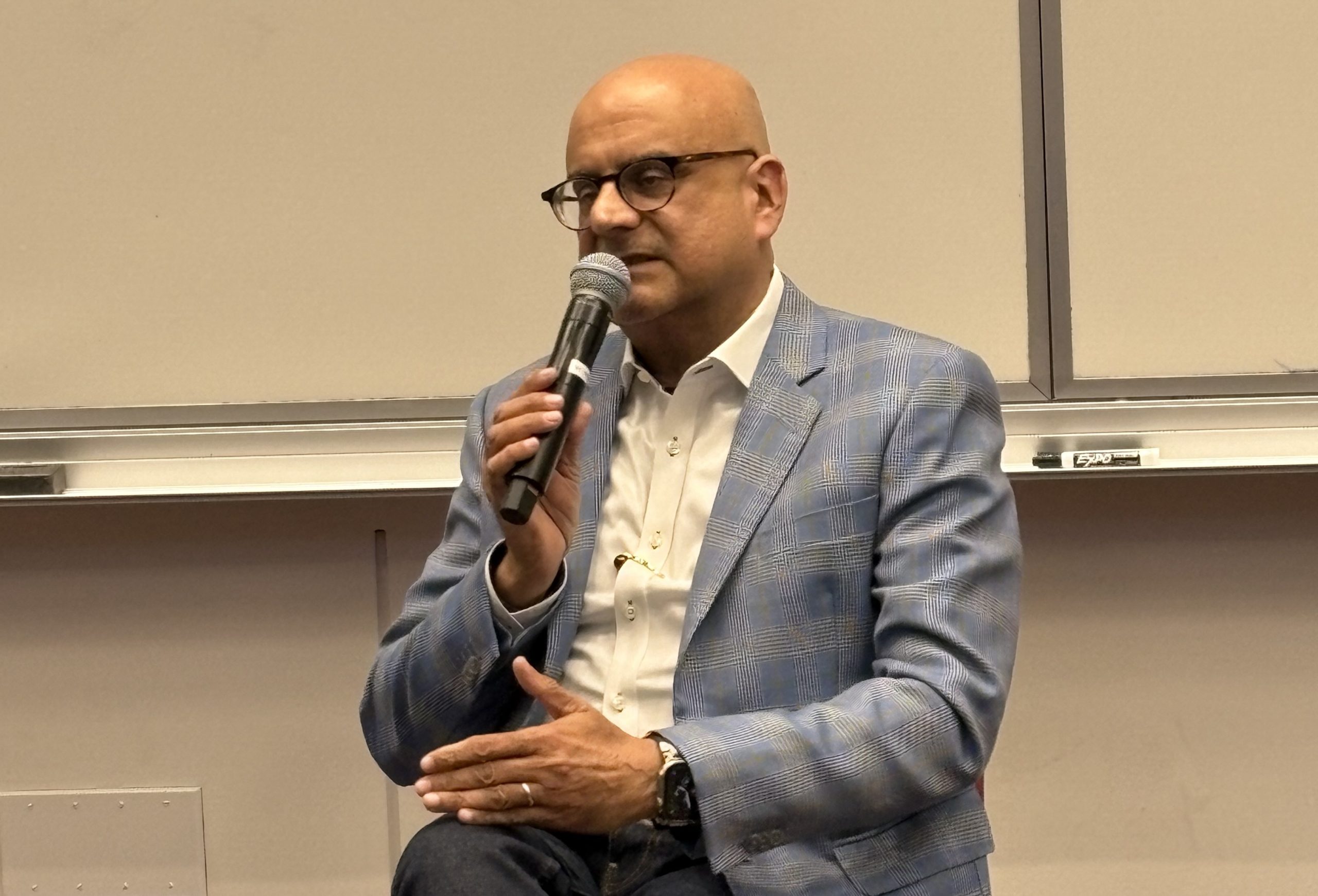
The Vistronix founder shared insights on scaling a business, attracting smart capital, surviving growth inflection points, and executing a successful exit.
For entrepreneurs seeking to enter the government contracting sector, Deepak Hathiramani has a simple yet powerful principle: “There is no right way of doing the wrong thing.”
Speaking at “Startup Bazaar: GovCon” at the University of Maryland in College Park on June 13, the veteran entrepreneur and investor who built and sold national security contractor Vistronix Intelligence and Technology Solutions shared lessons from more than three decades of building, scaling, and exiting businesses.
The fireside chat, moderated by Michael Hoffmeyer, managing director of the Dingman-Lamone Center for Entrepreneurship at the University of Maryland’s Robert H. Smith School of Business, explored one of the most important questions facing entrepreneurs in the government contracting industry: What does it take to build a company that can successfully scale and achieve a meaningful exit?
For Hathiramani, co-founder of the real estate investment firm SteeleHarbour Capital Partners, the answer begins with integrity.
“The first and most important thing for me was there is no right way of doing the wrong thing,” he said. “Creating a culture with unquestionable integrity and ethics is absolutely paramount.”
His remarks reflected lessons learned through both successes and setbacks.
READ: Maryland Secretary Atif Chaudhry champions startups and equity in state procurement at UMD Startup Bazaar (April 16, 2025)
Born in Africa and raised in India, Hathiramani came to the United States with aspirations of becoming an entrepreneur. After working at startups in the commercial sector — including one that successfully exited and another that went public before suffering a dramatic collapse in market value — he launched a government contracting company in 1990.
The journey was far from smooth.
Hathiramani recalled growing the business to approximately $30 million before nearly driving it into bankruptcy through strategic mistakes. The company survived, he said, because of a strong culture and solid financial foundation. Eventually, after rebuilding and scaling the business, Vistronix was acquired in 2016 by ASRC Federal Holding Company.
Looking back, Hathiramani identified several lessons that shaped his entrepreneurial philosophy.
Among them was the importance of surrounding oneself with talented people and empowering them to challenge conventional thinking.
“You always want to surround yourself with people who are smarter than you and give them the flexibility to challenge the status quo,” he said. “That’s how the best idea wins.”
He also emphasized a reality that many founders struggle to accept: the people who help a company reach one stage of growth may not be the right people to lead it through the next.
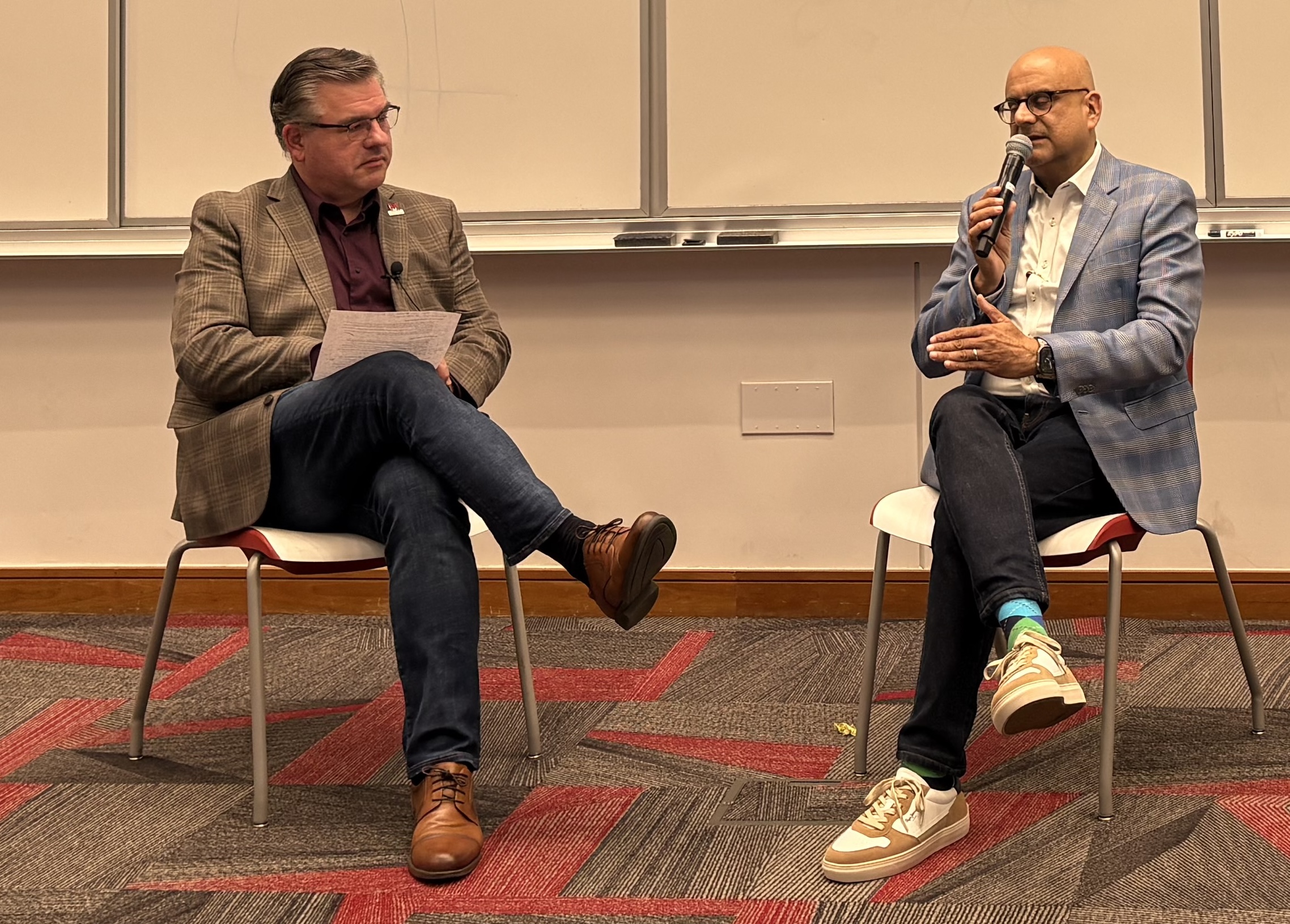
“The people who get you from A to B may not be the same people who get you from B to C,” he said. “Being able to make those decisions fast is an important lesson.”
Another critical insight involved capital.
“Capital comes in different shades of green,” Hathiramani said, noting that entrepreneurs often focus too heavily on securing funding without fully evaluating what investors bring beyond money.
That observation resonated with Hoffmeyer, who noted that investors often describe the distinction between ordinary capital and “smart money” — capital accompanied by strategic guidance, industry expertise, and valuable relationships.
Hathiramani agreed, arguing that selecting capital partners is among the most consequential decisions founders make.
“Ensuring that they bring more than just financial capital and bring strategic capital is another important factor,” he said. “The least valuable thing they bring is the capital.”
The conversation also explored the unique challenges of scaling government contracting businesses.
According to Hathiramani, many GovCon firms hit predictable growth plateaus. Companies often grow rapidly to certain revenue levels before stalling and needing to rethink their strategy.
Vistronix eventually reached approximately $200 million in annual revenue. At that point, leadership faced a difficult decision: continue pursuing aggressive growth or capitalize on favorable market conditions through a sale.
“The next step was, do we take it to $500 million to $1 billion?” Hathiramani recalled. “At that point, we decided that the risks were significantly greater as you scale the business and the market was primed for us to exit.”
Several factors influenced that decision.
The company would have required substantial additional capital to continue scaling. Hathiramani believed significant changes to the leadership team would also be necessary. At the same time, acquisition interest was strong, and a strategic buyer approached the company directly without an investment banker.
Taken together, those circumstances created what he viewed as an optimal exit opportunity.
Despite having planned from the outset to eventually sell the company, Hathiramani acknowledged that the emotional aspects of an exit are difficult.
“It still is a very difficult and emotional process,” he said. “As an entrepreneur, as the leader of a company, you’ve got to be able to separate your emotions from the decisions that drive the business and create value.”
Preparing for life after the sale helped ease the transition. Rather than immediately launching another company, Hathiramani chose to return to school full-time for approximately 18 months before pursuing new ventures.
Another major consideration during the acquisition process was ensuring the acquiring company would be a good fit culturally and strategically.
For Hathiramani, protecting employees and customers was critical.
“We wanted to ensure that the employees would be taken care of, their culture aligned with our culture, and that we knew what the long-term strategic plan was,” he said.
The discussion then turned to the current state of the government contracting market and the factors that make companies attractive acquisition targets today.
Hathiramani argued that the era of being a broad-based IT contractor is fading.
“If you look at where the government is emphasizing and spending dollars, being a generalist or a pure IT company is not going to survive in the next five years,” he said. “You’ve got to be very mission-focused. You’ve got to be very customer-focused.”
Using a memorable phrase, he advised entrepreneurs to become “six inches wide and a mile deep” rather than “a mile wide and six inches deep.”
In other words, companies should develop deep expertise in specific mission areas and customer challenges rather than trying to serve everyone.
That specialization becomes even more important as consolidation accelerates across the industry.
Hathiramani pointed to several long-term trends that he believes will continue driving investment in defense and national security technologies, including rising global instability, increasing defense budgets, and the growing importance of autonomous systems and drone technologies.
“The world is not getting any safer,” he said. “Most future wars are going to be autonomous.”
Audience members also questioned Hathiramani about trust, leadership, and company culture.
He responded by stressing that trust begins at the top and requires leaders to establish clear expectations and accountability.
READ: ‘Trust is a currency of commerce’: Maurice Boissiere on leadership, culture, and the courage to be vulnerable (December 22, 2025)
“Trust starts at the very top,” he said. “It is incumbent on you as the leader to create that culture.”
He shared examples of difficult personnel decisions he made when executives were found to be undermining the company, emphasizing that leaders must demonstrate through actions—not words—that integrity is non-negotiable.
“Actions always speak louder than words,” he said.
Toward the end of the session, entrepreneurs sought advice on transitioning from subcontractor status to becoming a prime contractor and building enterprise value.
Hathiramani described subcontracting as a common entry point for GovCon firms but stressed the importance of reinvesting in capabilities, relationships, and talent rather than remaining content with a lifestyle business.
“Our objective was to continue to invest in the business, recruit the right people, develop the relationship with the right customers, understand their mission, and then position ourselves with the right contracts,” he said.
His closing advice reflected themes that had surfaced throughout the conversation: integrity, culture, focus, and people.
For founders contemplating their own exits in the years ahead, he offered a concise summary.
“Integrity and ethics are paramount,” Hathiramani said. “Culture is absolutely critical. And surrounding yourself with people who are smarter than you is absolutely critical.”
For an audience of entrepreneurs seeking to navigate the increasingly complex world of government contracting, it was a message grounded not in theory, but in decades of hard-earned experience.
The event was the third annual Startup Bazaar event hosted at UMD, building on the success of previous gatherings.
The keynote address by Atif Chaudhry, Maryland’s Secretary of General Services, who outlined how businesses can work with government agencies in the state.