



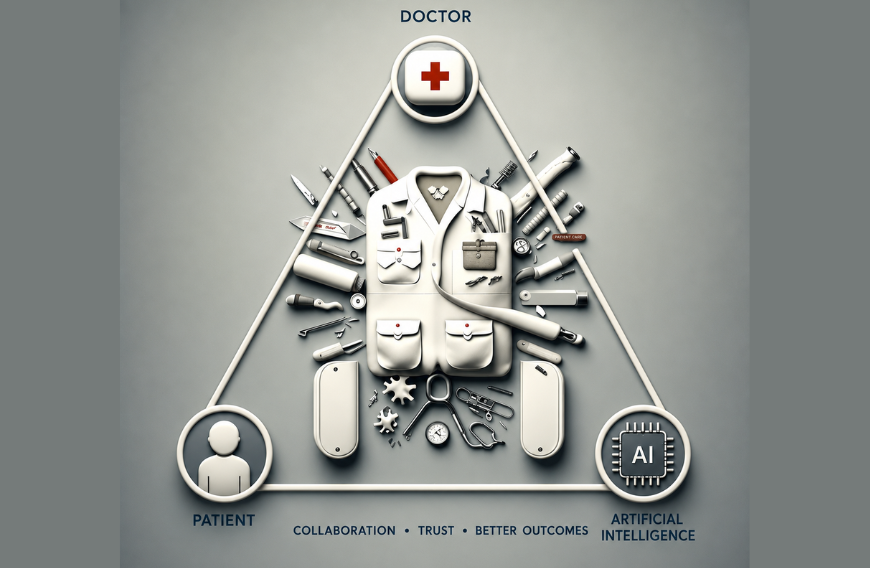
In our recent column on education, “Thought control: Who is teaching whom in the age of AI?,” we observed that AI introduces a third presence into the relationship between teacher and student. A similar transformation is now occurring in medicine. Technology can distribute medical information more efficiently than physicians can.
As a result, patients no longer arrive carrying only symptoms. They increasingly arrive carrying explanations, diagnoses, treatment suggestions, and the confidence that comes from consulting an AI system before consulting a physician. Yet in clinical encounters, patients rarely seek information alone. They seek reassurance, judgment, accountability, and guidance under conditions of uncertainty. They arrive not merely with symptoms or concerns but with circumstances, fears, constraints, tradeoffs, and tolerance for risk.
A patient recently presented complaining of itchy eyes and tearing. Before the examination, she suggested that she might have concretions in her conjunctiva.
Not long ago, a question like that would have immediately suggested that the patient was a physician, nurse, or healthcare professional. Today, it suggests something entirely different. It suggests that before coming to see the doctor, patients often spend time consulting ChatGPT or another AI model and arrive with a vocabulary and differential diagnosis that would have been unfamiliar to most patients only a few years ago. AI has taken on different roles for patients in the form of digital twins or as second opinion or even first opinion sometimes.
Much of the public debate has focused on whether AI will replace physicians, whether patients should trust chatbot-generated medical advice, or whether governments should accelerate the adoption of AI across healthcare systems.
READ: Sreedhar Potarazu and Carin Isabel Knoop | Thought control: Who is teaching whom in the age of AI? (June 3, 2026)
AI is changing the relationship between physicians and patients by giving both sides access to many of the same sources of information, and in doing so, it risks transforming a partnership centered on healing into an intellectual contest centered on knowledge.
For generations, medicine operated within a framework in which physicians possessed specialized information acquired through years of training, clinical experience, and continuous education.
Patients sought physicians not merely because they had access to information but because the professionals could interpret information, apply it to individual circumstances, determine the best course of action, and exercise judgment amid uncertainty. Trust emerged from the understanding that physicians could help patients navigate a complex landscape of symptoms, diagnoses, treatments, and outcomes.
Today, both physicians and patients increasingly enter clinical encounters accompanied by AI.
When knowledge becomes a contest
The democratization of information is not inherently problematic. Informed patients often become stronger advocates for their health and more active participants in clinical decision making. Concern arises when access to information is confused with understanding and when the clinical encounter becomes an exercise in determining whose source of information is superior rather than a collaborative effort focused on understanding a problem and restoring health.
When patients and physicians begin viewing one another as adversaries in a contest over knowledge, the purpose of medicine subtly shifts. The patient presents evidence generated by a chatbot. The physician responds with training and experience. The patient counters with another article, another prompt, another AI-generated explanation. The physician defends a diagnosis or treatment recommendation. What should have been a shared pursuit of healing gradually becomes a debate over who possesses greater expertise.
AI should not become a knife handed to opposing sides in a contest over information. It should become a scalpel.
AI should be judged according to the same standard.
Its value will not be determined by how many questions it can answer, how convincingly it can generate explanations, or how effectively it can overwhelm human beings with information. Its value will be determined by whether it helps physicians and patients arrive at more precise diagnoses, more personalized treatments, fewer unnecessary interventions, and ultimately better outcomes.
Physicians spend vast amounts of time performing administrative tasks that contribute little to direct patient care. Documentation requirements, coding obligations, prior authorizations, chart reviews, prescription management, and regulatory compliance consume hours that could otherwise be devoted to patients. Artificial intelligence can reduce these burdens and allow physicians to focus more attention on the individuals sitting in front of them.
AI can also serve as a powerful cognitive assistant capable of reviewing enormous bodies of medical literature, identifying relevant evidence, summarizing research findings, and helping clinicians navigate an ever-expanding universe of scientific knowledge. In specialties such as radiology, pathology, dermatology, and ophthalmology, machine learning systems have already demonstrated impressive capabilities in image interpretation and pattern recognition.
READ: Sreedhar Potarazu and Carin Isabel Knoop | Friction vs fiction: AI automators, validators, and cyborgs (May 22, 2026)
Knowledge is not understanding
Yet, knowledge and understanding remain fundamentally different concepts.
Large language models (LLMs) excel at generating language because they identify patterns across vast quantities of data. They do not truly understand disease as physicians do, nor do they fully appreciate the cultural, social, emotional, and economic realities that often determine whether a treatment plan succeeds or fails.
Every physician is taught to “think horses, not zebras” when evaluating symptoms, a reminder that common conditions are usually more likely than rare diseases. AI complicates that principle because it can instantly generate an extensive list of possibilities, including uncommon diagnoses that may be statistically improbable but emotionally compelling.
A patient with itchy eyes may become concerned about a rare autoimmune disorder when seasonal allergies are the far more likely explanation. Physicians can face a similar challenge when AI surfaces obscure possibilities that function as diagnostic red herrings. The value of AI should not be to generate the longest list of possible diagnoses, but to distinguish the signal from the noise and identifying which possibilities truly deserve attention in the context of the person with the illness, not just the illness.
A physician caring for a first-generation immigrant family may recognize concerns surrounding mental health that are never explicitly articulated because cultural stigma discourages open discussion.
A physician may recognize that a patient’s reluctance to proceed with surgery reflects caregiving responsibilities, religious beliefs, financial limitations, transportation challenges, or historical mistrust of healthcare institutions. These factors frequently determine outcomes as much as laboratory values, imaging studies, or clinical guidelines.
LLMs can identify patterns across populations, but they often struggle to appreciate the deeply personal circumstances that influence individual decisions. They may understand disease prevalence within a demographic group while missing the cultural nuance that shapes how a particular patient experiences illness, evaluates risk, or defines quality of life. AI can help illuminate possibilities.
Physicians help patients live with consequences.
Privacy and confidentiality introduce another layer of complexity that can erode trust for both physicians and patients. Medical records contain some of the most sensitive information, including details about physical and mental health, family history, genetics, and personal behavior. As patients increasingly interact with AI systems, important questions emerge about who owns that information, how it is stored and used, and whether patients fully understand the implications of sharing it.
A covenant, not a contract
The future of healthcare AI may also look very different from today’s LLM landscape. Small language models trained on carefully curated medical literature, specialty-specific evidence, and institutional protocols may ultimately prove more useful than massive general-purpose systems trained on broad segments of the internet.
For example, suppose that a chatbot evaluated the data on the patient population of a specific doctor’s practice rather than general population; its recommendations might be more relevant to the individual sitting in the exam room.
Whereas an LLM predicts the next likely word, the emerging frontier of AI is a world model that seeks to predict how reality unfolds. Rather than merely describing a diagnosis, a world model may eventually help predict how a specific patient’s disease is likely to progress over time and how alternative treatment strategies could influence that trajectory. This is especially relevant for understanding how diseases manifest across patients and for individualizing treatment.
These developments do not alter the central purpose of medicine.
Patients do not seek healthcare simply because they lack information. They seek healthcare because they need judgment, context, empathy, reassurance, accountability, and guidance through uncertainty. No algorithm, regardless of sophistication, can fully assume responsibility for another human being and this is the critical gap that may never be closed between the practice of medicine and AI.
The future of patient care will not be determined by who wins the battle for knowledge but understanding. And whether physicians, patients, and intelligent machines remain focused on the outcome that has always mattered most: healing.
In those moments of discomfort and uncertainty, healing depends not only upon knowledge but upon relationships. The physician’s role has never been simply to diagnose disease. It has also been to accompany another human being through vulnerability, uncertainty, and hope. AI may force physicians to become more explicit about that role and remind us all of its primacy.