



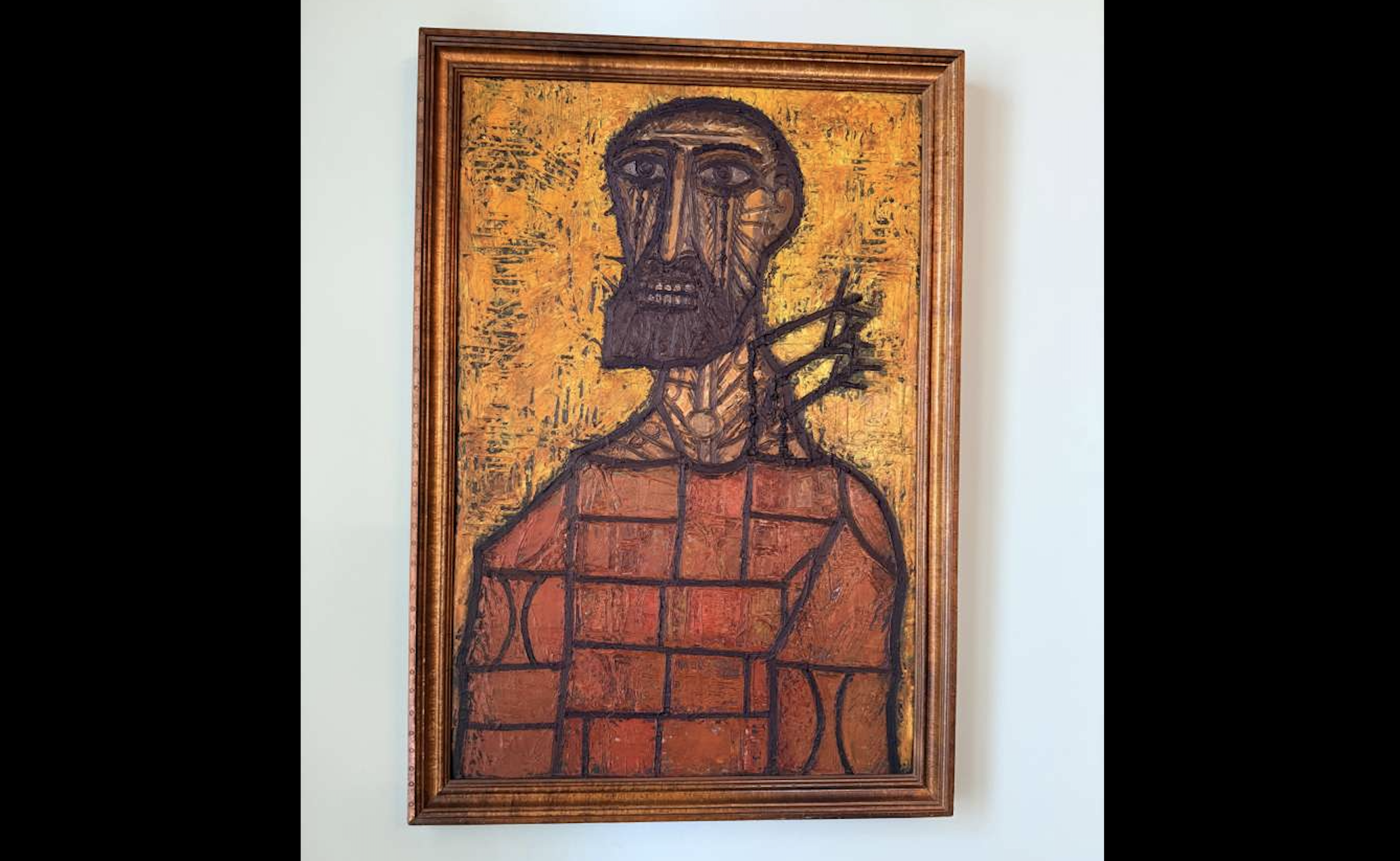
There is a painting that has been falling for thirty years.
Tyeb Mehta’s Mahishasura, the buffalo-demon caught mid-plunge, frozen on its diagonal axis of collapse, first broke into public consciousness at auction in 2005 when it sold for $1.6 million. Today, privately estimated at $8 to $12 million, the demon still falls and the market still rises. Somewhere in the gap between those two figures lives the entire story of what has happened to Indian civilization’s relationship with its own image.
Here’s the punchline: the story of Indian modernism is the same story, told three times across three continents and one hundred and sixty years apart, always ending the same way.

The Pattern
The pattern begins with rejection.
A group of artists, young and poor and consequential beyond all immediate recognition, is producing work that the established cultural authorities cannot accommodate. The academies dismiss them. The collectors ignore them. The critics, when they bother to notice at all, deploy the full arsenal of condescension. And then, gradually, in ways the artists themselves rarely live to fully witness, the world catches up. The work enters the canon. The prices achieve escape velocity. And the civilization that produced these artists, or adopted them, or, crucially, whose newly minted elite had the cultural confidence and the capital to claim them, is transformed in the process.
READ: Autopsy of a liquidity event. Biopsy results for the crypto trade (
This pattern has played out at least three times in the last century and a half. Each time, it has been precipitated by the same convergence: a cluster of extraordinary talent in a single geography, working in deliberate opposition to inherited convention, at precisely the moment when the economic and social conditions were ripening to receive them. Each time, the explosive and self-perpetuating demand for the works has been driven not merely by aesthetic appreciation but by something deeper, the desire of a rising civilization to see itself reflected in the art it covets.
The Impressionists in Paris. The Abstract Expressionists in New York. The Progressive Artists’ Group in Bombay.
Three movements, three geographies, and one recurring logic.
Paris: The First Eruption
In 1863, the jury of the official Paris Salon rejected more than two thousand works, including paintings by Pissarro, Jongkind, Whistler, and Manet. The outcry was significant enough that Napoleon III ordered a separate exhibition for the rejected works, the Salon des Refusés, which became, inadvertently, the founding moment of Western modern art.
Monet, Renoir, Degas, Pissarro, Sisley, Morisot: these were artists working against the grain of academic painting, replacing its polished surfaces and historical grandeur with the immediate, the atmospheric, the fugitive quality of light on water. They were not, initially, celebrated. Monet died in 1926, wealthy and famous, but he had spent decades in poverty so acute that he begged patrons for grocery money and once tried to take his own life. Renoir painted through arthritis so severe his brushes had to be tied to his hands. Pissarro, the eldest and most generous of the group, died having never achieved the commercial success his work deserved.
READ: The Review by Ajay Raju | Ask not what I can do. Tell me what you can do for me. (March 30, 2026)
What rescued them was not France, but America.
The great American collectors of the Gilded Age, the Havemeyers, Albert Barnes, Duncan Phillips, recognized in Impressionism a language that spoke to their own cultural moment: a new civilization, flush with industrial capital, hungry for aesthetic legitimacy, and unencumbered by the aristocratic hierarchies that constrained European taste. The Americans could buy Impressionism without guilt, without social complication, without having to navigate the web of inherited cultural authority that made the French establishment so slow to recognize what it had produced. They bought voraciously. The Havemeyers alone acquired dozens of Monets, Degases, and Manets. Albert Barnes assembled, in a Philadelphia suburb, what remains one of the greatest single collections of Post-Impressionist work ever gathered under one roof.
The prices the Americans paid seem modest by today’s standards. What matters is the mechanism: a rising civilization, its elite newly minted and globally ambitious, recognized in the work of another geography’s creative explosion something that validated both the art and themselves. The supply was fixed. Monet would paint no more Haystacks after 1926. The demand, driven by American institutional collecting, kept compounding. Today, a major Monet sells for $50 to $110 million.
The pattern was established. But it would take another war, another city, and another generation of artists to run it again.
New York: The Second Eruption
The Abstract Expressionists were, in their own way, as improbable a group as the Impressionists. Jackson Pollock was an alcoholic rancher’s son from Wyoming who had failed at almost everything before he found his drip. Mark Rothko was a Latvian Jewish immigrant who worked as a waiter and tutored children to survive while painting canvases of transcendent color that he priced at sums no one would pay. Willem de Kooning arrived in New York as a stowaway. Franz Kline painted on newspaper because he could not afford canvas.
They gathered in lower Manhattan in the 1940s around the Cedar Tavern and the Club, a fraternity of shared obsession and mutual argument, and produced, in the decade after World War II, a body of work that would become the defining visual language of the American century. Abstract Expressionism was not merely an art movement. It was a civilizational declaration: that the center of the art world had migrated, permanently, from Paris to New York, and that American culture was not a provincial echo of European achievement but a primary creative force in its own right.
The collector infrastructure that received them was, crucially, American institutional, the Museum of Modern Art under Alfred Barr, Peggy Guggenheim’s gallery, the networks of dealers and curators who understood that they were witnessing the emergence of something historically significant. But the broader validation came, again, from a civilization at the moment of its greatest confidence. Post-war America was the dominant economic and military power on earth. Its elite had capital, ambition, and the cultural hunger that accompanies arrival. Abstract Expressionism gave them a mirror.
Pollock’s drip paintings now sell for $200 million. Rothko’s color field canvases command $80 to $180 million. De Kooning’s Interchange sold in 2015 for $300 million. The men who could not afford canvas are now among the most expensive artists in human history.
The mechanism is identical to what happened in Paris. Extraordinary talent, concentrated in a single geography, working against convention, at the precise moment when a rising civilization had the capital and the cultural confidence to claim it. Fixed supply, compounding demand, and an explosive and self-perpetuating price appreciation.
The pattern had now run twice. The question, which I have been quietly asking myself for over fifteen years, standing in auction rooms in New York, London, Delhi and Mumbai, was where it would run next.
Bombay, 1947: The Third Eruption
Bombay, 1947. A group of six young men, Francis Newton Souza, Maqbool Fida Husain, Syed Haider Raza, K.H. Ara, S.K. Bakre, and H.A. Gade, sign a manifesto and form the Progressive Artists’ Group. They want Cézanne. They want Picasso. They want to be modern. They want to be free. They cannot afford train fare to the exhibition they are about to make famous.
The parallels to Paris in 1863 and New York in the 1940s are not incidental, but structural. The Progressive Artists’ Group was, like the Impressionists and the Abstract Expressionists before them, a self-conscious fraternity of talent working in deliberate opposition to inherited convention; in their case, the twin orthodoxies of academic Indian painting and the Bengal School’s romanticized nationalism. They wanted to make Indian art modern without making it merely derivative, to absorb the lessons of European modernism while finding a visual language adequate to the experience of a civilization remaking itself at the moment of India’s independence.
What they produced in their most fertile two decades, roughly 1947 to 1968, was a body of work of extraordinary range and ambition. Husain’s exuberant, mythologically charged canvases, painted at speed and with the physical confidence of a man who treated the entire world as his studio. Gaitonde’s meditative, Zen-inflected abstractions, canvases that seem to breathe, that hold silence the way a lake holds sky. Raza’s geometric explorations of the bindu as cosmic origin point, the circle as both Indian metaphysics and Parisian formal discipline, simultaneously. Souza’s slashing Catholic eroticism, the guilty body rendered with a line so decisive it seems to accuse. Tyeb Mehta’s monumental diagonals, figures caught in the physics of historical catastrophe.
They were making, as the Impressionists made and the Abstract Expressionists made, a visual language for a civilization discovering the terms of its own modernity. And like their predecessors, they did it in poverty, in argument, in the productive friction of a fraternity bound by shared obsession.
The difference, the historically significant difference, is the timing of the recognition.
The Impressionists waited decades. The Abstract Expressionists waited a decade. The PAG artists have waited longer still, long enough that several of them died before the full force of the market’s recognition arrived. Husain died in exile in 2011, a Qatari citizen hounded from his homeland by right-wing groups who destroyed galleries and filed criminal complaints over his nude goddesses. Souza died half-forgotten in New York while his canvases quietly appreciated. Gaitonde, the reclusive mystic who once said “everything starts from silence,” died in 2001, before the auction records that would bear his name reached into the millions.
They could not have known what was coming. But the pattern, once you have seen it in Paris and New York, is unmistakable. The only question was when the third eruption would fully detonate.
In 2025, it did.
2025: The Pattern Confirms Itself
In March 2025, a 14-foot-wide canvas that had hung, largely unseen, in a corridor of Oslo University Hospital for seven decades arrived at Christie’s New York. The painting was Untitled (Gram Yatra), a 1954 oil by Husain, 13 vignettes of Indian village life, painted five years after Independence, when the PAG was still asking its foundational question. A Norwegian surgeon had bought it in New Delhi in 1954. It then passed into hospital storage, its provenance pristine, its story extraordinary, its existence unknown to the market.
At Christie’s, Gram Yatra fetched $13.8 million against a presale high estimate of just $3.5 million, the highest price ever paid for a work of modern Indian art at public auction. It shattered Husain’s previous record of $3.1 million, set just months earlier at Sotheby’s in London, and nearly doubled the previous record for the entire category.
Five bidders competed. The winner was an anonymous institution. The proceeds funded a neurosurgical training center, completing, across seventy years, the original doctor’s humanitarian circle.
Six months later, at Saffronart’s 25th Anniversary Evening Sale at The Oberoi in New Delhi, an untitled 1970 Gaitonde canvas sold for $7.57 million, setting a world auction record for the artist. The sale achieved $40.20 million in total, the highest-value South Asian art sale in auction history, surpassing the record Saffronart itself had set just months earlier by over 60 percent. Eighty-five lots. One hundred percent sold. Days later, Sotheby’s sold Souza’s Houses in Hampstead at a price marginally below the Gaitonde, making it India’s third most expensive painting.
In eight months, the Indian art market had rewritten its own record book three times.
The pattern had confirmed itself. The third eruption had arrived.
Why Now?
The Impressionists needed American industrial capital to discover them. The Abstract Expressionists needed post-war American cultural confidence to claim them. The PAG artists need something more specific, more historically novel, and more powerful than either of those predecessors required: the emergence of an Indian global elite.
The numbers are almost surreal in their velocity. India is now the world’s fourth-largest economy, projected to become the third-largest within three years, with a GDP forecast of $7.3 trillion by 2030. The IMF has upgraded India’s growth forecast to 7.3 percent for 2025-26. India gains a millionaire household every thirty minutes. The number of dollar billionaires rose from one in 1991 to over 358 by 2025, a thirty-five-year multiplication that has few precedents in modern economic history. India now ranks third globally for billionaire count, with combined wealth representing roughly one-third of the country’s entire GDP.
But the numbers alone do not tell the story. The mechanism that is driving the Indian art market is not simply that India has produced wealthy people who can afford expensive art. It is that India has produced a global elite, people who run the world’s most consequential companies, who sit on the boards of its most powerful institutions, who have been educated at its most selective universities, and that this elite is Indian in identity, in cultural formation, in the psychological residue of their origins, even as they operate at the apex of global business.
Sundar Pichai runs Google. Satya Nadella runs Microsoft. The roster of Indian-origin CEOs at Fortune 500 companies is a social phenomenon without few precedents in American immigration history. The Indian-American community is, by most measures, one of the most economically successful immigrant communities in the United States. And the third-generation diaspora collector, children of the engineers and physicians who arrived in the 1960s and 1970s, graduates of Stanford and Wharton, working in private equity and venture capital and medicine, has more capital than their parents, less direct memory of India, and a hunger that achievement alone has not satisfied.
Read more columns by Ajay Raju
They are buying Souzas and Razas with the same psychological intensity that the Havemeyers bought Monets and the Rockefellers bought Pollocks: not purely as investment, though the investment case is now beyond serious dispute, but as an act of civilizational self-recognition. The art is a mirror. The mirror is becoming more expensive because more people with both the means and the identity need to look into it.
This is the engine of the third eruption. And it is self-perpetuating in ways that neither the Impressionist nor the Abstract Expressionist markets were at their equivalent moments, because the Indian diaspora is simultaneously accumulating wealth and accumulating cultural confidence at a pace that has almost no historical precedent.
India’s soft power is rising alongside its economic power. The Kochi-Muziris Biennale draws record crowds annually. Art Mumbai attracts 40,000 visitors. The Kiran Nadar Museum of Art is building a new Delhi building. The India Art Fair has become a genuinely international event. India has emerged as the standout performer in Asian art markets, with a sell-through rate of 89 percent in 2025, the highest across all five major Asian art regions, even as the overall Asian fine art market contracted dramatically, from $5.4 billion in 2021 to $2.2 billion in 2025. India is rising as China contracts.
The market is repricing Asia. India is the counterweight. And the works available to participate in this repricing are, by their nature, finite.
The Supply Problem, and the Opportunity
Can you see how the logic of the pattern is comparable to what happened in Paris and New York?
The Impressionists stopped painting. Monet painted his last canvas. Renoir’s last brushstroke, tied to arthritic hands, dried decades ago. The supply of major Impressionist works is permanently and absolutely fixed, and has been for nearly a century. What has happened to prices in the interim is a function of that fixed supply encountering seventy years of compounding global wealth creation among the kind of people who want to own them.
The PAG artists stopped painting. Husain is gone. Gaitonde is gone. Souza is gone. Raza is gone. Tyeb Mehta is gone. The supply of first-order PAG works is not merely limited. It is closed. The paintings that exist are the paintings that will ever exist. There will be no new Husain Gram Yatra, no new Gaitonde of the 1960s meditative period, no new Souza with the full force of his early Catholic violence.
I entered this market in 2010, when Christie’s and Sotheby’s were building their South Asian turf with the institutional ambition that precedes full market legitimacy. The auction rooms were smaller then. The bidder pools thinner. The estimates more conservative. I was bidding on most major works, winning few and losing most, with the particular ache of the auction room where the paddle goes up one final time and the work goes to someone with deeper pockets and a shorter hesitation. The ones I lost I still think about. The ones I won now hang on my walls, companions that carry a market logic I could not have engineered because I was not buying logic. I was buying images that spoke to something in my immigrant chest that no portfolio statement has ever managed to address.
At the time, who could have known that the supply was finite in this way? The scarcity was not yet visible because the demand had not yet revealed itself. I was acquiring works by Souza, Raza, Husain, and Gaitonde before the vocabulary of scarcity entered the room. Those acquisitions are now coveted in exactly the proportion that the supply has become understood and the demand has become undeniable.
The math, if it holds, and there are serious structural reasons to believe it will, is the same math that governed the Impressionists and the Abstract Expressionists. A major Husain sells for $13.8 million. A comparable Bacon or Freud sells for $50 to $150 million. A Pollock or Rothko sells for $80 to $300 million. The gap between where PAG works trade today and where the logic of the pattern suggests they will eventually trade is not a gap between comparable and incomparable. It is a gap between a market that has recognized the pattern and one that is still in the process of fully pricing it.
Today, the price action has become cost prohibitive for most mortals to acquire multiple works in a single auction, especially when the new bidders have arrived with far more resources than our early-days fraternity. But this is not a lament. It is a confirmation. The same dynamic played out in the Impressionist market in the 1970s, when the Americans who had bought Monets for tens of thousands of dollars found themselves priced out by the Japanese corporations that drove prices into the tens of millions. The early believers were not wrong. They were simply early.
The Fraternity and the Civic Taste
Art markets do not move on price signals alone. They move on relationships, on trust, on the slow accumulation of cultural authority that no auction result can manufacture. The PAG market is no different, and the human infrastructure beneath the headline numbers is, to my eye, the most interesting story in the room.
Art collectors are a particular species of human being, people for whom the question of what to put on a wall is inseparable from the question of who we are. I say this with great affection, having become one, and having spent considerable time in their company in Philadelphia, London, New York, Delhi, and Mumbai. The pretension is real. But so is the passion, and in the best cases, which are more common than the caricature suggests, the passion wins.
The moment that crystallized this for me came in 2016, when Christie’s hosted an auction on behalf of my Germination Project, a Philadelphia civic leadership fellowship whose animating conviction is that cities are made by the people who refuse to leave them. Artists from within this fraternity donated works. Collectors who had sat across auction room aisles from me became bidders for a different kind of stake. The sale proceeds purchased a CPR kiosk for Philadelphia, a defibrillator for a city, bought with the proceeds of art, made possible by the generosity of people who understood that culture and civic life are not separate conversations.
That evening changed the nature of my relationships in this world permanently. The artists who donated works are now close friends in the way that only shared purpose can produce, not the transactional proximity of the auction room, but something with roots in it. The collectors who supported the auction became civic and philanthropic partners. Christie’s and Sotheby’s, for their part, have both collaborated with me in the years since on an annual tradition: I take a busload of Philadelphia business leaders to New York for an immersive art experience, walking them through preview rooms and sale galleries with the argument I have been making my entire adult life, that the cultivation of an eye is inseparable from the cultivation of a civic imagination.
A bus full of lawyers, entrepreneurs, and civic leaders standing before a Gaitonde at Sotheby’s is not a trivial image. It is, in miniature, exactly the story this essay is trying to tell: that the encounter with Indian modernism is not only a financial event, not only an aesthetic one, but a civilizational reckoning available to anyone willing to stand still long enough to look.
I travel to Delhi and Mumbai annually. My friends there are prominent collectors, artists, and gallerists who have spent lifetimes building their eyes and their holdings. To sit with them, to walk through their homes and galleries, to argue about attribution and significance and the direction of the market over a meal that extends well past midnight, is an education that no auction catalog can provide. I bring what I learn back to Philadelphia. I bring what Philadelphia needs back to Delhi and Mumbai. The circuit, slowly, becomes a community. And communities, as the history of the Impressionists and the Abstract Expressionists both confirm, are how the pattern sustains itself.
The Questionable Questions
The pattern is powerful. It is not, however, without structural vulnerabilities.
The Indian art market has an authentication problem. The 2012 wave of forgeries and disputed attributions that threatened to destabilize the market is a reminder that price appreciation without institutional verification is a bubble, not a market. The PAG works that command the highest prices almost invariably carry impeccable provenance: the Gaitonde from the Krishna and Jean Riboud Collection, the Husain from Oslo University Hospital. Provenance is not merely paperwork. It is the architecture of trust upon which value is built. As the market expands and the incentives for fraud multiply, the institutional infrastructure of authentication must keep pace. It has not always done so.
The concentration risk is equally real. A market in which a handful of names, Husain, Gaitonde, Souza, Raza, Tyeb Mehta, Sher-Gil, drive the overwhelming majority of headline value is vulnerable in ways that diversified markets are not. The 2008 financial crisis cut Indian art prices catastrophically; the recovery took until 2012-13. The relationship between Indian art market performance and Indian GDP growth is not merely correlative. It is structural. The third eruption is real. But it is not immune to the business cycle.
The gender correction is long overdue. The Progressives were almost entirely male, and the women modernists who worked alongside and after them, Nasreen Mohamedi, Zarina Hashmi, Mrinalini Mukherjee, remain significantly undervalued relative to their historical importance. Nasreen Mohamedi’s auction record stands at $1.32 million, a fraction of what a comparable Gaitonde commands. This is a market inefficiency of the most consequential kind. The institutional correction is beginning. The Tate, the Met, and MoMA have all surveyed leading Indian women artists in recent years, but market corrections in gender representation are historically slow. The Indian art market must decide whether it will lead this correction or lag it.
And the primary market question is perhaps the most subtle. Some critics caution that emerging artists risk becoming commercialized too early, evaluated on investment potential before they have developed the practice that justifies it. The PAG artists developed in obscurity, in poverty, in relative market silence. That silence was not merely lack of recognition. It was, paradoxically, creative protection. A market that consumes its future for the sake of its present is not a market that deserves the artists it produces.
The Long Gaze
In 1863, Monet and Pissarro walked through a Paris exhibition of rejected paintings and understood, in the way that only artists can understand, that they were not failures. They were early.
In 1943, Pollock poured paint on a canvas on the floor of a downtown Manhattan loft and understood, in the same way, that the center of the art world had just moved.
In 1947, Souza founded PAG and understood, though the market would take another seventy years to agree, that Indian art was not a provincial footnote to Western modernism. It was the next chapter.
In 2025, Gram Yatra fetched $13.8 million at Christie’s New York. A Gaitonde sold for $7.57 million in a Delhi ballroom. Eighty-five lots. One hundred percent sold. The chapter had announced itself.
I sit somewhere in the middle of this history, not at its origins, and not at its apex. The market now is much larger than the fraternity. A new generation of collectors has arrived, for whom price is not a constraint but a signal. I arrived in America in 1983. I came with the particular inheritance of a civilization that had not yet decided what its image was worth. I have spent the better part of my adult life watching it decide.
The works on my walls are not trophies. They are companions, and they carry stories their makers could not have fully anticipated: that the language they invented in poverty in Bombay in 1947 would travel to Oslo and Philadelphia and Delhi and New York, and return home at prices measured in the tens of millions, acquired by people who were not yet born when the paint was wet.
The pattern is clear. The Impressionists needed American industrial capital to rescue them from French indifference. The Abstract Expressionists needed post-war American confidence to claim them for civilization. The PAG artists are being rescued, and claimed, by a global Indian elite that has arrived at precisely the historical moment when the supply is fixed, the works are scattered across the world’s great collections and corridors and hospital walls, and the demand is compounding with every new Indian billionaire, every Indian-origin CEO, every third-generation diaspora collector standing in a Sotheby’s preview room wondering, for reasons they may not entirely be able to articulate, why the painting on the wall feels less like an acquisition and more like a homecoming.
The supply will not grow. The demand will not stop. The gap between a major Husain at $13.8 million and a major Bacon at $150 million is not a gap between equivalent and lesser. It is the gap between a pattern at mid-confirmation and a pattern at full maturity. History suggests they converge.
Read more columns by Ajay Raju
The demon is still falling in Tyeb Mehta’s painting. That is the nature of great art. It holds its moment of crisis forever, in suspension, without resolution, immune to the passage of time and the fluctuation of markets. The civilization rising around it is a different kind of testimony, that three movements, across three continents and one hundred and sixty years, have followed the same logic: talent clusters, work accumulates, a rising civilization arrives with capital and hunger, and the supply that was fixed the moment the last brush stroke dried becomes, in retrospect, the most valuable thing in the room.
Even if the painter died in exile.
Even if the painting spent seventy years in a hospital corridor in Oslo.
Even if the collectors who loved these works earliest can no longer afford to add to them, and know, with the bittersweet clarity of a long gaze, that this is precisely the confirmation they were waiting for.
The third eruption has only just begun.
_________
Ajay Raju, a venture capitalist and lawyer, is the author of The Review, a column that attempts to decode the patterns emerging from the unprecedented shifts reshaping our world. In a world where adaptation is survival, The Review offers a compass for the journey ahead.