



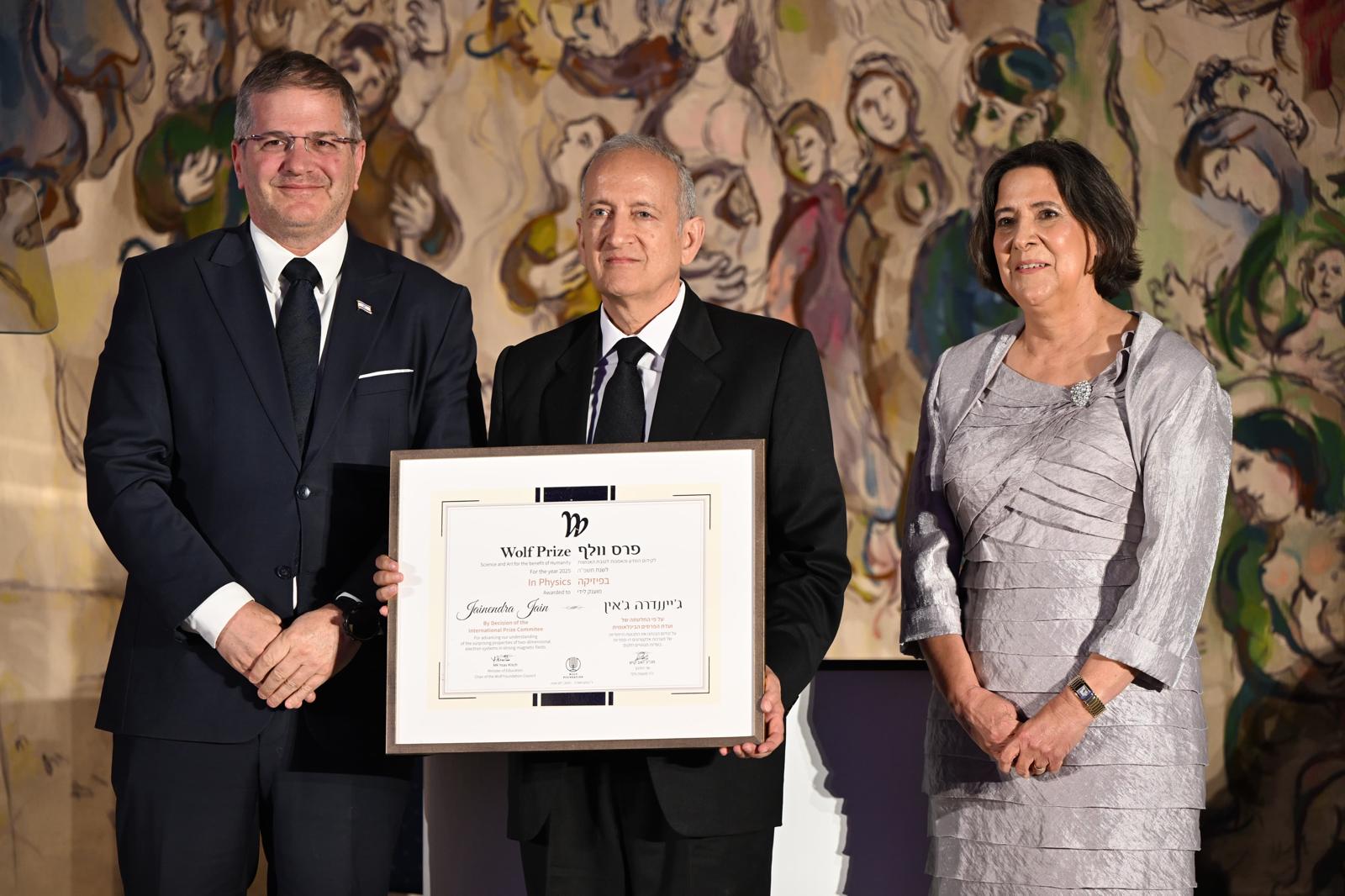
Professor Jainendra K. Jain, one of the world’s leading theoretical physicists and the founding director of the newly established Lodha Theoretical Physics Institute (LTPI), has been awarded the prestigious Wolf Prize in Physics. The award was presented by Israeli President Isaac Herzog during a ceremony at the Knesset in Jerusalem on June 18.
Jain, who grew up in the small Rajasthan town of Sambhar near the Thar Desert, is the Evan Pugh University Professor and Eberly Family Chair in Physics at Pennsylvania State University. He is the first person of Indian origin to receive the Wolf Prize in Physics, one of the world’s most respected honors in the field.
Established in 1978 by the Wolf Foundation, the Wolf Prize recognizes groundbreaking contributions to science and the arts. The award is often considered a precursor to the Nobel Prize, with 27 previous physics laureates later going on to receive Nobel honors.
Speaking after receiving the award, Jain reflected on his journey from rural India to the highest levels of scientific achievement.
“I am deeply honoured by this recognition. Physics has given me far more than I could ever have imagined when I began this journey as a young boy growing up in rural Rajasthan. I feel immensely fortunate and am grateful to my teachers, students, collaborators, family, and friends, and to the many scientists whose work laid the foundation for my own. The opportunity to spend a lifetime trying to understand nature is a privilege beyond measure.”
Jain was recognized for his discovery of “composite fermions,” a concept that transformed scientists’ understanding of the fractional quantum Hall effect, one of the most puzzling phenomena in condensed matter physics.
The breakthrough came in 1989 while Jain was a postdoctoral researcher at Yale University. Physicists had been struggling to explain why electrons confined to ultra-thin semiconductor layers and subjected to powerful magnetic fields exhibited electrical conductivity in precise fractional values.
According to Jain, the key insight arrived unexpectedly while he was doodling during a television commercial break. He realized that the unusual experimental observations could be explained if electrons combined with tiny quantum vortices to form entirely new particles. He named these particles composite fermions.
His theory, published in the journal “Physical Review Letters” in 1989, provided an elegant explanation for a problem that had long baffled researchers. The fractional patterns predicted by the theory are now widely known as the “Jain sequences” or “Jain states,” and composite fermions have become a cornerstone of modern quantum physics.
More than three decades later, Jain’s work continues to influence cutting-edge research. Scientists have discovered that composite fermions can create exotic quantum states with unique topological properties. These states are being explored as potential building blocks for future quantum computers because they may help protect quantum information from certain types of errors.
Jain has authored or co-authored more than 250 scientific papers and wrote the influential book *Composite Fermions*, published by Cambridge University Press in 2007.
His many honors include the Oliver E. Buckley Prize, the Distinguished Alumnus Award from the Indian Institute of Technology Kanpur, and election to the United States National Academy of Sciences, the American Academy of Arts and Sciences, and the Indian National Science Academy.
Jain’s path to scientific recognition was far from easy. As a child in Rajasthan, he developed a fascination with physics after reading about Indian physicist Satyendra Nath Bose and his collaboration with Albert Einstein in a children’s magazine.
At age 12, tragedy struck when a tram collided with his family’s car during a visit to Kolkata. His mother died from her injuries, while Jain suffered severe injuries that resulted in a lifelong disability.
Returning to Sambhar on crutches, his dream of pursuing higher education seemed uncertain. However, the low-cost Jaipur Foot prosthetic, developed by Dr. P.K. Sethi and craftsman Ram Chandra Sharma, helped him regain mobility and continue his education.
He later earned a bachelor’s degree from Maharaja College, a master’s degree from IIT Kanpur, and a Ph.D. from Stony Brook University. In 1981, at age 21, he boarded his first flight to the United States to begin the next chapter of his academic journey.
Today, Jain is helping shape the future of scientific research in India through the Lodha Theoretical Physics Institute in Mumbai, which aims to become the country’s first fully privately funded center dedicated to fundamental research in theoretical physics.
Looking ahead, Jain expressed hope that the institute will nurture the next generation of researchers.
“I hope LTPI will help create an environment where young scientists can pursue ambitious ideas, collaborate with outstanding researchers from around the world, and engage with the deepest questions in physics.”
Jain’s Wolf Prize recognition marks not only a personal achievement but also a milestone for scientists of Indian origin on the global stage. It celebrates a career that has reshaped our understanding of the quantum world and inspired generations of physicists.