



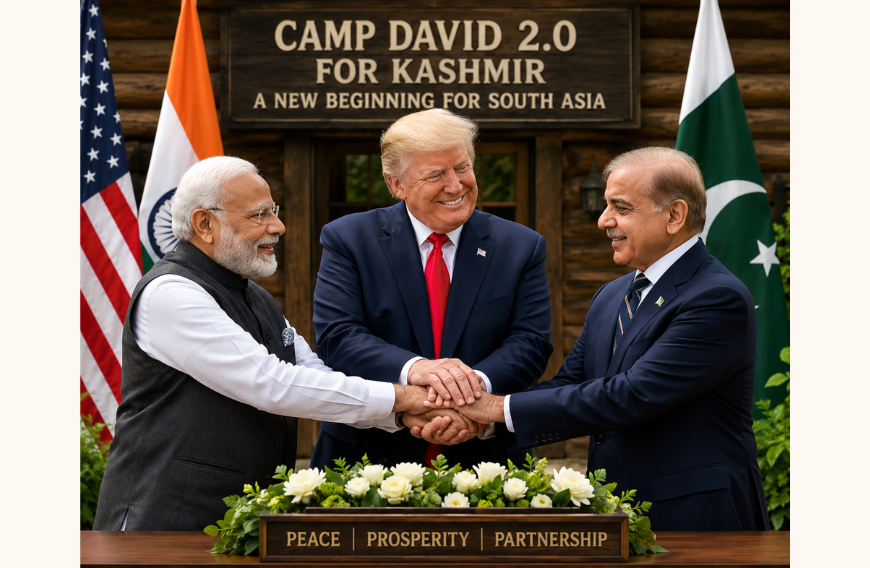
An unexpected opportunity
For nearly eight decades, India and Pakistan have lived under the shadow of Partition. Wars have been fought, thousands have died, terrorist attacks have scarred both nations, and generations have grown up believing that hostility between India and Pakistan is permanent, natural, and unavoidable. Perhaps it is time to challenge that assumption.
Recent reports that President Donald Trump reassured Prime Minister Narendra Modi that America would stand with India in times of crisis, despite the absence of a formal defense treaty, reveal something remarkable. Few American presidents have enjoyed this level of trust in India. Most Indians heard those words as a message of friendship. I heard something more. I heard a message that India should not have to spend the next eighty years trapped inside the assumptions of the previous eighty years. I heard a message that India should not have to live indefinitely under the shadow of cross-border terrorism, military standoffs, and regional instability while trying to become a developed nation. I heard a message that if America is prepared to stand with India strategically, perhaps it is also prepared to help create conditions under which India no longer needs to fear Pakistan in the way it has since 1947.
Many Indians see Trump’s simultaneous engagement with Pakistan as a contradiction. I see an opportunity. The question before South Asia today is not whether India and Pakistan can continue managing their differences. They have done that, imperfectly, for almost eighty years. The real question is whether they are finally ready to resolve them.
Why better U.S.-Pakistan relations may help India
For decades, Indian strategic thinking has often viewed every improvement in US-Pakistan relations as a setback for India. That perspective may have made sense in another era. Today, India is one of the world’s largest economies, a major technological power, an increasingly influential diplomatic actor, and a country whose future trajectory is brighter than at any point in its modern history. A confident India should not fear a stable Pakistan.
Many Indians instinctively oppose any warming of relations between Washington and Islamabad. Yet the alternative is rarely discussed. What happens if America completely abandons Pakistan?
Pakistan does not disappear. It does not suddenly become weaker and more cooperative. It simply becomes more dependent on China. From India’s perspective, a Pakistan that maintains meaningful relations with both Washington and Beijing may actually be preferable to a Pakistan whose future is tied exclusively to Beijing. Reducing China’s monopoly over Pakistan’s strategic choices may serve Indian interests better than reinforcing it.
Read more columns by Vinson Xavier Palathingal
A Pakistan with options behaves differently from a Pakistan with no options. The objective should not be to weaken Pakistan forever. The objective should be to reduce incentives for conflict and increase incentives for stability. Strong nations do not seek weak and unstable neighbors. They seek predictable ones.
The question nobody wants to ask
Perhaps the most damaging assumption in Indian strategic thinking is that Pakistan must remain a permanent enemy. Why? Nations are not born enemies. They become enemies because of historical circumstances, political choices, and unresolved disputes. France and Germany fought devastating wars for centuries. Britain and America fought a war of independence. The United States and Vietnam fought a brutal war that left deep scars on both societies. Today, they maintain productive relationships. Why should India and Pakistan be uniquely condemned to perpetual hostility?
The burden of proof should lie with those who argue that peace is impossible, not with those who argue that it is desirable. Unfortunately, both countries have invested so heavily in the politics of hostility that many people now struggle to imagine an alternative. The conflict has become part of the political landscape. That does not mean it serves the interests of either nation.
The cost of eight decades of hostility
The greatest tragedy of the India-Pakistan conflict may not be the territory contested or the wars fought. It may be the prosperity that was never created. Imagine if even half the energy spent managing hostility since 1947 had been invested in creating jobs, attracting investment, improving infrastructure, reducing regulations, and building world-class cities. Imagine if South Asia had focused more on competing with the world’s most successful economies and less on competing with itself.
Millions of Indians left the country because opportunities were better elsewhere. Generations stood in line for visas to America, Canada, Britain, Australia, and the Gulf. India became extraordinarily successful at exporting talent. We produced engineers for Silicon Valley, doctors for American hospitals, entrepreneurs for Western markets, and professionals for economies around the world. The term NRI itself is a reminder of opportunities that were not created at home.
Imagine how different South Asia might look if even a fraction of the effort spent managing hostility had been directed toward creating opportunity within the region. Imagine a South Asia where goods moved freely across borders, where energy networks connected nations, where transportation corridors linked markets, and where businesses viewed the region as an integrated economic opportunity rather than a collection of suspicious neighbors. The lost potential is staggering.
The greatest economic reform available to India today may not be hidden in a government budget. It may lie along the Line of Control itself.
The terrorism question
Many readers will immediately object and ask how anyone can discuss peace before discussing terrorism. That is exactly the point. No Camp David 2.0 for Kashmir can succeed unless terrorism is addressed directly, credibly, and permanently. Peace with Pakistan is not about ignoring terrorism. It is not about pretending the problem never existed. It is not about asking Indians to forget the victims of terrorist attacks. It is about creating a framework where terrorism becomes incompatible with Pakistan’s long-term interests.
One possible interpretation of Trump’s reassurance to Modi is this: India should not have to live indefinitely under the threat of terrorism while pursuing peace and prosperity. Any serious normalization effort would have to make the permanent abandonment of support for terrorism a central condition. If Pakistan seeks deeper economic cooperation with the United States, broader international legitimacy, greater foreign investment, and long-term regional stability, then powerful incentives can be aligned in favor of peace.
Such an arrangement would not merely protect India. It would also help Pakistan move away from policies that have often damaged Pakistan itself. The objective is not to trust blindly. The objective is to structure incentives intelligently. Peace becomes sustainable when maintaining it becomes more beneficial than violating it. That is true in business, politics, and international relations.
India and Pakistan are not natural enemies
Read more columns by Vinson Xavier Palathingal
One of the most overlooked facts about South Asia is how much India and Pakistan still share. Languages overlap. Food is familiar. Music crosses borders effortlessly. Family structures remain remarkably similar. Social values often mirror one another. Millions of families still have roots on both sides of the border.
The tragedy is not that India and Pakistan became separate countries. Nations separate all the time. The tragedy is that they became permanent enemies. This reality becomes even more striking when compared with some of the assumptions that have guided Indian foreign policy in the past. The slogan “Hindi Chini Bhai Bhai” proved to be one of the great geopolitical illusions of modern history.
India and China share far fewer civilizational and cultural similarities than India and Pakistan. Yet Indians were encouraged to view friendship with China as natural and hostility with Pakistan as inevitable.
Perhaps those assumptions deserve reexamination. Perhaps it is time to stop asking how India can manage hostility with Pakistan and start asking whether hostility itself continues to serve India’s interests. That question, more than any other, should define the next phase of Indian strategic thinking.
The bilateral doctrine
Another assumption deserves scrutiny. For decades, Indian governments have repeated the phrase “Kashmir is a bilateral issue” so often that many Indians now treat it as a law of nature rather than a policy choice. It is not a law of nature. It is not a constitutional requirement. It is not a commandment handed down from heaven. It was a policy adopted in a particular historical context to serve a particular purpose.
Policies exist to serve national interests. National interests do not exist to serve policies. If a future opportunity emerges where a trusted third party can help India and Pakistan reach a settlement that advances India’s security, prosperity, and global standing, why should India reject that opportunity automatically simply because of a diplomatic formula created decades ago for a different era?
No serious country treats its diplomatic doctrines as religious scripture. Successful nations constantly reevaluate policies in light of changing realities. India should do the same. The question is not whether Kashmir has historically been treated as a bilateral issue. The question is whether a strictly bilateral approach has brought South Asia any closer to a durable settlement after nearly eight decades. That is a legitimate question, and it deserves a legitimate answer.
Kashmir and the limits of perfect solutions
No discussion of India-Pakistan relations can avoid Kashmir. The issue is emotional, political, historical, strategic, and deeply intertwined with national identity in both countries. Yet realism requires acknowledging certain facts.
The Line of Control has functioned as the practical dividing line for generations. Neither India nor Pakistan appears capable of imposing a comprehensive solution on the other. Both countries possess nuclear weapons. Both understand the limits of military solutions. Both understand that total victory remains elusive.
If neither side is realistically going to obtain one hundred percent of what it wants after nearly eighty years, what exactly is the alternative strategy for the next eighty years? More military spending? More hostility? More diplomatic deadlock? More lost opportunities? At some point, patriotism requires asking whether preserving a dispute is helping the nation more than resolving it.
The purpose of diplomacy is not to produce perfect outcomes. It is to produce workable outcomes that improve the lives of future generations. History is filled with examples of leaders accepting practical realities in order to secure larger benefits for their people. The most successful statesmen are rarely those who insist on perfection. They are the ones who recognize when the pursuit of perfection has become the enemy of progress.
From Line of Control to Line of Peace
A serious conversation should begin around an idea that many privately acknowledge but few publicly advocate: transforming the existing Line of Control into a mutually recognized international boundary and a permanent Line of Peace.
India would retain the territories it administers. Pakistan would retain the territories it administers. Neither side would achieve every objective, but neither side would suffer a humiliating defeat either. Both sides would gain certainty. Most importantly, both sides would gain the freedom to focus on the future rather than relitigating the past.
Many people will object to this proposal immediately. That reaction is understandable. But a simple question remains. If not this, then what? What is the realistic alternative? What is the path by which either side achieves complete victory after eighty years of stalemate?
No serious answer exists.
The practical reality is that the Line of Control has already functioned as a de facto border for generations. The proposal merely recognizes reality and transforms it into a foundation for peace. The purpose of statesmanship is not to maximize symbolic victories. It is to improve the lives of citizens.
The greatest economic reform available to India
India’s next great economic leap may not come from a budget speech, a tax reform, or a new industrial policy. It may come from peace.
Trade corridors could expand dramatically. Transportation networks could reconnect. Tourism could flourish. Energy cooperation could become possible. Regional supply chains could emerge. Cross-border investment could increase. The peace dividend would be enormous.
India has spent decades debating labor laws, tax rates, industrial policy, privatization, and infrastructure. All of those matters are important. But none of them carry the transformational potential of removing one of the largest geopolitical obstacles hanging over the region.
The greatest economic reform available to India today may not be hidden in a government document. It may lie along the Line of Control itself. Peace would not merely reduce tensions. It would create wealth. Unlike many government programs, it would do so without requiring massive public expenditure. Entrepreneurs would find opportunities. Investors would deploy capital. Markets would expand. That is how prosperity is created.
Why Modi is uniquely positioned
History often shows that only strong leaders possess the credibility necessary to make bold peace initiatives. Richard Nixon could open relations with China because nobody questioned his anti-communist credentials. Menachem Begin could make peace with Egypt because nobody doubted his commitment to Israel’s security. Ronald Reagan could negotiate with Mikhail Gorbachev because nobody questioned his determination to defeat Soviet communism.
Similarly, if a lasting settlement between India and Pakistan is ever achieved, it may be more likely under Narendra Modi than under leaders whose patriotic credentials are constantly challenged. A weak leader would be accused of surrender. A strong leader can negotiate from confidence.
That is one of the great paradoxes of history. The leaders best positioned to make peace are often those least suspected of weakness. Modi has political capital that few Indian leaders have enjoyed. If he concludes that a settlement serves India’s interests, he possesses more room to pursue it than any Indian leader in recent memory.
History remembers leaders for many reasons. Some are remembered for winning elections. Some are remembered for winning wars. The rarest are remembered for solving problems that previous generations considered unsolvable.
Peace is a nationalist idea
Many Indians instinctively associate peace initiatives with weakness. That is a mistake.
Peace with Pakistan is not a Congress idea. It is not a left-wing idea. It is not a secularist idea. It is not even a Pakistani idea. It is an Indian idea if it makes India richer, stronger, safer, and more influential.
Nationalism should not be measured by the ability to preserve old disputes indefinitely. Nationalism should be measured by the ability to advance national interests. If peace serves India’s interests better than hostility, then pursuing peace becomes an act of confidence rather than surrender.
A nation does not demonstrate strength merely by sustaining conflict. It demonstrates strength by creating prosperity, stability, and opportunity for its citizens. That is the standard by which all policies should be judged.
A Camp David 2.0 for South Asia
Camp David succeeded not because Egypt and Israel suddenly became friends. It succeeded because leaders concluded that stability would benefit their peoples more than permanent confrontation. The agreement did not eliminate all disagreements. It did not erase history. It did not require the two nations to love one another. It simply created a framework under which peace became more beneficial than conflict.
Read more columns by Vinson Xavier Palathingal
South Asia does not need to copy Camp David. It needs to learn from it. The objective is not friendship. The objective is predictability. The objective is stability. The objective is prosperity.
Trump’s role would not be to dictate terms. No outsider can impose peace on India and Pakistan. The decision must belong entirely to the two nations. His role would be to facilitate dialogue, create political space, and help leaders explore possibilities that may otherwise remain politically difficult.
The Abraham Accords demonstrated that apparently permanent conflicts can become manageable when leaders decide that the future matters more than inherited grievances. South Asia deserves the same opportunity. Trump’s relationship with India, his willingness to engage Pakistan, India’s growing strength, Pakistan’s search for economic stability, and the broader desire for regional peace have created a rare opening. Opportunities like this do not appear often. History rarely offers nations the chance to rewrite long-standing assumptions. When such opportunities appear, wise leaders at least examine them.
A historic choice
Peace with Pakistan is not about loving Pakistan. It is not about trusting Pakistan. It is not about forgetting terrorism. It is not about surrendering Indian interests.
It is about asking a simple question. Is perpetual hostility helping India become richer, stronger, safer, and more influential, or is it merely preserving a status quo that benefits nobody?
The generation that inherited 1947 had little choice. Our generation does. We can spend the next eighty years arguing about the mistakes of our grandparents. Or we can spend the next eighty years building opportunities for our grandchildren.
The question is not whether peace is possible. The question is whether India can afford another eighty years without it.
And if history ever records a Camp David 2.0 for Kashmir, it may remember it not as the moment India compromised, but as the moment India was confident enough to lead.
The greatest economic reform available to India today may not be in New Delhi. It may lie on the Line of Control.
The greatest legacy available to South Asia’s leaders may not be another victory claimed in a speech or another diplomatic point scored in an international forum. It may be the creation of a future in which India and Pakistan finally stop living in 1947.
That would be a legacy worthy of history.
1 Comment
STOP THE CHARADE. DISPLAY INTEGRITY
The author calls overlapping language, food, and music “shared traits,” like that’s supposed to be the basis for reconciliation. It’s backwards. None of this evolved in parallel. A single civilizational state was split in two in 1947, and what’s being called “shared” is actually just what one side took with it when it broke off.
Start with language, since that’s the one people get most wrong. Punjabi, Sindhi, Urdu, all of it is rooted in the Indic family, derived from Sanskrit and the Prakrits. Urdu specifically grew out of military camps in Delhi, UP, and the Deccan. None of these languages formed on the other side of a border that didn’t exist until 1947. There was no separate linguistic development happening in some place called Pakistan, because Pakistan wasn’t there yet. The language came first, the country came centuries later, and only one of those two things is actually old.
Food and farming follow the same pattern. The spices and cooking traditions of Punjab and the Indus Valley go back thousands of years, long before anyone drew that border. So does the agriculture.
And the classical arts, the ragas and rhythms people love to point to as proof the two countries aren’t so different, those were shaped over centuries in courts and temples that existed in undivided India, full stop. Calling any of that a “similarity between two neighbors” isn’t generous, it’s just wrong. It treats something one side inherited as something both sides grew. They didn’t. One side built it. The other side got handed a piece of it in 1947 and has been arguing it’s original ever since.