



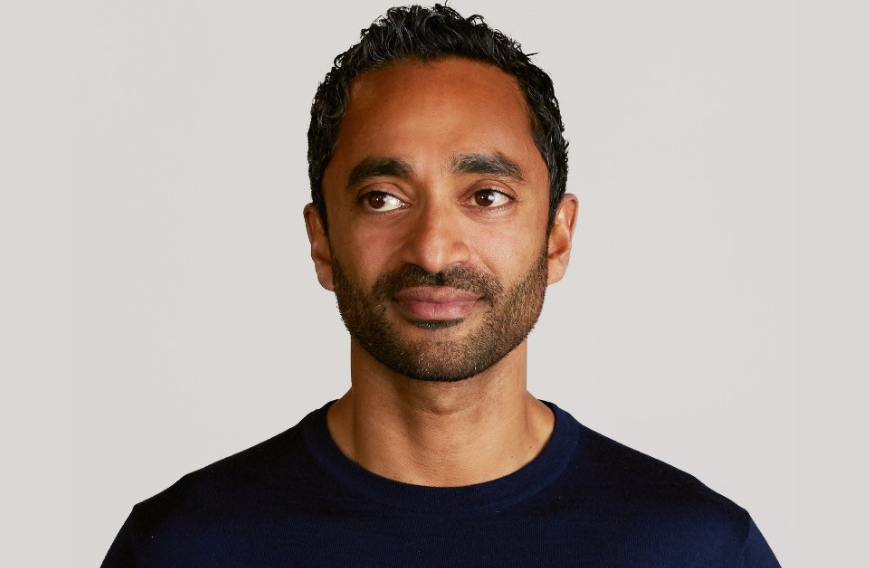
Venture capitalist Chamath Palihapitiya says the United States should continue attracting the world’s brightest talent, but argues the H-1B visa system needs significant reforms after years of abuse that have undermined public trust and made it harder for exceptional candidates to immigrate.
Speaking to Axios’ Dan Primack on “The Axios Show,” the Sri Lankan-born entrepreneur reflected on his own path to Silicon Valley and shared his views on legal immigration, skilled visas and America’s ability to remain competitive in the global race for talent.
Setting up the discussion, Primack contrasted Silicon Valley’s past with its present while pointing to immigration and research funding policies under the Trump administration.
“We started this conversation talking about Silicon Valley, then versus now you come into Silicon Valley, but obviously talked a bunch about the White House. I’m curious, you obviously you came here via Canada. One of the things of this White House, kind of one of the marks has been a combination of cuts to basic R&D funding and also cuts to legal immigration, illegal immigration also, but also cuts to legal immigration.”
Primack then questioned whether limiting legal immigration could ultimately hurt the country’s innovation ecosystem.
“Do you feel we are handicapping ourselves for that? When you think of Silicon Valley as this place where all the greatest minds come?”
READ: USCIS continues issuing RFEs over controversial $100K H-1B fee as court fight continues (June 23, 2026)
Palihapitiya responded that while immigration remains essential, the conversation cannot overlook what he described as widespread misuse of long-standing immigration programs.
“I think that there’s been a lot of abuse in some of these foundational programs and I think if you’re going to set them on its right course, we have to be honest about the abuses.”
When Primack replied, “But if you stipulate the abuses, but let’s stipulate them,” Palihapitiya pushed back, saying the issue deserves a deeper explanation.
“It’s not as easy as saying stipulate. Let me explain to you what’s happening. I came on an H1B visa. Elon came on H1B visa, okay. At the time, you got your H1B visa right away because, and then there was many that were available. This is in the early 2000s. Why? Nobody was applying for these things. And who did you have.”
Looking back at that period, Palihapitiya said the visa program attracted scientists and engineers whose contributions transformed the technology industry.
“Forget about me, I’m irrelevant, but had guys like him that were, you had these incredible scientists, Urs Hölzle that ends up at Google. These are giants, okay.”
He contrasted that with the current H-1B system, arguing that mass applications from a relatively small number of employers have fundamentally changed the odds for highly qualified applicants.
“What’s happening now, for the last 15 or 20 years, what’s been happening? You have farms of applications from a handful of companies, 20,000 slots open up, 800,000 applications flooded. So you can’t stipulate abuse because what that means is the odds have become so overwhelming that the next Elon or Urs Hölzle was already being shut out of America.”
Palihapitiya said the current process is so competitive that he doubts he would have qualified under today’s rules.
READ: H-1B saw 98% approval, yet employers see a tougher future ahead (June 22, 2026)
“I sure as shit would never have gotten an H-1B in the way that the program works today.”
Despite those criticisms, he made clear that he supports immigration and believes the United States should continue recruiting top global talent.
“So I think it’s fair to say two things. We can stipulate the following two things. Immigration is really good. We should be attracting the best of the best of the best, and they should want to be here.”
However, he argued that reforms are needed to ensure the system rewards merit rather than volume.
“But we should also make it fair so that the best of the best of the best who have been getting Heismaned for the last five years because a handful of companies in certain countries have abused this system.”
According to Palihapitiya, restoring confidence in the immigration system is just as important as attracting skilled workers.
“You need to stop and tourniquet the bleeding so that you can reestablish trust with the American population at large.”
He also acknowledged that some Americans wrongly associate immigrants like him with the problems they see in the current system.
“There’s a lot of people that look at me and say, that guy’s part of the problem. You can see it in the comments on X. And I’m like, wow, me?”
Primack then shifted the discussion to politics, asking whether the tone of the immigration debate has been influenced by the Trump administration.
“But do you think that’s partially because of the rhetoric that’s come from DC come from this administration?”
Palihapitiya disagreed, saying public frustration has been building for years because many Americans believe they have witnessed abuse of the visa system firsthand.
READ: 100,000 fake degrees raise H-1B visa concerns (June 7, 2026)
“No, I think that that’s been building up for decades because they see the abuses on the ground, they see the people that show up and they’re like, they’re like, wait a minute, this people is not smarter than me. All I can see is wage suppression.”
He said policymakers have an obligation to acknowledge those concerns instead of dismissing them.
“We have a responsibility for the people that are here and paying into the system, to answer their questions honestly.”
Palihapitiya concluded by arguing that meaningful reform requires openly recognizing past failures.
“You can’t stipulate and move on to everything. You can’t. Sometimes you gotta say, you know what, that was gross abuse.”
Palihapitiya is a Canadian-American venture capitalist based in the San Francisco Bay Area and the founder and chief executive of Social Capital, an investment firm focused on backing entrepreneurs and companies working in areas including healthcare, energy transition, space and consumer technology. Before launching Social Capital, he was an early member of Facebook’s senior executive team and previously held roles at Mayfield Fund, AOL and Winamp. He earned a bachelor’s degree in electrical engineering from the University of Waterloo.
1 Comment
The big problem with H-1b is that the employer sponsors the OPT, H-1b, and Green Card process. This really limits economic growth capability of foreign workers. Because the worker is never completely free, until this long process is finished. And it takes decades for that to happen for some.
It hasn’t changed in decades, if you read the Email exchanges in the Silicon Valley no Poaching Scandal, you would probably reach the conclusion the Broligarch’s and their managers like it that way.
To fix this, we need to:
– End the OPT tax discount or give the discount to all students
– Before a company can use H-1b, require a self auditing local competition for the job
– Written feedback to all who are not hired.
– If discrimination is feared, then presumed standing for discovery (at zero plaintiff cost). After discovery, normal rules where the plaintiff could get hit with court costs should they lose their case
– After this, then H-1b can be used to fill the open position.
– The H-1b worker is in, he can’t be kicked out. If they lose their job they can stay with 2 yrs of some kind of voluntary service, including military (which should speed their citizenship).
– 2x/4yrs or in just 2 yrs with volunteer service, Green Card, no country limits
This plan would give control over destiny back to the worker.
The greatest force in Silicon Valley has been the ability of a worker to learn a job/skill/trade, and then go and start/join the competition. The Broligarchs don’t like competition, hence H-1b never changes. It stifles the amount of innovation and job creation we could have otherwise had.
All the big tech companies were started by free workers, not by H-1b. Elon is the one exception, but he didn’t start he acquired. Meta, Google, Microsoft, Apple – All started by people early in their career. If we can get H-1bs to a Green Card faster we have a better chance at starting equally big companies.
But more importantly, we can eliminate a lot of the resentment felt by locals and foreign workers about the entire goofed up visa to GC to citizenship system that is threatening everyone and limits economic potential.