



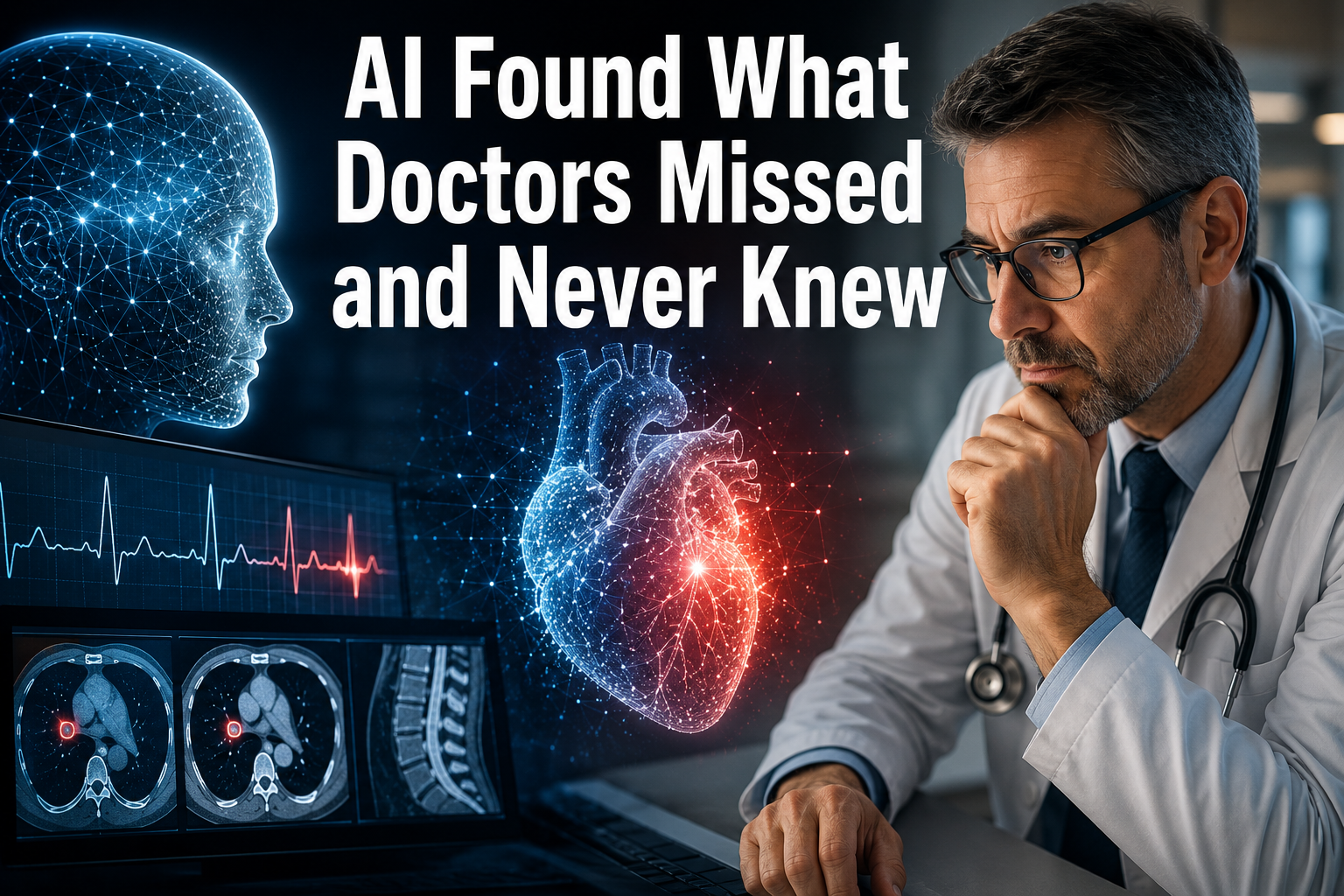
Medicine has always been built on a simple premise: if we gather enough knowledge, train physicians well enough, and study patients carefully, we will eventually uncover every important clue the human body has to offer. For generations, that belief has driven every medical breakthrough, from the discovery of new diseases to the development of lifesaving treatments.
Artificial intelligence is forcing us to reconsider that assumption.
Across cardiology, radiology, pathology, and ophthalmology, AI is uncovering biological patterns that have been hiding in plain sight for decades. These signals existed in electrocardiograms, retinal photographs, pathology slides, and medical images that physicians had already examined millions of times. They were not missed because doctors lacked expertise. They were missed because some patterns are simply too subtle and mathematically complex for the human brain to recognize.
This is not another story about computers reading X rays faster or completing medical paperwork more efficiently. It is the beginning of something far more profound. Artificial intelligence is becoming a scientific discovery engine, revealing entirely new biomarkers, identifying hidden predictors of disease, and expanding the boundaries of what medicine is capable of knowing.
That raises an extraordinary question. If the next generation of medical discoveries increasingly comes from machines finding relationships that humans cannot perceive, how should the role of the physician evolve?
The answer is already beginning to emerge.
READ: Sreedhar Potarazu | Medicare’s new GLP-1 Bridge Program is a good start, but not a long term solution (June 30, 2026)
One of the most striking examples comes from cardiology. Researchers trained deep learning models using hundreds of thousands of electrocardiograms linked to long term patient outcomes. The system identified previously unknown electrical patterns hidden within routine ECGs that predicted sudden cardiac death in patients who would not have been identified using current clinical guidelines. Cardiologists have interpreted millions of ECGs over several decades. The information was always present in the electrical signals of the heart, but the mathematical relationships remained invisible to generations of highly trained physicians. AI did not simply read the ECG more efficiently. It uncovered an entirely new biomarker.
Ophthalmology is witnessing a similar transformation. Researchers have shown that artificial intelligence can analyze a routine retinal photograph and predict conditions far beyond eye disease, including cardiovascular disease, chronic kidney disease, Parkinson’s disease, Alzheimer’s disease, and other systemic illnesses. Ophthalmologists have long recognized that the retina reflects overall health, but AI is identifying microscopic vascular patterns and subtle structural changes that no physician can reliably detect. A simple eye examination may soon become one of medicine’s most powerful screening tools.
Radiology offers another compelling example. AI systems have demonstrated the ability to detect tiny lung cancers, subtle bone metastases, and early breast cancers that were overlooked during routine interpretation. Rather than replacing radiologists, these systems consistently improve physician performance when used together. The technology recognizes imaging features that are often too faint or too complex for even experienced specialists to appreciate consistently.
Perhaps the most surprising advances are occurring in pathology. Artificial intelligence models trained on digital pathology slides are beginning to predict genetic mutations, treatment response, and long term survival directly from tissue samples. Traditionally, physicians relied on additional molecular testing to obtain this information. AI is discovering hidden biological signatures embedded within ordinary pathology slides that pathologists themselves cannot see.
These examples share a common theme. The data always existed. The ECGs had already been recorded. The retinal photographs had already been taken. The CT scans had already been interpreted. The pathology slides had already been reviewed. Artificial intelligence did not create new information. It revealed patterns hidden within existing information that human perception could not recognize.
Some observers view these advances as evidence that artificial intelligence will eventually replace physicians. I believe they point toward a very different future.
READ: Sreedhar Potarazu | How do our kids prepare for the age of AI? (July 1, 2026)
Artificial intelligence and physicians possess different forms of intelligence that complement one another.
AI excels at quantitative intelligence. It can process enormous datasets, discover previously unknown biomarkers, identify subtle imaging abnormalities, recognize complex statistical relationships, and estimate risk with extraordinary precision. These are computational problems, and machines are becoming increasingly capable of solving them.
Patients, however, do not experience illness as probabilities, algorithms, or imaging findings. They experience illness through fear, uncertainty, family responsibilities, financial concerns, cultural beliefs, and deeply personal definitions of hope and quality of life.
This distinction highlights one of the most important differences in medicine. Disease is measurable. Illness is experienced.
Disease exists in laboratory values, retinal photographs, ECG waveforms, pathology slides, imaging studies, and physiological measurements. Illness exists in conversations between physicians and families, in the anxiety surrounding a diagnosis, in the difficult decisions about treatment, and in the personal values that shape every medical choice.
Artificial intelligence may identify that a patient carries an exceptionally high risk of sudden cardiac death or detect a cancer invisible to the human eye. It cannot determine whether that patient should undergo an invasive procedure, how much risk they are willing to accept, or what tradeoffs matter most in the context of their own life. Those decisions require empathy, ethical judgment, communication, and trust.
Ironically, the better AI becomes at discovering disease, the more important the physician becomes.
As machines assume responsibility for identifying hidden biological signals, physicians will spend less time searching for disease and more time helping patients understand what those discoveries mean. AI will contribute extraordinary quantitative intelligence. Physicians will contribute qualitative intelligence through empathy, contextual understanding, ethical reasoning, and shared decision making.
The emergence of AI as a discovery engine also raises an uncomfortable question for medical education. If machines are becoming better at discovering hidden biological signals than physicians, are we preparing doctors for the medicine of yesterday rather than the medicine of tomorrow?
Future physicians will certainly need anatomy, physiology, pathology, and clinical reasoning. But they will also need fluency in artificial intelligence. They must understand how these models are developed, where they perform well, where they fail, how bias can influence results, and how to explain AI assisted recommendations in language patients can understand and trust.
Perhaps that is the most important lesson emerging from these discoveries. Artificial intelligence is not transforming medicine because it has learned to think like physicians. It is transforming medicine because it can perceive aspects of human biology that physicians cannot.
The future of healthcare will therefore depend not on choosing between doctors and artificial intelligence, but on combining the quantitative intelligence of machines with the qualitative intelligence of physicians. One expands the boundaries of medical discovery. The other gives those discoveries meaning for the individual sitting in the examination room.
If we succeed, the future of medicine will not belong to doctors or to machines alone. It will belong to a partnership that makes healthcare more accurate, more personalized, and ultimately more human than either could achieve independently.