



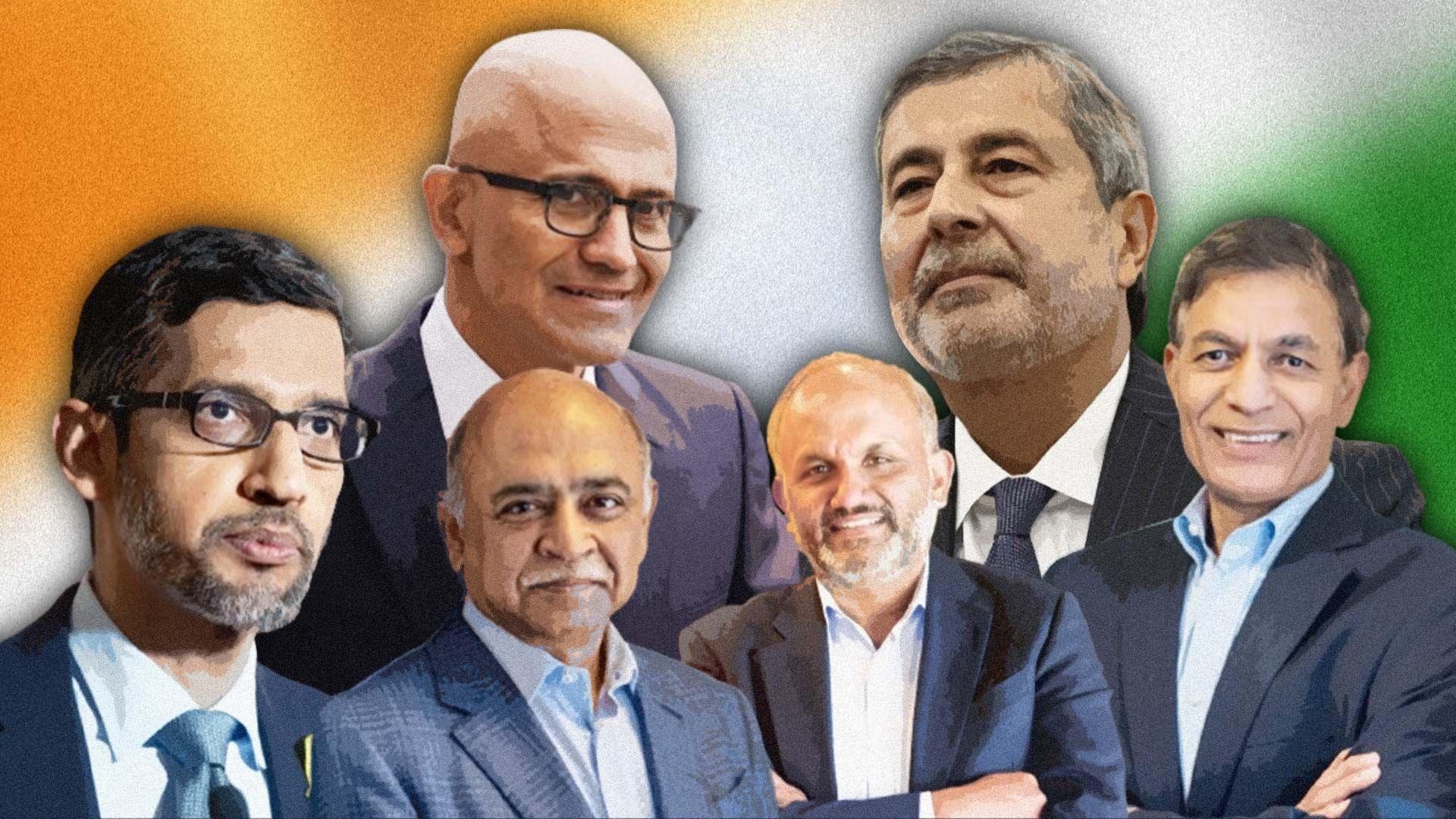
Indian American CEOs continue to shape global business in 2026, holding some of the most influential executive positions across technology, pharmaceuticals, manufacturing, cybersecurity and consumer goods. Their reach now extends far beyond Silicon Valley, touching industries central to artificial intelligence, semiconductors, cloud computing, healthcare and global supply chains.
This year has brought fresh evidence of that trend. In January, Shailesh Jejurikar became the first Indian American to lead Procter & Gamble in the company’s 187-year history, according to a company statement. Around the same time, Bhavesh “Bob” Patel was named incoming CEO of Sempra Infrastructure, an energy company preparing for a major ownership transition led by KKR, according to the company.
The pattern spans far beyond any single sector. Indian American executives now run companies central to cloud computing, enterprise software, cybersecurity, networking hardware, life sciences and media, giving them outsized influence over how American business adapts to AI and automation.
Sundar Pichai and Alphabet’s AI push
Sundar Pichai has led Google since 2015 and its parent company Alphabet since 2019. Under his leadership, Alphabet has accelerated investments in artificial intelligence, cloud computing and data center infrastructure.
Alphabet reported strong first-quarter 2026 results, with Google Cloud revenue rising 63% year over year to about $20 billion, according to the company’s earnings release and Reuters. The company said demand for AI services and cloud infrastructure drove the fastest growth in the cloud unit since Alphabet began separately reporting the business. Alphabet has also increased its planned AI-related capital spending as competition intensifies among major technology companies.
Pichai’s journey from Chennai to the top of one of the world’s most valuable companies remains one of the most prominent examples of Indian American leadership in corporate America. He earned his engineering degree from the Indian Institute of Technology Kharagpur before studying at Stanford University and the Wharton School.
READ: Indian American AI startup Noon acquires Bengaluru FinalRun (June 30, 2026)
Satya Nadella and Microsoft’s cloud empire
Satya Nadella has served as chairman and CEO of Microsoft since 2014, overseeing the company’s transformation into a cloud and AI powerhouse.
Microsoft said its AI business surpassed an annual revenue run rate of $37 billion in fiscal 2026, up 123% year over year. The company has continued investing heavily in AI infrastructure, cloud services and enterprise AI tools while expanding its global data center footprint. Reuters also reported that Microsoft plans record levels of capital spending to support future AI demand.
Nadella, who was born in Hyderabad and studied engineering in India before moving to the United States, is widely credited with revitalizing Microsoft’s growth and positioning Azure as a major competitor in cloud computing.
Arvind Krishna and IBM’s enterprise AI strategy
Arvind Krishna has led IBM since 2020, focusing the century-old technology company on hybrid cloud and enterprise AI.
IBM has deepened its partnership with Red Hat and introduced new services such as Red Hat AI Inference and Red Hat OpenShift Virtualization Service on IBM Cloud. The company said these offerings are designed to help enterprises accelerate AI adoption while maintaining security and flexibility across hybrid cloud environments. IBM and Red Hat have also pledged significant investments in open-source AI and hybrid cloud technologies.
Krishna, who grew up in Andhra Pradesh and studied at the Indian Institute of Technology Kanpur, has become one of the most influential voices advocating for enterprise AI that can operate across multiple cloud environments.
Nikesh Arora and the cybersecurity boom
Nikesh Arora has served as chairman and CEO of Palo Alto Networks since 2018.
Arora has transformed Palo Alto Networks into one of the world’s largest cybersecurity companies through an acquisition-driven strategy that integrates network security, cloud security and AI-powered threat detection into a unified platform. His leadership comes at a time when cyber threats are becoming more sophisticated and AI is increasingly being used both by defenders and attackers.
Before joining Palo Alto Networks, Arora held senior leadership roles at Google and SoftBank, making him one of the most experienced Indian American executives in the technology sector.
Vasant Narasimhan bridges healthcare and AI
Vasant Narasimhan has led Novartis since 2018 and has become a prominent advocate for using AI in drug discovery and healthcare.
In April 2026, AI company Anthropic appointed Narasimhan to its board of directors, according to the company. The appointment made him one of the first major pharmaceutical industry leaders to join the governing board of a leading AI research company, reflecting the growing convergence between healthcare and artificial intelligence.
A physician-scientist by training, Narasimhan has emphasized the potential for AI to accelerate medical research, improve clinical trials and help develop new treatments more efficiently.
Shailesh Jejurikar makes P&G history
Shailesh Jejurikar became the first Indian American CEO of Procter & Gamble in the company’s nearly two-century history.
Jejurikar joined P&G in 1989 and rose through the ranks by leading operations across multiple regions and product categories. His appointment reflects the expanding presence of Indian American executives in consumer goods, an industry traditionally dominated by leaders from North America and Europe.
As CEO, Jejurikar is expected to focus on brand growth, supply chain resilience and innovation across P&G’s global portfolio of household and personal care products.
READ: Nita Ambani receives AAPI Humanitarian Award in Florida (July 4, 2026)
Bhavesh “Bob” Patel and the energy transition
Bhavesh “Bob” Patel was named incoming CEO of Sempra Infrastructure as the company prepares for a major ownership transition involving investment firm KKR.
Patel previously led major energy and industrial businesses and is expected to play a significant role in expanding Sempra Infrastructure’s liquefied natural gas, renewable energy and energy export operations. His appointment highlights the growing influence of Indian American executives in the energy sector, where infrastructure investment and energy security have become strategic priorities.
Revathi Advaithi and the manufacturing renaissance
Revathi Advaithi has served as CEO of Flex since 2019.
Under her leadership, Flex has expanded its power, data center and advanced manufacturing businesses, helping customers build infrastructure needed for AI, cloud computing and electrification. Fast Company named Advaithi its Modern CEO of the Year, recognizing her efforts to reposition Flex as a key player in next-generation manufacturing and supply chains.
Advaithi’s career spans engineering, operations and global manufacturing, making her one of the most prominent Indian American women leading a major public company.
Jayshree Ullal and the AI networking race
Jayshree Ullal has led Arista Networks since 2008 and helped transform it into a major provider of cloud and AI networking equipment.
Arista’s high-speed switches and networking software have become increasingly important as technology companies build massive AI data centers that require fast, efficient connections between thousands of servers. Ullal has guided the company through rapid growth while competing against much larger networking rivals.
She is also one of the few women of Indian heritage to lead a major U.S. technology company.
George Kurian and the data infrastructure business
George Kurian has served as CEO of NetApp since 2015.
Kurian has overseen NetApp’s shift from traditional storage systems toward cloud data management and AI infrastructure. As companies generate and process enormous amounts of data for AI applications, NetApp’s tools have become increasingly important for managing information across on-premises systems and public clouds.
His leadership reflects the critical role data infrastructure plays in the broader AI economy.
Anjali Sud brings Indian American leadership to streaming
Anjali Sud has led Tubi since 2023, making her one of the most visible Indian American executives in media and entertainment.
Tubi has grown to more than 100 million monthly users, according to Fox Corporation, as audiences increasingly embrace free ad-supported streaming services. Sud previously gained attention for leading Vimeo through a period of significant growth and transformation.
Her success demonstrates that Indian American leadership is expanding beyond technology and engineering into media, entertainment and consumer-facing businesses.
READ: Texas students raise millions for medical cargo drone startup (June 18, 2026)
Shantanu Narayen’s lasting Adobe legacy
Shantanu Narayen has led Adobe since 2007 and is one of the longest-serving CEOs in the technology industry.
In March 2026, Adobe announced that Narayen plans to step down as CEO once a successor is named. He remains in the role and continues to oversee Adobe’s push into AI-powered creative tools, including generative AI features integrated across Photoshop, Illustrator and other products.
Narayen is widely credited with transforming Adobe from a company focused on packaged software into a cloud-based subscription business that serves millions of creative professionals worldwide.
A pipeline from Indian campuses to American boardrooms
For Indian American students, engineers and entrepreneurs, this concentration of leadership carries both symbolic and practical significance. Many of these executives began their journeys at Indian engineering institutions before building careers in the United States, demonstrating that technical expertise, global experience and long-term leadership development can lead to the highest levels of corporate America.
As artificial intelligence reshapes how companies compete, the decisions made by these leaders on technology, talent, infrastructure and global strategy will influence industries far beyond their own organizations. Their collective presence has become a defining feature of corporate America in 2026, illustrating how Indian American leadership now spans nearly every major sector of the U.S. economy.