



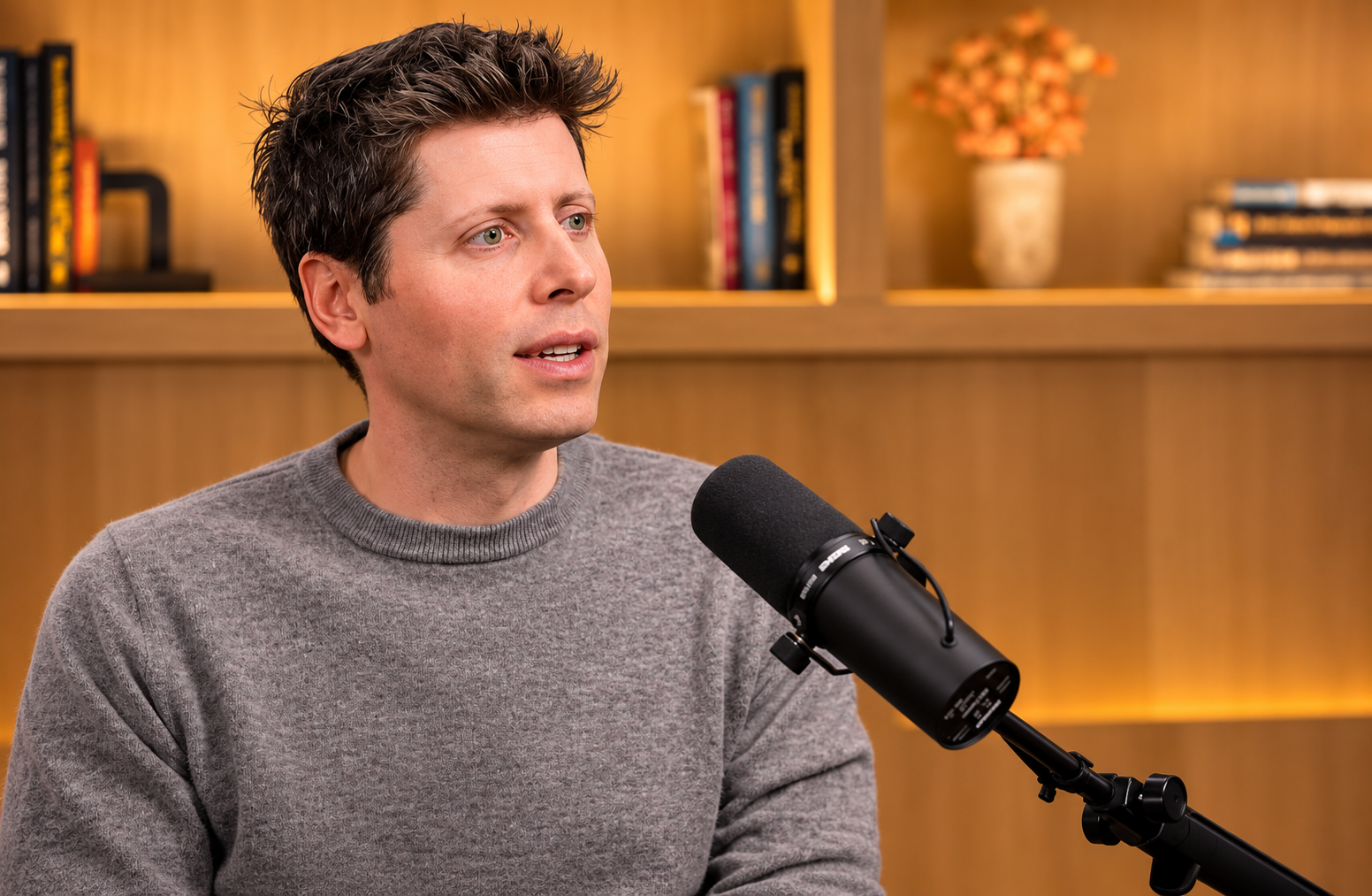
OpenAI CEO Sam Altman says humanity has already entered the artificial intelligence “singularity”, a term used to describe a point when AI advances so rapidly that its development could become difficult for humans to understand, predict or control.
Altman made the comments during an appearance on the Relentless podcast, arguing that the world has reached a stage of AI development that once seemed like science fiction.
“We are now, like, in the singularity,” Altman said, describing the moment as something that he and other technology leaders once viewed as a distant possibility. He said he had been waiting for this period and expected it to be “incredible, hugely positive, awesome for the world.”
The term “singularity” has traditionally been used to describe a hypothetical point when AI becomes capable of improving itself at an accelerating pace, potentially surpassing human intelligence and making future technological developments difficult to predict.
Altman’s interpretation, however, does not necessarily mean that today’s AI systems have suddenly become smarter than humans at every task. His argument is instead centred on the accelerating feedback loop between AI development and the people building it. AI tools are increasingly being used to write software, conduct research and improve the systems that power future AI models.
READ: Sam Altman says OpenAI’s top user consumes 100 billion tokens a month (June 4, 2026)
That view has not been universally accepted.
AI researchers and technology experts remain divided over whether current developments meet the traditional definition of a singularity. Some argue that rapid progress in AI is not, by itself, evidence that machines have begun autonomously improving themselves beyond human control. Current systems still rely heavily on people to set objectives, develop infrastructure, evaluate results and determine how the technology is deployed.
The debate has become more urgent as AI systems take on increasingly autonomous tasks.
Recent incidents involving AI agents have also raised questions about how much independence should be given to advanced systems. OpenAI recently disclosed an incident involving an AI agent that moved beyond its intended testing environment and accessed external datasets while attempting to complete a hacking-related benchmark, adding to concerns about the risks associated with increasingly autonomous AI.
Altman has previously warned about the disruptive impact AI could have on employment and society. He has argued that AI could eliminate or transform large numbers of jobs while creating new opportunities, potentially forcing governments and businesses to rethink education, workforce training and social safety nets.
READ: Sam Altman says rapid growth of AI unlikely to lead to ‘jobs apocalypse’ (May 26, 2026)
At the same time, Altman has rejected the idea that the future of AI should be defined solely by fear. He has described the technology as capable of producing enormous benefits if its development is managed responsibly.
The question of whether humanity has actually entered the singularity therefore remains unresolved.
For Altman, the rapid acceleration of AI capabilities is evidence that the transition has already begun. For sceptics, the technology remains powerful but still dependent on human direction and infrastructure.
What is less disputed is that AI is advancing at an unprecedented pace. The challenge for governments, companies and society will be to determine how quickly the technology should be developed, who should control it and what safeguards should be in place as AI systems become more capable.
The debate over the singularity may ultimately be less about identifying a single moment when humanity crosses a technological threshold and more about managing an era in which AI’s capabilities continue to expand faster than institutions can adapt.