



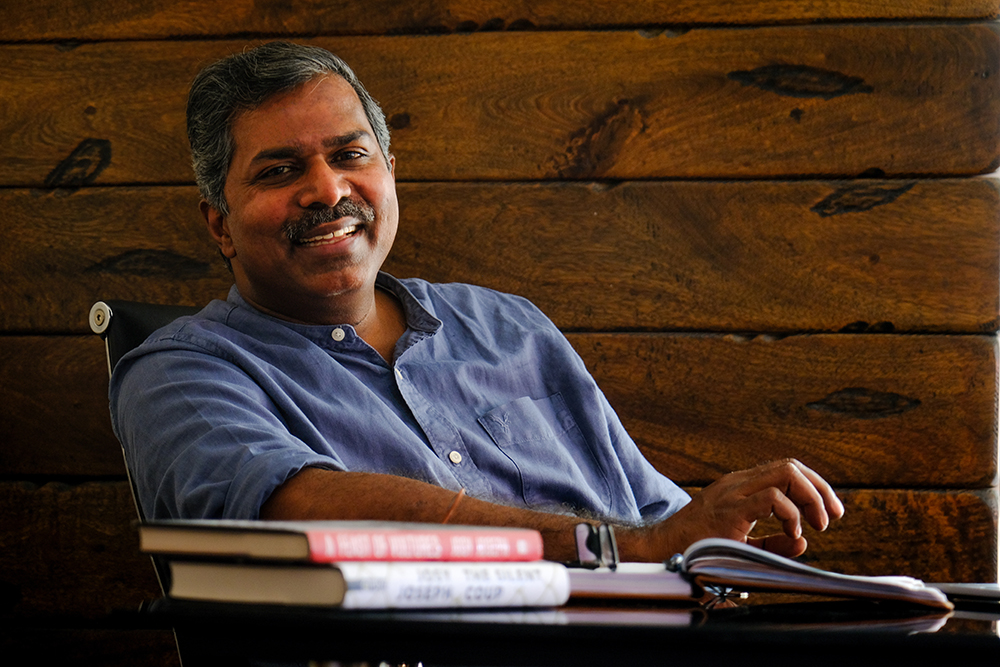
As the United States deepens its strategic partnership with India to counter China’s growing influence, veteran investigative journalist Josy Joseph argues that Washington may be overlooking troubling changes within the world’s largest democracy.
Speaking on the “Global Power Shifts” podcast, Joseph said India’s democratic institutions are gradually weakening even as the country becomes an increasingly important U.S. geopolitical and economic partner. “You don’t need any more tanks on the road or to take over the national television channel to carry out a coup,” he told hosts Jim Stenman and Suzanne Kianpour Angus. “Democracy dies slowly, quietly.”
Joseph’s remarks come at a time when Washington has invested heavily in strengthening ties with New Delhi, viewing India as a critical democratic counterweight to China in the Indo-Pacific. His new book, “Birth of a Nation,” argues that the India many Western governments believe they are partnering with is becoming increasingly different from the republic envisioned by its founders.
The recent nationwide student protests in India over an alleged medical entrance exam scandal is an example of growing institutional dysfunction. The demonstrations ultimately forced the government to accept protesters’ demands and led to the education minister’s resignation, but only after weeks of unrest marked by police action, internet restrictions around protest sites, and the closure of metro stations.
READ: Indian American lawmakers urge diaspora to fight anti-India hate (July 26, 2026)
Joseph argues that India’s democratic backsliding should concern not only human rights advocates but also investors and policymakers in the United States. According to Joseph, India was well positioned to emerge as the democratic alternative to China as Western businesses sought to diversify supply chains. Instead, he says, political polarization and institutional weakening have complicated that narrative.
“The majoritarian governance has forced India into a corner economically, not just socially,” Joseph said, arguing that investors lose confidence when they believe state institutions serve political interests rather than operate independently.
Drawing on newly declassified archives in “Birth of a Nation,” Joseph traces how India emerged from Partition in 1947, when 565 princely states surrendered their sovereignty to form a unified republic. The book explores the intelligence operations and political negotiations that held the fledgling nation together during one of the most turbulent periods in its history. “Republics and democracies are very difficult to create,” he said, “and easy to lose.”
Joseph also argues that democratic institutions have become increasingly vulnerable under Indian Prime Minister Narendra Modi’s government. Rather than relying on overt authoritarian measures, he describes a system in which investigative agencies and intelligence bodies are used to pressure political opponents, corporations, journalists, and civil society organizations. He estimates that roughly four million non-military intelligence and investigative personnel now serve governments across India, creating what he views as an unprecedented concentration of state power.
READ: The day after the ballot: India and the politics of deferred reality (May 13, 2026)
While India’s global image remains strong—with Indian-born executives leading some of Silicon Valley’s biggest companies and the Indian diaspora thriving abroad—Joseph believes that success masks deeper domestic challenges. “When authoritarianism rises, merit is the first thing that takes a backseat,” he said, arguing that India’s problem is not a lack of talent but diminishing opportunities for those who remain in the country.
Joseph also highlighted the treatment of India’s roughly 200 million Muslims, arguing that repeated failures to investigate or prosecute discrimination undermine public confidence in democratic institutions. He links those developments to the rise of Hindutva, an ideology that seeks to redefine India as a Hindu nation rather than the secular republic established at independence.
Despite his criticism, Joseph said India’s democratic story is not over. He described independent journalism as entering a “golden era,” with reporters continuing to investigate powerful political and corporate interests despite mounting legal pressure. “But there are the barking dogs and the biting dogs, and they will not give up.”
For U.S. policymakers, Joseph’s message is that India’s strategic importance should not overshadow concerns about the health of its democratic institutions. As Washington continues to deepen security, trade, and technology partnerships with New Delhi, he argues that understanding the country’s internal trajectory is becoming as important as recognizing its geopolitical value.
Joseph discussed these issues with Jim Stenman and Suzanne Kianpour Angus on the “Global Power Shifts” podcast.
Find the full conversation below: