



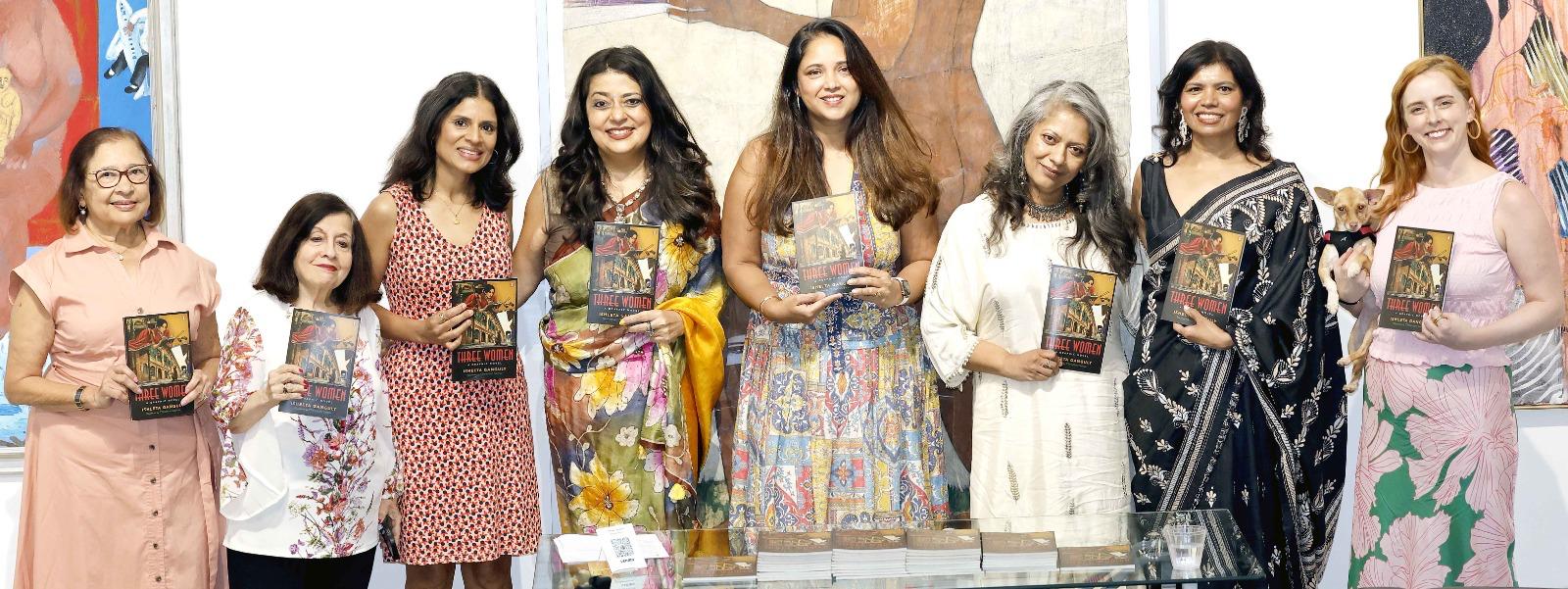
The AICON Gallery, in collaboration with the Jaipur Literary Festival NY, presented Indian American author and playwright Isheeta Ganguly, in a new creative chapter in New York City.
From launching her music album “Damaru” to staging her musical “Three Women,” the city has become a recurring milestone in her artistic journey. On July 23, Ganguly returned once again, this time to unveil “Three Women,” a graphic novel illustrated by Chirantan Sarkar, at the Jaipur Literature Festival (JLF) New York.

Hosted at AICON Art, the launch brought together writers, artists, and cultural leaders for an evening that explored how the lives of Rabindranath Tagore’s women continue to mirror the questions confronting women today.
Among those attending the event were senior journalist Lavina Melwani, Indo American Arts Council head Suman Gollamudi, Culture Tree founder Anu Sehgal, political activist and strategist Reshma Patel, JLF USA head Debjani Dev and AICON ART Gallery Director Pam Grendon.
Drawing from Tagore’s iconic female characters Charu, Bimala, and Kadambari, the graphic novel moves between the Bengali Renaissance and New York City in 2026. While separated by more than a century, the women are connected by familiar struggles over ambition, identity, love, purpose, and the expectations society places on them.
The discussion extended beyond literature, asking what it means to be a woman navigating changing social norms. It questioned who the “cool” girls really are, whether they are the rule-following women of the 1990s or the outspoken, emotionally honest women represented by Charu, Bimala, and Kadambari. It also reflected on resilience, grief, and the challenge of turning personal loss into purpose.
Reflecting on the launch, Ganguly told The American Bazaar, “The New York City launch at AICON Art took me back to my roots. New York City is where my cross-over work with Tagore fusion began… From launching my album ‘Damaru’ to the musical theater ‘Three Women,’ to now ‘Three Women – a graphic novel,’ nothing I create is ‘real’ until I launch it in nyc…
READ: Isheeta Ganguly reimagines Tagore’s heroines in new graphic novel ‘Three Women’ (June 6, 2026)
“So grateful to be in the company of extraordinary NYC cultural icons like Lavina Melwani, Divya Shah, Suman Gollamudi, Anu Sehgal, Reshma Patel and others who remind us that the see-saw of defining ambition, purpose, identity and love of self are a timeless arc.”
During the conversation, Ganguly was asked why she chose to reinterpret Tagore’s celebrated women in a graphic novel and whether she was apprehensive about reimagining such iconic literary characters.
She answered, “I felt the women from my musical Three Women had renewed relevance for Gen Z and today’s women across generations and therefore the thought to recreate it in a new audio-visual medium (we did an Audible recording in addition to the graphic novel). The themes of negotiating ambition, identity, balancing purpose with passion and defining ‘beauty’ were central to Charu, Bimala and Kadambari’s lives in the 19th century and are as relevant to Gen Z women today.
There is also this question of who are the ‘cool’ girls? Are they the ‘rules’ girls of the 1990s or the ‘put it out there like it is’ 19th century women who spell it out in many ways and don’t play the game. Gen Z is direct like Charu, Bimala and Kadambari are reimagined – there isn’t this suffocating sense of holding back to masque vulnerability like the Carrie Bradshaw ‘rules’ girls are…

“On stage the production offers live music, dance, movement and performance of Tagore’s recreations, on page the graphic novel brings a play of light and shadow, ecstasy and pain, nuance and uncertainty. The dramatic element of the graphic novel with the peaks and valleys of the narrative has kept a mysterious element for readers to discover why Kadambari the ghost time travels, why Charu the lonely housewife defines herself through Amal’s artistic aspirations and why Bimala feels that Bengal’s freedom movement is the only chance for women to liberate themselves.”
When another audience member asked why the story unfolds in 2026, Ganguly pointed to the emotional continuity between Tagore’s era and the present.
“Tagore’s heroines in the 19th century were nuanced, quick-witted, intricately complex women who were isolated amidst drawing room silences and engulfed in a deep loneliness. In 2026, women are just as intricate and complex and yet still grappling with the loneliness of digital silences… So much has changed on the outside yet so little on the inside with women still battling their own worth and value to society… Yet, like Charu, Kadambari and Bimala in the 19th century, women are still looking for second chances in 2026 in their careers and personal aspirations and answering the ‘what ifs.’ The quest for ‘second chances’ is a theme that resonates deeply for women who are reinventing and redirecting themselves.”
More than a retelling of Tagore’s work, “Three Women” positions his heroines within today’s conversations about identity, ambition, loneliness, and reinvention. By blending literature, theater, visual storytelling, and contemporary questions, Ganguly’s latest work suggests that while women’s worlds have transformed dramatically over the past century, many of the emotional battles they face remain strikingly familiar.