



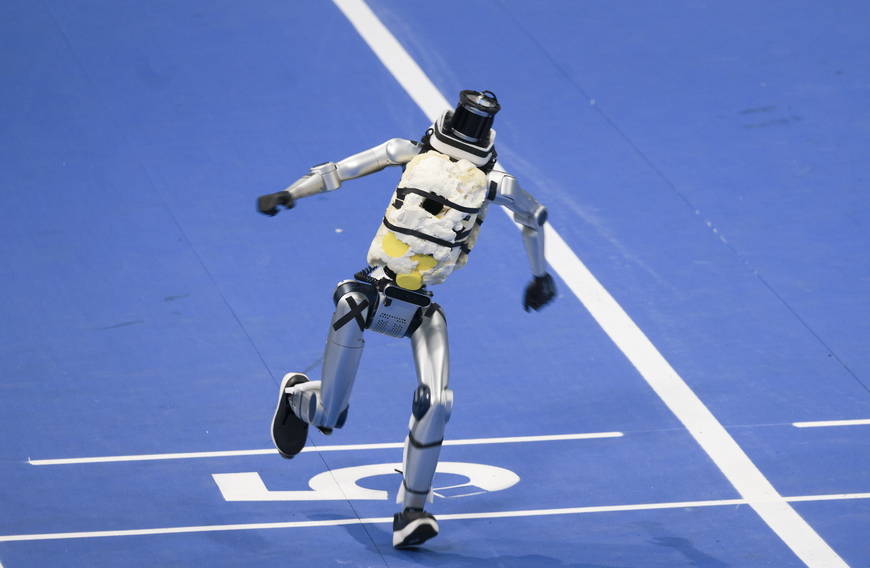
A humanoid robot sprinted impressively around an indoor track in Beijing before abruptly veering off course and breaking at the waist near the finish line, turning a demonstration of robotic speed into a viral reminder of the challenges still facing the technology.
The robot, identified as Unitree’s H1, was taking part in preparations for the second World Humanoid Robot Games in Beijing, which are scheduled for Aug. 22-26 at the National Speed Skating Oval.
Video of the incident shows the bipedal machine accelerating down the track before losing control near the finish. It veers toward the sidelines and crashes into equipment, with the robot appearing to buckle at its waist.
The clip quickly drew attention online, with viewers alternating between amazement at the robot’s running ability and jokes about its inability to stop.
READ: Chinese startup Unitree unveils ‘Superman’ robot, faster than Usain Bolt (August 18, 2026)
“Humanity trying to run away from reality,” one commenter wrote. The incident also highlights one of the central engineering challenges facing humanoid robotics: speed is only useful if a machine can maintain balance, direction and control.
The World Humanoid Robot Games are designed to showcase advances in robotic mobility and coordination through athletic competitions. More than 2,000 robots from 666 teams across 16 countries are expected to participate in events including sprints and other challenges.
Unitree’s H1 has previously demonstrated the ability to run at competitive speeds. At the 2025 World Humanoid Robot Games, the H1 completed the 1,500-meter race in 6 minutes, 34.40 seconds, setting a competition record for humanoid robots.
The latest crash therefore does not simply show a machine failing. It illustrates the gap between demonstrating impressive physical capability and achieving the reliability required for robots to operate safely around people. Humanoid robots must coordinate multiple systems simultaneously, including balance, movement, perception and navigation. At higher speeds, even a small error in trajectory or braking can quickly become a major problem.
READ: Chinese CEO leaves US to launch successful AI startup despite ‘many opportunities’ (July 20, 2026)
That challenge becomes increasingly important as companies develop humanoid robots for warehouses, factories, logistics operations and eventually everyday environments.
The Beijing games are intended to put those capabilities to the test in a controlled setting. The viral H1 crash offered viewers a humorous moment, but it also provided a real-world demonstration of why reliable control remains one of the biggest hurdles in the development of athletic humanoid machines. For now, the robot’s sprint may have impressed viewers with its speed. Its finish demonstrated something equally important for the robotics industry: learning how to stop.