



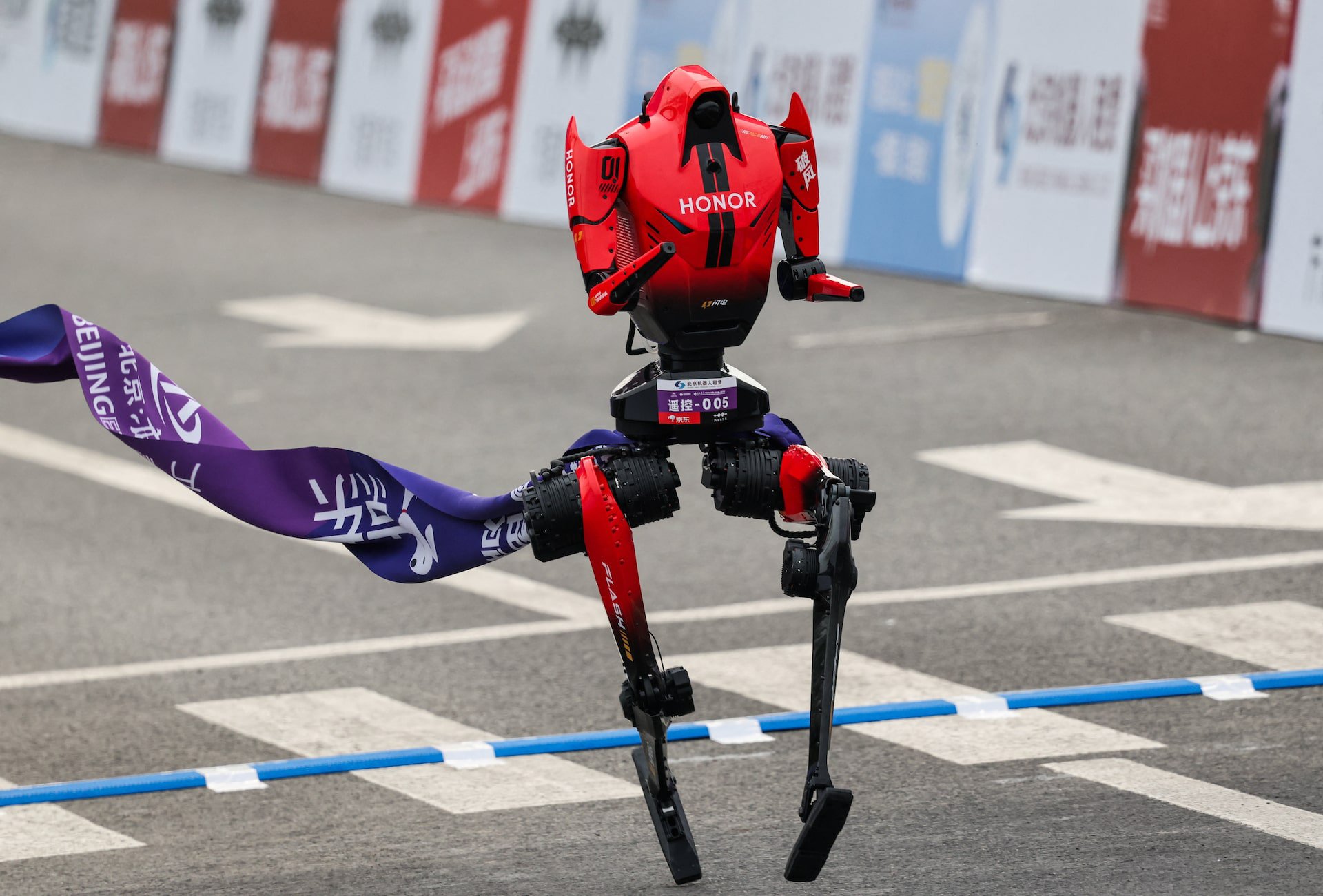
A Chinese humanoid robot has beaten Usain Bolt’s 100-meter world record, highlighting the rapid advances in robotic speed and control as China expands its push into humanoid technology.
The robot, developed by Beijing-based X-Humanoid, completed the 100-meter sprint in 9.39 seconds at the World Humanoid Robot Games in Beijing on August 22, according to Reuters. That was faster than Bolt’s 9.58-second human world record, set in 2009.
The performance came during the opening events of the five-day competition, which brings together more than 2,000 robots from 666 teams representing 16 countries.
Another Chinese humanoid robot, Lightning, developed by smartphone maker Honor, also surpassed Bolt’s mark. It recorded 9.47 seconds in the 100-meter final, while the robot had previously clocked 9.32 seconds in a test run, according to reports.
READ: Humanoid robot crashes after Beijing sprint (August 20, 2026)
Despite the impressive times, the race also demonstrated some of the limitations facing humanoid robots.
Tiangong Ultra, the X-Humanoid robot that recorded 9.39 seconds, lost stability near the finish and veered off the track. Lightning also struggled after completing its run and had to be carried away. The incidents underscored the gap between achieving high speeds and maintaining reliable control.
The competition is designed to showcase more than running ability. Organizers have included 51 events, including sports such as sprinting, soccer and table tennis, as well as tasks intended to test robots in real-world environments.
More than 40% of the competitions reportedly require robots to operate autonomously. Other challenges include warehouse logistics, cable connections, material handling and emergency-response scenarios, putting their vision, balance, coordination and fine motor skills to the test.
The sprint performance follows other advances by Chinese humanoid robots this year. In April, humanoid robots competed in a Beijing half-marathon, with the winning autonomous robot completing the 21-kilometer course in 50 minutes and 26 seconds.
READ: Chinese startup Unitree unveils ‘Superman’ robot, faster than Usain Bolt (August 18, 2026)
China has made humanoid robotics a strategic technology area, with companies developing machines for manufacturing, logistics and consumer applications. The country’s growing capabilities have also become part of the broader technology competition with the United States.
The U.S. government announced in July that it would restrict imports of foreign-made humanoid and quadruped robots, citing national and cybersecurity concerns. The move is expected to affect Chinese manufacturers particularly, which have become major players in the sector.
The robot sprint therefore represents more than a headline-grabbing race against a human sporting legend. It illustrates how quickly humanoid machines are improving in areas such as speed, balance, and mechanical power. Their struggles with stability and autonomous decision-making show how far the technology still has to go before it can reliably perform complex tasks outside controlled demonstrations.