



By Rajwa Quasim
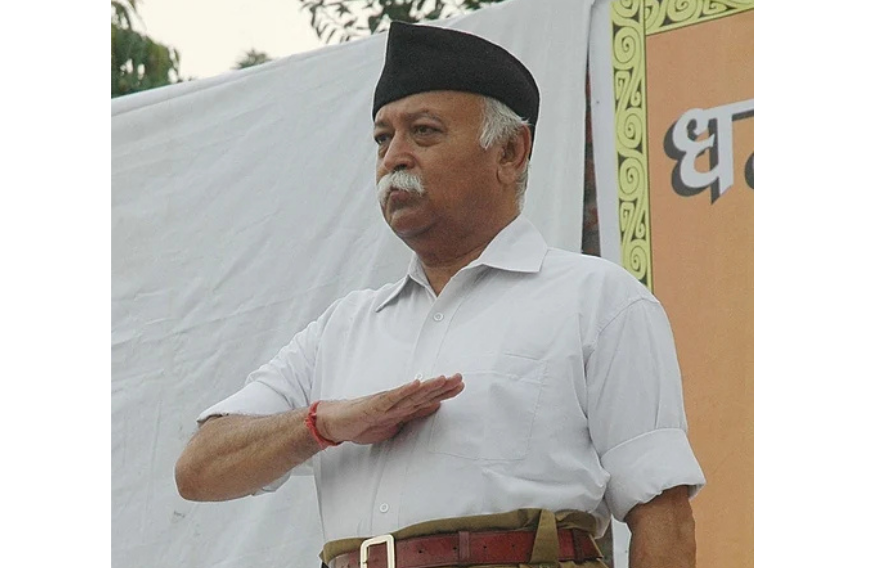
Rashtriya Swayamsevak Sangh (RSS) Chief Mohan Bhagwat’s visit to the U.S. and Canada has triggered sharply divided reactions, with supporters welcoming the outreach program while critics accuse the Hindu nationalist group of attempting to improve its image on international platforms.
In New York on Saturday, Bhagwat attended the “Universal Oneness Celebration” at Madison Square Garden as one of its keynote speakers. The event, organized by American Hindus for Engagement and Dialogue, aimed to send the message that “the world is one family.”
Meanwhile, some faith groups and human rights organizations rejected his presence, claiming that the RSS has long been accused of stoking violence against India’s minorities, including Muslims, Christians and Sikhs. They argued that Bhagwat was using the platform to whitewash the group’s record and alleged involvement in violence.
The RSS has defended Bhagwat’s international engagements. The organization has been closely associated with the ruling Bharatiya Janata Party (BJP), particularly Indian Prime Minister Narendra Modi, who entered politics through the group.
READ: Mamdani opposes RSS Chief Mohan Bhagwat’s Madison Square Garden event (August 26, 2026)
Deputy Executive Director of Hindus for Human Rights Sravya Tadepalli said, “The organizations behind this have pitched it as a broad appeal to Hindu history with an emphasis on inclusivity when, in reality, the RSS advocates for the exact opposite.”
New York Mayor Zohran Mamdani criticized the RSS ideology but said he had no jurisdiction to cancel a private event. “It has been incredibly troubling to see the rise of a movement that is predicated on an exclusionary vision of any country, frankly. And it is one that I find myself in deep opposition,” he said.
The backlash wasn’t limited to activists. The U.S. Commission on International Religious Freedom (USCIRF) called this week for Bhagwat’s visa to be revoked, as its chair warned that religious freedom conditions in India are deteriorating and highlighted rising violence against minorities.
After his U.S. visit, Bhagwat traveled to Toronto, Canada, where he addressed a gathering of more than 2,000 people from across Canada. He addressed the “Hindu Vishwa Bandhu—Embrace the World in Friendship” gathering, which was organized by Canadian Hindus for Outreach, Relations and Dialogue (CHORD).
There, he argued that India achieved its civilizational influence through knowledge and service and that India never conquered or converted anyone. Instead, he said, Indians shared mathematics, Ayurveda and cultural values with the world.
READ: Zohran Mamdani speaks Bangla, Mandarin, Spanish, and the internet can’t get enough (August 18, 2026)
“It served the world and by its own character, it became ‘Vishwaguru not Mahashakti’. So, the rise of Bharat means a more united, more emancipated humanity. We did it long back when there were no roads, no boats, no airplanes, no motor vehicles. Only bullock carts and horses. […] And what did they do? They conquered no country. They converted nobody. Wherever they went, they gave knowledge, they gave mathematics, they gave astrology, they gave Ayurveda, they imparted civilizational values,” he said.
In Toronto, he further mentioned that India accepts persecuted minorities. “Many came to Bharat from outside as aggressors, but they still thrive there, with all their specialties intact. They are now Bharatiya citizens. Muslims, Christians, and Jews are there… Many people come to Bharat for asylum,” he said.
Former Alberta Premier and former federal Cabinet Minister Jason Kenney was the chief guest, while Kashmir Singh Dhaliwal, who represented Khalsa Diwan Society and the Ross Street Gurdwara, was the Guest of Honor.