



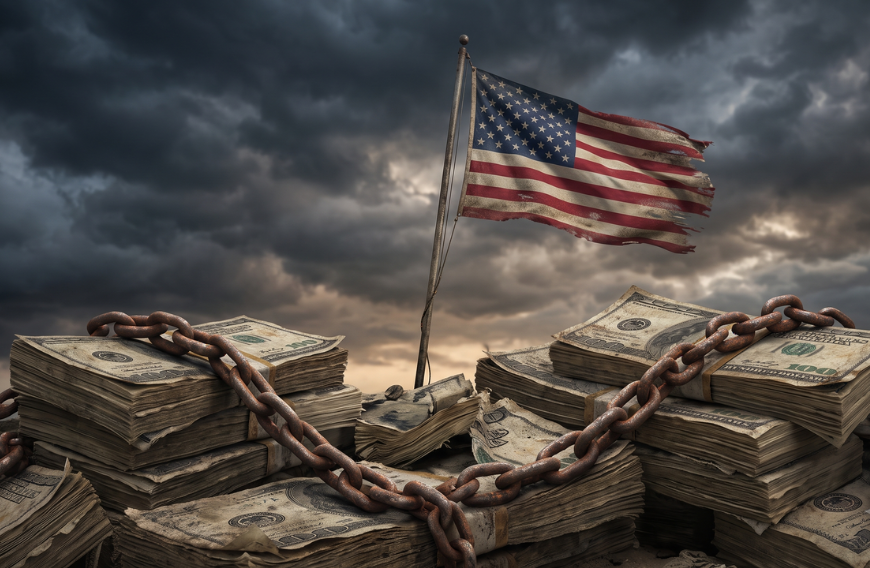
I spent the early nineties as a college student, and I have been working, and paying attention to interest rates the way other people watch the weather, since 1996. Somewhere along the way I bought houses at rates near 2 percent, and took out lines of credit just as cheap, and got used to feeling that money didn’t cost much. My father did not get to feel that. He bought our first house in the 1980s at 16 percent interest, a rate that made a mortgage feel like a second job. Same family, only one generation apart, but my father and I have experienced two completely different Americas as homebuyers. The difference is the story of the dollar.
That story is longer than any of our lifetimes, and it now sits at every kitchen table in this country, whether or not anyone at the table has ever heard the words “reserve currency.”
The musical chair
As Americans, we believe that our reserve currency status is a birthright, but it isn’t. That status is a chair that keeps moving to whichever economy is strongest. Genoa and the other Italian city-states held it when they dominated Mediterranean trade and banking. The Dutch guilder took it in the 1600s, backed by Amsterdam’s trading houses and the Dutch East India Company. The British pound sterling held it through the 19th century and into the 20th, backed by the empire on which the sun never set. The dollar then became dominant after the First World War because the United States had emerged as the world’s largest creditor and industrial power while Europe had bled itself financially and demographically dry.
Bretton Woods, in 1944, made it official. With the United States responsible for something close to half of world economic output at the time, representatives from 44 nations agreed to peg their currencies to the dollar, and the dollar alone was pegged to gold. The rest of the world effectively adopted the dollar as its monetary anchor because the United States was, by a wide margin, the only economy strong enough to be one.
The 1950s and ’60s really were halcyon days for that arrangement. Then we started spending like the arrangement would last forever. Between the Great Society’s welfare and entitlement expansion and the cost of Vietnam, the United States ran deficits and printed dollars beyond what its gold reserves could support. Other nations noticed and began redeeming dollars for gold. In August 1971, Richard Nixon closed that window, the “Nixon Shock,” severing the dollar from gold entirely. When European finance ministers complained that this would export America’s inflation problem to them, Treasury Secretary John Connally delivered the famous line: “The dollar is our currency, but it’s your problem.” The 1970s that followed were defined by exactly that: oil shocks, stagflation, and inflation that ate paychecks alive.
READ: The Review by Ajay Raju | March of the robots – next decade (September 7, 2026)
My father’s decade
Which brings us to the world my father bought his first house in. By the early 1980s, Federal Reserve Chairman Paul Volcker was slamming interest rates into the high teens to strangle inflation that had run out of control, and conventional mortgage rates followed it there. Homebuyers of that era financed the American dream at rates that today would be almost unthinkable for a middle-class family.
The mid-1980s brought the first real postwar challenge to American economic primacy: Japan. Japanese manufacturing, quality control, and export dominance were so complete that by 1989 the Japanese stock market’s total value briefly exceeded that of the U.S. market, an extraordinary fact given the size difference between the two economies. Washington responded to Japanese competition with the 1985 Plaza Accord, engineering a coordinated devaluation of the dollar against the yen that roughly doubled the yen’s value within a couple of years. Japan, flush with a suddenly stronger currency and easy credit, opened its economy and inflated an asset bubble that popped catastrophically in 1990, ushering in Japan’s “Lost Decades,” two-plus decades of stagnation from which it arguably never fully recovered. The lesson embedded in that episode, that Washington can and will use the dollar’s structural position to defend its primacy, has never been forgotten by any rival since.
The euro looked like the next real challenge in the 2000s, until the eurozone sovereign debt crisis of 2010–2012 exposed just how fragile a currency union without a unified fiscal authority really is. Greece, Ireland, Portugal, and eventually the currency bloc’s credibility itself, took the hit. Today it is China, with a manufacturing base, technology ambitions, and a Belt-and-Road financial network that together represent the most serious long-term structural challenge the dollar has faced since Bretton Woods.
Present Day
On August 19, 2026, the Treasury Department confirmed that total U.S. federal debt had crossed $40 trillion for the first time, a milestone reached months earlier than forecasters had expected, and one that means the debt has more than doubled in under a decade. Divided across the population, that works out to roughly $119,000 of debt for every American, and the debt-to-GDP ratio now sits above 120 percent, a level exceeded historically only by the peak reached just after World War II.
READ: The Review by Ajay Raju | Hedonic Treadmill Paradox: Why we remain unimpressed with technological miracles (August 31, 2026)
The interest bill on that debt should give heartburn to anyone sitting around the American kitchen table. Net interest payments crossed $1 trillion for the first time in fiscal year 2025, and by the first ten months of fiscal 2026, interest costs had already overtaken health-insurance spending to become the second-largest category of federal spending, trailing only Social Security and other retirement programs. The Congressional Budget Office projects those interest costs will climb toward $2.1 trillion a year by 2036. Every dollar that goes to bondholders is a dollar not available for anything else the government does, and unlike a mortgage, this bill has no fixed end date.
Then, why aren’t we hitting the panic button? Because the world still overwhelmingly wants dollars. As of early 2026, the dollar still accounted for roughly 57 percent of the world’s official foreign exchange reserves, tracked by the IMF’s COFER data, versus about 20 percent for the euro and under 2 percent for China’s renminbi. Nearly 90 percent of global foreign-exchange trading still involves the dollar on one side of the transaction, and a majority of world trade is still invoiced in dollars. Consider that nobody, by contrast, holds meaningful reserves in Canadian dollars, despite Canada being a close, stable, resource-rich neighbor. That’s because reserve status requires deep, liquid, trusted capital markets that almost no other country can offer at scale, and that scarcity is exactly what has let the U.S. borrow $40 trillion at rates other nations could never get away with.
But that dollar share was above 70 percent as recently as 2000, and the drift downward has accelerated for a specific reason: sanctions. Having watched Russia’s central bank reserves frozen and countless individuals and entities cut off from the dollar system, other governments, friendly and unfriendly alike, have concluded that dollar dependence is also a geopolitical vulnerability, not just a financial convenience. This explains central banks’ gold-buying binge (roughly 50 tonnes a month since 2022) and Beijing’s slow push to settle more trade in yuan.
Kitchen table headaches
For those of us who bought homes or opened credit lines when 2 percent money was on the table, we now know that it was not normal. It was the tail end of an unusual multi-decade period when the world’s insatiable appetite for dollar-denominated debt let the Federal Reserve keep rates extraordinarily low. That was then. As of September 11, 2026, average rate on the popular 30-year fixed mortgage crossed over 7% for the first time since May 2025, hitting 7.07%, according to Mortgage News Daily. Fannie Mae and the Mortgage Bankers Association now expect rates to stay in the mid-6 percent range rather than fall meaningfully further. If you do not already own, the “2 percent America” I benefited from is very likely gone for a generation, not because the dollar has collapsed, but because a still-growing $40 trillion debt load has to be financed by convincing bondholders, at home and abroad, that it is worth the risk, and that now costs more.
To be clear, a strong dollar cuts both ways for ordinary families. A strong dollar let me finance houses cheaply and let Americans buy imported goods, oil, and electronics for less than almost anyone else on earth pays, in real terms. It also allows Washington to fund the world’s most expensive military without asking Americans to sacrifice consumption the way past wartime generations did. But the flip side is that the interest bill will quietly eat the federal budget from within, as it competes directly with the entitlement promises, including Social Security, that an aging country like ours will need more, not less, in the years ahead.
READ: The Review by Ajay Raju | My city elders don’t trust Bitcoin (August 24, 2026)
Future
Most Americans don’t believe the dollar will be dethroned anytime soon the way the pound was dethroned. Nothing else offers the depth, legal predictability, and liquidity of U.S. capital markets, and China’s capital controls make full yuan convertibility a nonstarter for now. What we can expect, and what history, from Genoa to Amsterdam to London to Washington, suggests we should expect, is a slow drift toward a more diversified currency world: a dollar still first among currencies, but no longer as singularly dominant as it was for the 80 years since Bretton Woods. Crypto and stablecoins will very likely carve out a real, if secondary, role, particularly among the roughly one-fifth of global trade that already moves through informal or sanctioned channels. This global shadow economy has every incentive to find a settlement rail Washington cannot freeze.
So, here’s the reality that American families must now face. The cheap-money decades were a gift bought with borrowed time, not a permanent feature of American life. My father paid the price of a currency defending itself against inflation. My children will end up paying the price of a currency defending itself against its own government’s spending. Either way, the dollar’s story is really not about currency, but about which nation the rest of the world trusts enough to hold its money. That trust took two centuries to build for us, but it would be foolish to assume it cannot erode.
The midterms
With the midterms approaching, Americans are sitting around the kitchen table again, listening to two different stories about the $40 trillion debt. One party is telling them that the number is a moral failure of spending, that entitlements and discretionary programs must be cut before the interest bill cuts them for us, and that AI-propelled productivity growth and discipline will shrink the ratio if given the chance. The other is telling them the number is a moral failure of revenue, that a generation of tax policy starved the government of the money it needed, and that asking the wealthiest to pay more is the only path back to balance. Both stories are being told with total conviction, skipping the parts of the ledger that makes their own argument harder. Neither party built this debt alone, and neither will unbuild it alone either, because the math does not care whose name is on the bill.
Before you walk into the voting booth, ask what happens to the interest line, not just the headline plan. Ask whether the growth assumptions survive a bad year, not just a good one. Ask whether “someone else will pay for it” ever really means someone else, or whether it has always, eventually, meant you, in a mortgage rate, a grocery bill, or a Social Security check that arrives a little lighter than promised. One generation paid down a currency crisis with double-digit interest rates and a decade of discipline they didn’t choose but had to live through anyway. The next generation will pay down whatever this crisis becomes, whether or not anyone at their kitchen table ever votes on it directly. Meanwhile, the chair will continue to move. The question on the ballot this November should be whether we are the generation that finally notices, or the one that leaves the bill, again, for the next family down the table.
To be continued…