



Indian Americans have spent decades trying to earn a seat at the table. Texas shows it’s time to stop waiting for one.
By Aditi Bussells
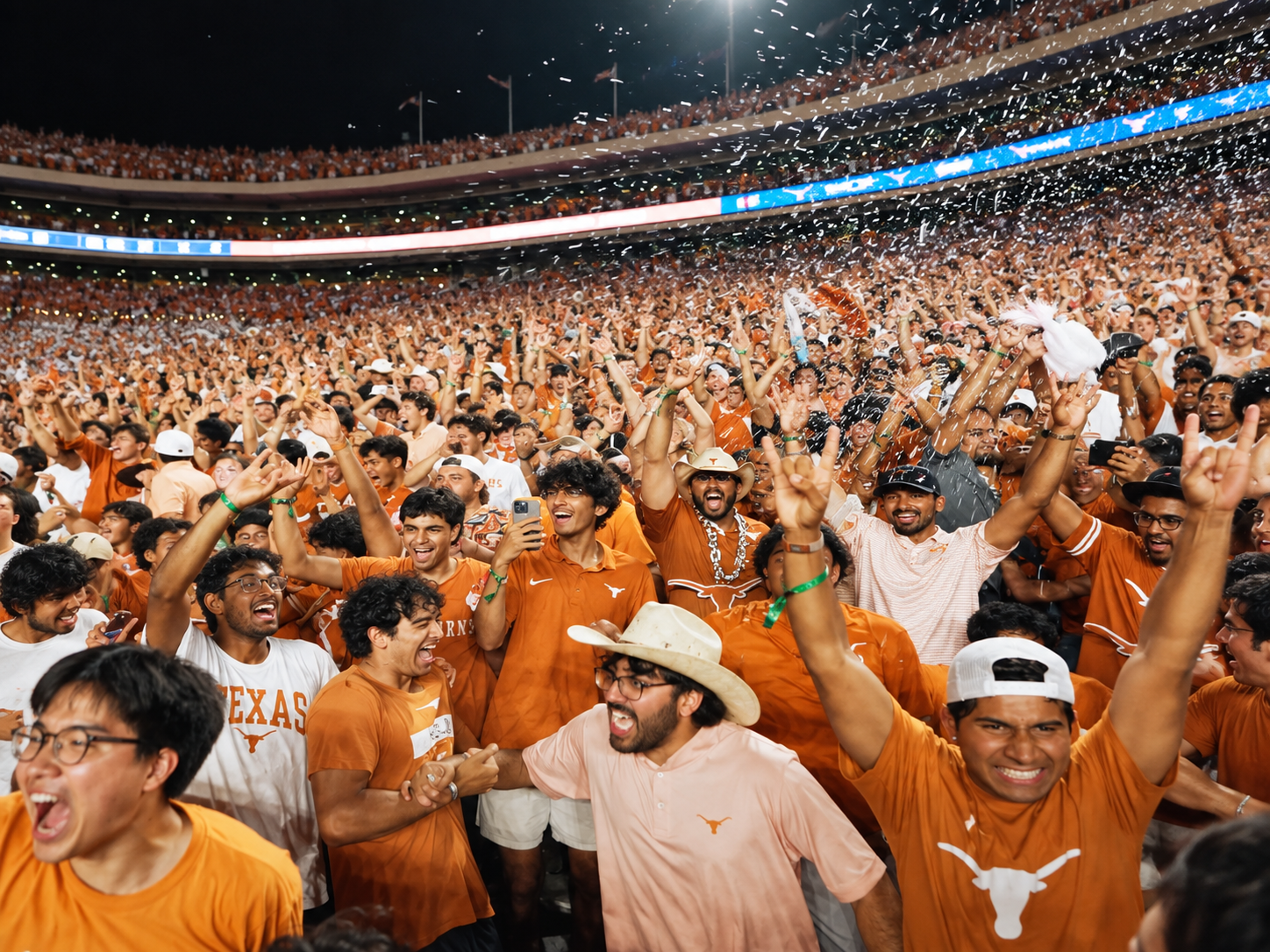
The morning after Texas beat Ohio State, a photo of college kids in burnt orange went around online. They were screaming. Grinning. Arms up. It was a comeback win at home, and it was about as Texan as it gets.
I heard UT graduation this year looked like this. I didn’t believe it. The problem is now obviously far worse than anyone imagined. pic.twitter.com/Ys1bql0y4U
— Bo French (@bofrench) September 13, 2026
Then Bo French, the Republican nominee for Texas Railroad Commissioner, posted that photo and called it proof that Americans are being “displaced by foreigners.”
Nothing in that picture said where those students were born. Nothing said what passport they carry. The only thing it showed was that they were brown. For French, that was enough.
When a radio host asked him about it the next day, he didn’t back down. He called it DEI.
I wish I could say I was shocked. I wasn’t. After 9/11, a lot of brown Americans learned the same lesson fast: your belonging can be taken back based on how you look. That lesson is the reason I do this work. And it keeps getting retaught. In a state where the governor has already told public universities to pause new H-1B visas, that photo wasn’t a one-off. It was a signal.
Here’s the pattern. Indian Americans are among the highest-earning communities in this country. We build companies. We run hospitals. We teach, we practice medicine, we write big checks to candidates in both parties. And for decades, we’ve had remarkably little political power to show for it.
We’re good enough to fund the campaign. Good enough to headline the fundraiser. Good enough for the diversity photo. Right up until someone decides we’re a threat. Then we’re foreigners at a football game.
That’s what happens when your whole political strategy is asking. Asking for a seat. Asking to be seen as the right kind of immigrant. Asking to be picked.
It’s time to stop asking.
What it looks like
Look at this year. Abdul El-Sayed won Michigan’s Democratic Senate primary over the party establishment’s pick, while being outspent more than eight to one. In New York, candidates backed by Mayor Zohran Mamdani knocked off two sitting members of Congress, over the objections of House leadership.
Nobody handed those seats out. Nobody waited their turn.
You don’t have to share their politics to learn from their playbook. They built coalitions across race and age. They showed up with votes, not requests. And the gatekeepers had to deal with them.
I learned the same thing on a smaller stage. When I ran for City Council in Columbia, South Carolina, the establishment wasn’t saving me a spot. So I stopped waiting for one.
For decades, Indian Americans have been incredibly successful economically while remaining underpowered politically. TX is an opportunity to change that equation & make one thing clear: targeting Indian Americans for political gain shouldn’t come without a political cost. https://t.co/02rnJPvvf0
— Dr. Aditi Bussells (@aditisrivastav) September 14, 2026
Texas is the other half
Winning races is offense. Making bigotry expensive is defense. Texas is where we play defense, and the bill is already coming due.
Sen. John Cornyn called French out. Gov. Greg Abbott said it was “not my message.” Karl Rove, of all people, says he’ll vote for Democrat Jon Rosenthal. A race that was supposed to be safe is now in play.
But condemnation is cheap. A statement costs nothing. Votes cost something.
The Railroad Commission is the race nobody watches. That’s exactly why it matters. Texas is home to one of the largest Indian American communities in the country. If that community shows up on November 3 for a down-ballot race most people skip, every campaign in America will notice.
The message is simple. Target us, and it will cost you. Not a bad news cycle. An election.
And this isn’t about one party. Democrats don’t get our votes just for not being Bo French.
Republicans don’t get our checks just because some of us like lower taxes. The rule applies to everybody.
So what does “stop asking” mean?
Vote the whole ballot. Every race, down to the ones you’ve never heard of. That’s where the message lands loudest.
Put terms on your money. Every check should come with a question: Where were you when they came for our kids?
Keep score. Remember who spoke up, who stayed quiet, and who waited to see which way the wind blew.
Run. School board. City council. Anything. You will not be invited. Go anyway.
Those students in burnt orange didn’t ask anyone whether they belonged in that stadium.
They bought a ticket, wore the colors, and cheered their team home.
That’s the energy.
Doors don’t open. They get opened.
(Aditi Bussells is a former at-large member of the Columbia, S.C., City Council, a public health expert, and a political commentator.)
READ MORE:
Raja Krishnamoorthi condemns Bo French’s UT remarks (September 14, 2026)
‘Pajeet’, a racist slur against Indians, is spreading across the internet (November 16, 2025)
It’s time Indian Americans made campaign donations, and got out and voted (August 4, 2016)