



If electricity failed tomorrow or access to AI were removed, what impact would it have on your ability to perform and how you present to the world? Many of us have been in situations in which technology failed, and we had to present without slides or backup. Most of the time, we developed our slides ourselves, so we were fluent in the content. As more of us outsource more to AI, we become less connected not just to the final product, but to the many iterations it once took us to produce it.
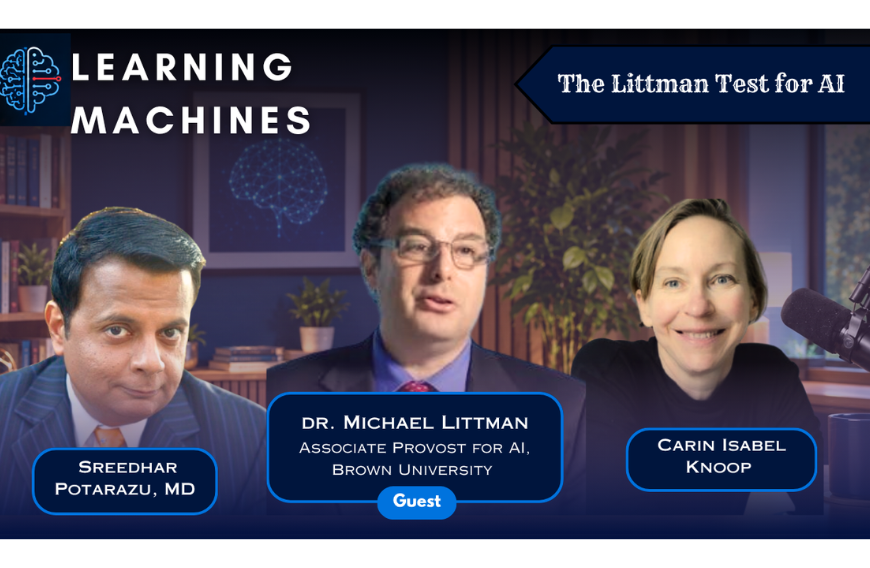
We explored this question in a recent episode of our Learning Machines podcast with Michael L. Littman, University Professor of Computer Science and Associate Provost for Artificial Intelligence at Brown University. Littman has spent much of his career studying how machines learn, particularly decision-making under uncertainty.
His perspective led us to what we dubbed the “Littman Test,” a simple way of thinking about human responsibility in an age of increasingly capable machines. The idea is straightforward: If a computer has helped make a decision or produce an artifact, can the person responsible still explain why it was made, defend the reasoning behind it and accept responsibility for the outcome?
Littman put the question more directly: “If somebody later asks me to defend this decision, do I have a defense?” His conclusion was equally direct: “‘The computer told me to’” is “a terrible defense.” But how much do we actually need to understand to defend an AI-assisted decision?
When performance outruns capability
We have adopted Gen AI at extraordinary speed, without the training, shared norms and institutional practices that normally accompany a technology capable of changing how people work and learn. AI can improve our performance without necessarily improving our capabilities. For much of our working lives, we have assumed that simply performing a task is itself a form of training. Even when the work is imperfect, the process creates knowledge we can apply next time.
Gen AI changes that relationship. A person can now produce a sophisticated answer without necessarily understanding the reasoning that produced it.
This is where another concept from Littman’s field becomes relevant: the distinction between exploration and exploitation. AI must decide whether to use what it already knows to maximize an immediate result or explore an uncertain possibility that might provide information useful for future decisions. Humans face the same tradeoff. Exploration is how we learn, while exploitation allows us to apply what we already know.
Maximizing Utility vs. Maximizing Knowledge
Littman described the technical distinction as one between “actions to maximize utility” and “actions to maximize knowledge,” acquiring information now that may allow better decisions later.
AI is becoming exceptionally good at exploitation. It can draw upon vast amounts of accumulated information and rapidly generate an answer based on what it has learned. But if we increasingly let AI handle exploitation while also letting it perform exploration, we may eventually find ourselves in an unusual position. The machine keeps learning while the human becomes increasingly dependent on the machine’s accumulated knowledge and risks losing some capacity to evaluate it.
But Littman also resisted a simple anti-AI interpretation. AI, he said, “is the ultimate exploratory tool, but it is also the ultimate exploitatory tool. And it depends on how you use it.” The opportunity to learn is profound, provided the human remains an active, not passive, learner.
This is why the familiar idea of keeping a “human in the loop” may not be enough. A person can remain formally responsible for an AI-assisted decision without meaningfully engaging with the reasoning behind it. Someone can approve a recommendation, edit an AI-generated document or accept a proposed course of action while doing little more than checking whether the result looks reasonable.
The limits of AI exceptionalism
Here we need to push back on our own Littman Test. We often judge technology divorced from the human alternative. We tolerate human error as ordinary but may treat a similar error by a machine as evidence of technological failure. Thousands of human driving mistakes barely register, while a single autonomous-vehicle accident can provoke widespread alarm.
In this discussion, the Littman Test first assumes we can distinguish what we know from what the machine contributed. Increasingly, that may be difficult. Once we have asked AI for an answer, questioned it, edited it and incorporated parts of it into our own thinking, where does its contribution end and ours begin? AI may introduce an idea we had never considered, but it may also simply articulate something we already understood. We cannot always know what is “ours.”
More fundamentally, the Littman Test risks imposing a standard on AI that we have never applied to other sources of expertise.
A CEO presenting a forecast to the board may not understand the mathematical models underlying it. A physician may rely on a lab result without understanding every step the equipment took to produce it. A manager may accept an analysis prepared by a finance team without being able to reproduce it. Modern organizations work because expertise is distributed. Responsibility has never required knowing everything, and companies could not scale or grow if leaders had to remain all-knowing and all-understanding.
Companies also need to train employees to give credit where credit is due and not claim credit for AI work nor blame AI for poor outcomes because of poor human prompting.
Littman himself provided part of the answer when discussing the limits of mathematical decision-making: “There are choices in how we turn things into math. And those choices can make things wrong, even if the math is correct.” So AI does not create our dependence on expertise we do not possess. What it can do is make that dependence unusually difficult to see.
When a CEO relies on the CFO, they usually understand who produced the analysis, where the expertise resides and whom to question. With AI, those boundaries can be much harder to see. There is another complication. We may not even be able to distinguish cleanly between our thinking and the machine’s contribution. Once we have asked AI for an answer, questioned it, edited it and incorporated parts of it into our own thinking, where does its contribution end?
Knowing enough to know what comes next
This suggests a more useful version of the Littman Test. Do we know what we are relying on? Do we recognize where our own knowledge ends? Do we know when the stakes require another source, another expert or another question? And are we prepared to take responsibility for acting on the answer?
Dependence itself is not the problem. We have always depended on people and tools whose expertise exceeds our own. The greater risk is dependence without awareness of the dependence.
This has important implications for education. For decades, schools have evaluated essays, examinations, projects and other artifacts as evidence of learning. That model becomes less reliable when an AI system may have produced the artifact. The more useful question may be whether the student understands what was produced and can explain and defend the choices behind it.
Littman described educational approaches in which students can use AI but remain accountable for explaining their work when questioned. The objective is not necessarily to prevent AI use, but to ensure that using AI does not eliminate the learning that education is supposed to produce.
Organizations face a similar challenge. Managers have traditionally assumed that employees become more capable as they perform their jobs. If AI removes the most cognitively demanding portions of those jobs, that assumption may no longer hold. An organization can become more productive while weakening the development of some of the judgment and expertise it will later need. This can be particularly problematic in crises when improvisation is required, whether in the boardroom or the operating room.
Knowing what we want vs. what we were trained to do
Yet while we increasingly ask AI to pursue objectives we define, human intentions are far more complicated than the objectives we can express mathematically. Littman’s book “Code to Joy,” written before the emergence of ChatGPT, explored the importance of expressing human intent in ways computers can understand. As AI systems become more autonomous, communicating intent clearly becomes increasingly important because a machine can optimize an objective without necessarily understanding everything we meant when we created it.
Littman connected this problem back to human communication through what his family calls the “no mind reading rule”: “You should never expect somebody to carry out your wish that you never expressed.” The lesson extends beyond prompting. Putting intent into words forces us first to clarify what we want and then to communicate it to someone — or something — else. AI may therefore expose a very old human problem: We are not always as clear about our own intentions as we imagine.
READ: Sreedhar Potarazu and Carin Isabel Knoop | Getting Our Needs Met: Learning to Speak Human From GenAI (February 11, 2026)
This is one reason Littman’s ideas about clarity, humanity and humility matter. He argues that humans can learn from machines by becoming clearer about what we want, while also recognizing limits to what machines can capture about human experience.
Clarity. Humanity. Humility.
We focus considerable attention on how to train machines. Littman’s argument also invites us to consider how we train ourselves to live and work with increasingly capable machines. That brings us to a more modest definition of understanding.
Increasingly, however, understanding cannot mean knowing everything, nor can it require us to distinguish neatly between “my thinking” and “the machine’s thinking.” Complete understanding was never the standard.
Littman’s final lesson was humility. “There are permanent holes in our uncertainty. And that is the universe we live in.”
When PowerPoint fails, the expert is not in the room, or the machine gets it wrong, we do not need to know everything. We need to know enough to know what comes next.
At the very end of our conversation, Littman left us with three explicit lessons humans can learn from machines. The first is to be clear and communicate with intent and precision. Know what you want rather than simply “throwing something out there and seeing what comes back.”
Second, do not lose our humanity. As machines move into increasingly human domains, from mathematics to intimacy, they force us to reconsider what is genuinely distinctive and valuable about being human. He emphasizes that “the depth really matters,” not merely the surface appearance of intelligence or relationship.
Finally, be humble. Accept that knowledge is inherently incomplete. As he puts it, there are “permanent holes in our knowledge,” and we need to recognize and live with those limits.
For a deeper understanding, please check out our book suggestion that aligns with this topic: “The Knowledge Illusion: Why We Never Think Alone” by Steven Sloman and Philip Fernbach.