



My mother watches football the way most people watch the news: as an unbroken sequence of impacts. Large men collide, someone falls, a whistle blows, and then it happens again. She asks me why players keep doing that to each other, and I never have a satisfying answer, because from where she is sitting, there isn’t supposed to be one. It looks like organized chaos because, to someone who hasn’t learned the language of football, that’s exactly what it is.
I watch football one level up from her, and, for me, it feels like sitting through a French movie with English subtitles. I can follow the story, recognize the language, know a blitz when I see one, understand why a team punts on fourth down, and can even tell when a defense is disguising its coverage before the snap. But I don’t have native fluency even though I played high school football. I listen to the broadcast commentary to understand the play as though I was reading translation, not the original language. Somewhere high above me sits a person like Tom Brady, watching the same eleven men on the same field, and seeing something entirely different: not a play, but the fourth move in a sequence set up two series earlier, a defense’s tendency exploited from a formation shown in the second quarter specifically to be cashed in during the fourth. He isn’t watching a game, but reading a plan.
Americans have been watching the news events of 2026 the same way. Depending on your level of expertise and engagement, you are either my mom, me, Brady, or somewhere in between.
The View from the Couch
Taken individually, 2026 reads like my mother’s football game, a series of disconnected, faintly alarming collisions with no visible logic behind them. Why did we bomb Iranian nuclear sites in February, then let the campaign drift into a summer stalemate? Why seize a Venezuelan oil tanker in December, then announce weeks later that its president had been captured? Why revive, of all things, a century-old argument about who runs the Panama Canal? Why pick a fight with Denmark over an island most Americans couldn’t have located on a map two years ago? And why does the conversation keep bending, no matter which crisis you’re reading about, back toward semiconductors, rare earths, and the electricity bill for a new generation of data centers?
If you watch one story at a time, on one news cycle at a time, none of it coheres. It just looks like a violent, expensive and chaotic habit that Trump’s America can’t seem to break.
The Subtitled Version
Watch it a level closer, though, and patterns start to surface, not the whole play, but enough to sense that something is being run on purpose.
READ: The Review by Ajay Raju | To do: Race with China. Save human race. (September 21, 2026)
$400 billion. That’s what Beijing pledged to Tehran in a twenty-five-year accord signed back in March 2021, an investment in exchange for a steady, deeply discounted river of Iranian crude. At the time, the 2021 deal between China and Iran probably looked like two sanctioned states doing each other a favor, but it now looks different if you connect it with other dots. China buys roughly 90 percent of everything Iran ships by sea. Officially, the two countries reported under $10 billion in trade last year; unofficially, Chinese refiners took in another $31 billion in crude that never appeared in any customs filing. Add it back, and you will no longer see oil as a footnote to the relationship. What you see is only three-quarters of it, paid in yuan rather than dollars, moved by a fleet of tankers built for exactly one purpose: invisibility. Ships go dark near the Gulf, transfer cargo hull-to-hull in open water off Malaysia, and resurface near Shandong with paperwork claiming the oil began its journey somewhere else entirely. That looks like industrial-scale rehearsal for an oil trade that no longer needs the dollar to function. Now, consider two unrelated dots that may also matter. Saudi Arabia quietly declined to renew its own petrodollar arrangement, and the dollar’s share of global reserves slid to a twenty-five-year low.
Why does it matter? By some estimates, Iran’s Revolutionary Guard controls roughly half of the country’s oil export revenue outright, meaning the money moving through those darkened tankers isn’t just funding bread subsidies, but funding the missiles. So when the strikes came in February, when nuclear sites were hit, with weeks of active combat, and a ceasefire that couldn’t hold past June, most of the country watched a single-issue war: centrifuges, breakout timelines, a regime that might or might not still want a bomb. And that was real; Tehran had reportedly been close enough to a negotiated framework days before the bombs fell that the nuclear justification can’t be waved away as pure theater. But watch Beijing instead of Tehran in the weeks that followed, and a second story comes into focus. Chinese oil imports jumped 16 percent as the country scrambled to stockpile, a reflex reaction to more than five million barrels of its daily supply shut down by a regional war around Hormuz. Russia tried to backfill with 300,000 extra barrels a day, but that wasn’t close to enough.
Meanwhile, Moscow and Tehran created dots of their own that weren’t measured in barrels. In September 2024, more than a year before the first bombs fell, the Kremlin approved a 44-page roadmap for expanding its strategic and economic relationship with Tehran, which included more trade settled in national currencies, alternative financial messaging systems, energy cooperation, nuclear projects, and specific roles assigned to Russian ministries and state-owned companies. Nowhere does the document call any of this sanctions evasion because it doesn’t need to. Every transaction that moves off Western financial infrastructure is one that Western sanctions have a harder time reaching. The dark tankers were moving the oil; the roadmap was laying the plumbing for the money.
READ: The Review by Ajay Raju | Our dollar, your problem (September 14, 2026)
When you connect these dots, the Iranian conflict no longer looks like a conflict between Washington and Tehran, and starts looking more like a broader conflict that may be running through Tehran, but directed at someone else entirely.
Reading the Whole Field
Once you assume there’s a third or fourth team on the field, the rest of the year’s “unrelated” plays start looking like they were called from the same sideline.
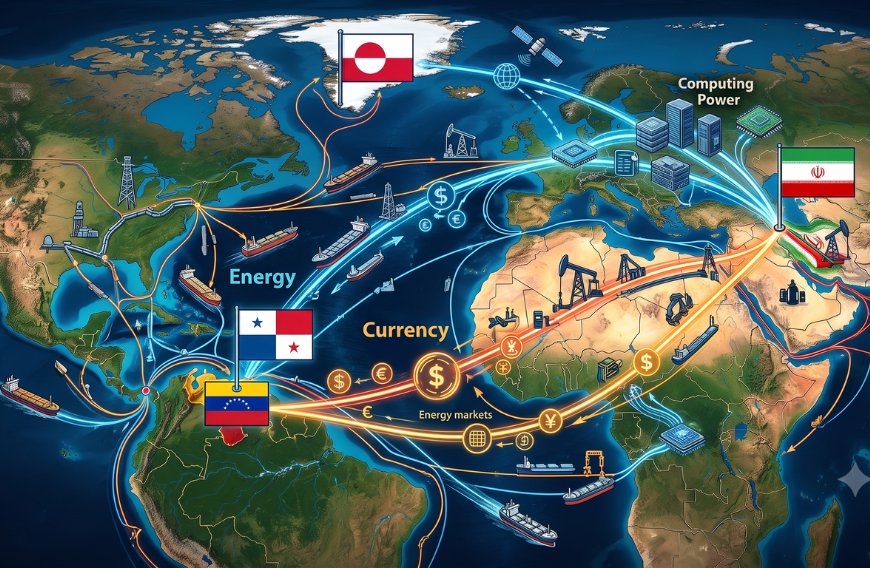
Venezuela holds the largest proven oil reserves on Earth and had, for years, sold its crude to China through the same kind of shadow-intermediary network, until a December tanker seizure, an FBI statement tying that vessel to both Venezuelan and Iranian sanctioned oil, and a January announcement that Caracas would surrender tens of millions of barrels. The news about Panama is connected to the larger game as well if you consider a Hong Kong consortium’s port leases, cited by name, as evidence that Beijing’s reach has crept to within sight of the Canal Zone. Greenland: rare earths, Arctic shipping lanes, and countering the very Chinese interest that’s been growing there for a decade. Underneath all of it sits the less cinematic work of onshoring manufacturing, subsidizing chip fabrication, and securing the raw electricity to run the next generation of AI data centers, the recognition that computing power, like oil a century ago, will belong to whoever controls its inputs.
Four fronts, four different press briefings, each offering its own local justification. Run through a Brady-level read of the whole field, they stop being four stories and become four routes off the same formation, energy, currency, rare earths, and computing power, each one a different way of asking the same question: who does the twenty-first century’s supply chain answer to?
A Long Season
Here’s what makes this different from a normal geopolitical crisis that otherwise resolves in a news cycle or two. This isn’t one game, but a season, possibly a string of seasons, against an opponent that plans in decades while our own institutions are built to plan in four-year increments. China locked in a quarter-century of discounted Iranian crude back in 2021 while most of the world was still counting centrifuges. Moscow drew up its own blueprint for Tehran in 2024, long before anyone in Washington was talking about strike packages. China has been running a long, patient offense, with energy security, currency alternatives, rare-earth leverage, and chip independence, for years, largely unwatched, because each individual play looked too small to matter on its own. And it hasn’t been running that offense alone. The different news reports in 2026 represent the other side of the formation. America seems to be contesting every one of those fronts at once rather than waiting to react to them one at a time.
READ: The Review by Ajay Raju | March of the robots – next decade (September 7, 2026)
That reframes what would otherwise look like four overextended, faintly imperial interventions into something more coherent: a team that has finally noticed it’s been playing containment defense for a decade, and has decided to start playing downfield. Under that frame, we see China as a legitimate, formidable opponent, a program with its own history, its own coaching staff, its own long-term plans.
Not Every Player Is Running the Same Play
Of course, not everyone on this field is a pawn wearing someone else’s jersey. Iran has its own playbook, built over forty years of proxies and regional strategy, that predates any tanker deal with Beijing and will outlast this war regardless of its final score. Venezuela’s president wasn’t fighting for Xi Jinping; he was fighting to stay in power. Russia’s appetite for sanctions-proof plumbing has as much to do with its own isolation as with anyone else’s game plan.
Flattening every actor on the board into a piece moved by a single hand would be a misreading, the equivalent of assuming every player on defense is executing the same assignment just because the coverage looks unified from the cheap seats.
Last Word
To see the season-long pattern, we have to watch more than one game and connect the dots. Tonight, when our Eagles take on the Bears for a Monday night showdown, my mother will keep seeing collisions without cause, because nobody’s ever sat her down and explained why a cornerback bites on a double move. I’ll keep watching from one level up, catching enough to know a formation when I see one repeated four times in four different countries, even if I couldn’t call the next play before it happens. And somewhere high above both of us, insiders are watching the entire season unfold exactly as drawn up, reading Iran, Venezuela, Panama, and Greenland not as four games, but as four plays in the same quarter of the same game, against the only opponent good enough to make it last a hundred years.