



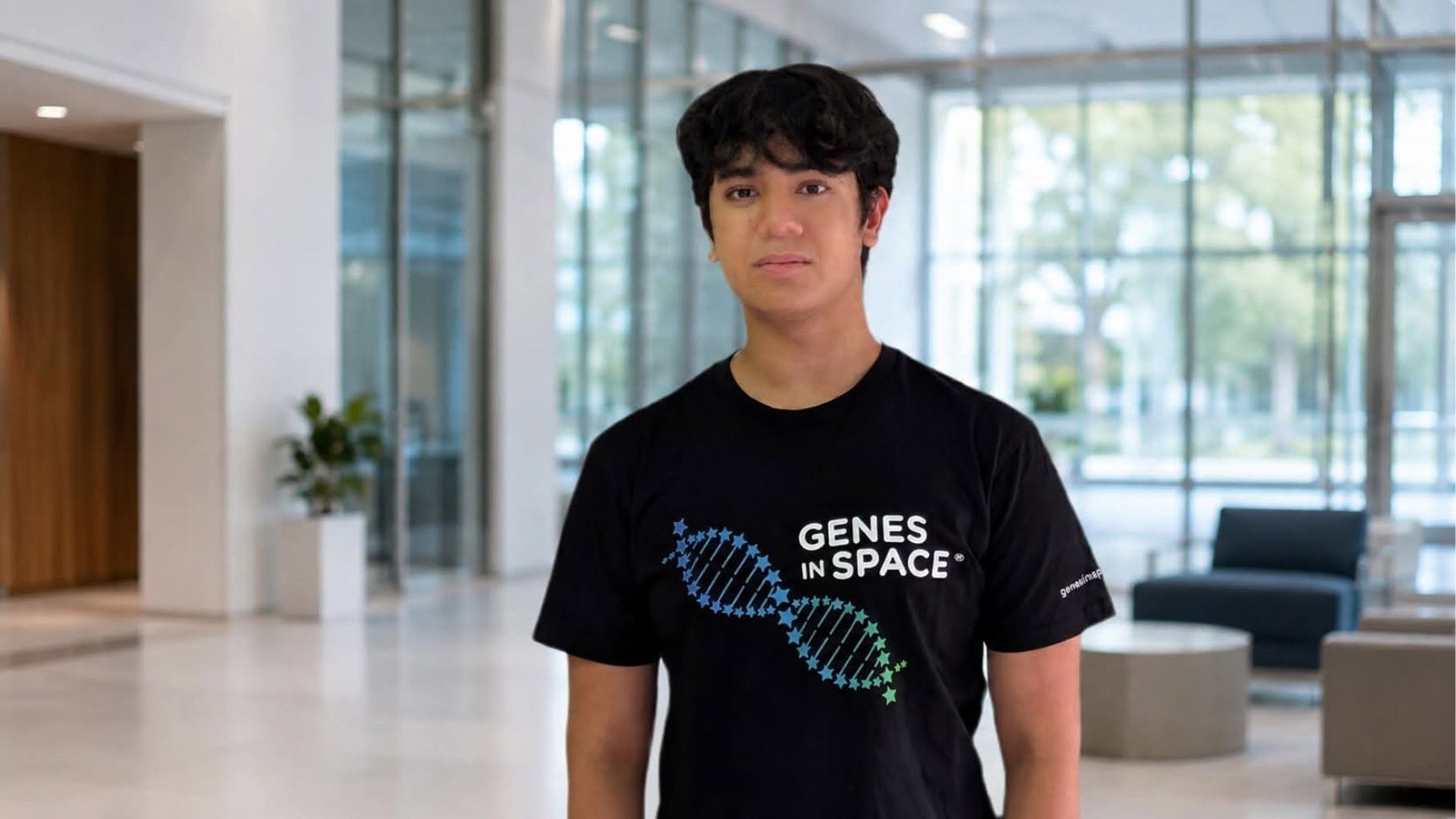
At 14, Indian American student Aryash Shyam is already making his mark in science, technology and broadcasting. Now, the Pennsylvania ninth-grader has added another distinction to a growing list of achievements – a national literary prize.
Aryash has been named one of four middle-school winners of the 2026 John Estey Student Writing Competition, presented by the American Writers Museum in Chicago, for “The Weight of Lead,” a work of historical fiction set in a Philadelphia print shop on July 4, 1776.
The award carries a $1,000 prize, and Aryash’s winning work has been published by the museum.
Set against the birth of the United States, “The Weight of Lead” explores a contradiction at the heart of the nation’s founding: the promise that “all men are created equal” and the reality that freedom and equality did not extend to everyone.
The story follows Will, a 13-year-old printer’s apprentice helping set the type for the Declaration of Independence. As he handles the lead letters that will carry the revolutionary words into history, he becomes increasingly conscious of another boy whose prospects for freedom are profoundly different from his own.
It is a sophisticated subject for a young writer, but one that reflects Aryash’s broader curiosity about ideas and their consequences.
“I always found myself paying attention to how everyday things work,” Aryash says of growing up in Pennsylvania’s Lehigh Valley. “I spent a lot of time reading on my own and noticing the details of the world around me, simply out of natural curiosity.”
That curiosity extends well beyond literature.
READ: Indian American student Jaya Basu wins $86k Sophie Kerr Prize (May 19, 2026)
A ninth-grade student at Lehigh Valley Academy, Aryash has distinguished himself in fields ranging from space biology and gene editing to artificial intelligence, robotics and science communication.
Earlier this year, he won a 2026 Genes in Space Junior Scientist Award for a proposal exploring whether a compact CRISPR-based diagnostic system could function in microgravity.
Genes in Space selected just five Junior Scientist Award recipients from 130 submissions by seventh- and eighth-grade students nationwide. Aryash’s project, “Validating a Cell-Free CRISPR Fluorescent RNA Diagnostic in Microgravity,” examines whether a freeze-dried CRISPR-Cas13 system could be activated with water and produce a fluorescent signal when target RNA is present.
The idea could have implications for monitoring astronaut health during spaceflight as well as for diagnostic testing in remote or resource-limited settings on Earth.
Aryash has also demonstrated an unusual ability to make complex scientific subjects accessible through the written word.
In September, he was named first-place winner in the high-school category of the 2026 American National Standards Institute Student Paper Competition for “Designing Out Error: How ISO 80369 Turned a Deadly Universal Connector into a Life-Saving Standard.”
The achievement was particularly notable because Aryash had completed middle school only months earlier.
His paper drew upon something personal – his own experience as a surgical patient at Children’s Hospital of Philadelphia – to examine how standards governing medical tubing connectors can prevent potentially dangerous errors by making incompatible systems physically impossible to connect.
All three essays he submitted to the 2026 John Locke Institute Global Essay Prize – in economics, philosophy, and science and technology – were also shortlisted.
But Aryash does not confine his ideas to paper.
He is the creator of GreenBeam, an artificial intelligence-powered robotic system designed to identify and target weeds without routinely spraying chemical herbicides.
“I kept coming back to a problem that seemed solvable,” Aryash says. “Invasive plant species – plants that spread aggressively outside their native range – are typically removed using chemical herbicides that can damage surrounding ecosystems. I wanted to find a better way.”
His answer was to combine computer vision with precision targeting.
“GreenBeam is my answer: a computer-vision system – software that allows a camera to identify specific plants by sight – paired with a precision laser that can target and eliminate invasive plants without applying any chemicals to the surrounding soil or native plants,” he explains.
Aryash built the core system in Python and trained it on plant imagery. The project earned him Pennsylvania State Merit recognition in the 2025 3M Young Scientist Challenge.
His passion for communicating ideas has also taken him behind the microphone.
Aryash hosts Teen Scientist, a monthly program on WDIY 88.1 FM, Lehigh Valley Public Radio, an NPR member station, where he interviews researchers and innovators on subjects ranging from artificial intelligence and biotechnology to space, mathematics and climate innovation.
READ: Indian American researcher wins UCLA engineering alumni award (October 5, 2026)
“Every first Thursday of the month, I sit across from someone whose work is quietly reshaping the world, and I get to ask them anything,” Aryash says.
He remembers the first time the studio’s “ON-AIR” light turned red.
“A real scientist across the table, a page of questions I had carefully prepared, and thirty minutes to make the conversation count,” he recalls. “I was a little nervous at first, but once we started talking, the excitement took over.”
He has also created Editing Humanity: A CRISPR Conundrum, a documentary examining the science and ethics of gene editing, and founded RacingGecko, a STEM-learning platform aimed at making subjects such as mathematics, artificial intelligence and coding more accessible to younger students.
“If I can understand it well enough to explain it clearly on camera, then the explanation is probably the right length and the right level,” Aryash says. “I believe students learn better from peers who remember what it felt like to not understand something yet.”
For a teenager whose pursuits stretch from the printing press of 1776 to the possibilities of CRISPR in space, the subjects may appear strikingly different.
Yet a common thread runs through them: a desire to understand how things work, what they mean and how ideas can be used to solve problems.
His latest recognition brings that journey back to the written word – and to a young printer’s apprentice contemplating the meaning of equality as some of the most consequential words in American history take shape, one lead letter at a time.