



She arrived at a quarter past five in the morning, at an airport she remembers as a poorly lit hangar. It is the first Indian building in the book, and she measures it as a provincial measures everything, against home.
It was smaller and dimmer than the airport in Rome; even the one in Turin, she notes, was bigger and brighter. In her bag was a return ticket. Her father, who distrusted the whole venture, had bought it for her. She was to use it if she did not like the place, or if the people were not kind to her. It was the sensible luggage of a sensible people.
The ticket is the most interesting object in Belonging, and the book does not quite know it. It stands for a way of looking at a new country: as a place one might leave, a place to be judged by whether it is kind. It is the traveller’s way. But she was not to be a traveller. She was to be a bride, and a bride does not judge the house she enters. She learns it.

The Italy she came from was small and had edges. Her father had been a sergeant major in the Bersaglieri, had survived the retreat from Russia, and had moved his family to a Piedmontese village where the people called them furesté, foreigners. He built a business that ran sulla parola, on a given word.
When his small daughter stole three walnuts and lied about it, he beat her hands until she wet herself, and sent her to return them. It was a hard world, but it was legible. Things had names and prices; a promise was a promise; a theft was a theft.
In Cambridge, where she went to learn English, the world first lost its edges. The food appalled her: boiled cabbage and, “the ultimate horror, tinned spaghetti on toast.” She held her breath and walked fast past the East Pakistani restaurant on the main street. This is honest, and it is the beginning of every traveller’s education: the body’s recoil before the mind’s curiosity.
Then, in a Greek restaurant that served the only food in town “somewhat similar to Italian,” she saw a young man “tall and handsome with deep black eyes.”
READ: Satish Jha | Rahul Gandhi and the paradox of opposition (October 27, 2026)
The prose here is the prose of the lending library. It is the romance as she felt it, and it is not examined.
What she entered in Delhi was not a family but a court. She does not use the word; she gives the evidence. A Congressman named Kalpnath Rai waits in a corner of the corridor “as if punished” for the prime minister to appear. Once he throws himself at her feet and cannot get up, and an attendant has to be called to haul him upright. On another day she finds him in the same corner, weeping, chewing his handkerchief, crying “Ma, Ma! Shakti do!” (Mother, Mother, give me strength!).
The staff and the doctor send the daughter-in-law in each morning to find out whether the mood is all right. The bodyguard, a former wrestler, can enter the corridor only sideways.
She tells these things as comedy, and they are comic. But they are also a picture of a political culture in which the elected men of a democracy behave as supplicants before a mother. She sees the behaviour. She does not see what it means. When Indira loses her temper and sends her thali flying across the table, Sonia explains it by her own childhood: the outbursts reminded her “of my father’s explosions.”
A political system is translated into a family quarrel, and a family quarrel is something she understands. It is the bride’s way of seeing, and it is the book’s limit.
The court had rituals as well as manners. In September 1970, at the family house in Allahabad, Indira opened a cupboard and took out three small containers: the preserved ashes of her grandfather, her mother and her father. Ashes being preserved? I hadn’t known of such a thing.” At dawn the young Italian went out with her husband and his brother in a battered motorboat, its rusty engine deafening, its fuel stinking, the marigold garlands so pungent that she later developed an allergy to them. The only person in the boat curious about the actual country is Sanjay, who asks the boatman how many trips he makes in a day and what he earns. Sonia holds her small box and feels “rather nervous and inept.” At the confluence she scatters the ashes, her hair stands on end, and she wonders “at the destiny that had brought me there.”
Destiny is the word one uses when one has stopped asking how. The understanding came later, she says, when she read Nehru’s will and its passage on the Ganga. That is the method of the whole book, and perhaps of the whole life: the ritual first, the idea afterwards, and sometimes not at all. She learned Hindi because Indira had ruled that only Hindi was to be spoken at the table. She was married in a khadi sari woven from thread Nehru had spun in prison. Her first Nauroz ended with Kashmiri greens and sweet rice. It was the household’s India, and she learned it thoroughly. The country beyond the household’s walls appears in the book mostly as crowds.
Only at the deaths does the writing change, because here she is not describing a country but her own loss. When Rajiv reaches the hospital where his mother lies dead and tells her he has been asked to become prime minister, she begs him with folded hands to refuse: they will kill him too. “They will kill me anyway,” he says. Seven years later her daughter comes down a corridor to say that he is dead, and the book moves into the present tense and stays there, as if the past tense could no longer hold it.
She opens the bag of clothes he had changed out of and bends over it “seeking to inhale the elusive scent of my beloved.” These pages are true. There is nothing of the court in them.
READ: Satish Jha | What a mandate cannot buy (October 19, 2026)
Then comes politics, and one sentence that the author does not hear. She asks herself what right she had to lead the party, “except for the fact that I carried the family name.”
Consider what the sentence describes. A woman who had lived in India for thirty years, and who had never held any office, became the head of the party of the national movement because of a name acquired by marriage. In an older India this would have been understood at once: the widow of the king, holding the kingdom for the son. The book does not see it that way. It reaches instead for the Gita, for Arjuna on the battlefield restored to himself and ready to do his duty. The old epic is brought in to ennoble an act that a modern republic ought to have found strange.
The refusal of the prime ministership in 2004 is the book’s great scene. She tells her party that her “inner voice” bids her decline; her colleagues weep; she nearly faints. What followed she describes plainly: “the government under Dr. Manmohan Singh, and the party under me.” The office went to the minister. The palace kept the party.
When a senior colleague hinted, some years later, that it might be time for a change at the top, “I gently changed the subject.” It is the perfect sentence of the court. The bride had learned its manners completely.
The epilogue is set in her garden. The monsoon has washed the dust from the jamun trees; the lime trees are fruiting; the gardenias are recovering. Troops of rhesus monkeys, “pushed out of their original habitat by the expanding city,” have been invading homes and marauding gardens. The city outside presses in, and the garden survives. She ends with the piety the household always spoke in: Mahatma Gandhi’s India, “the India of kindness and compassion, will prevail,” and love has never failed her.
It would be easy to call this evasion. It is something more interesting. It is the record of a complete assimilation, but an assimilation more to a household than as much to a country. She never needed the return ticket because she never really left the house; the house became her India, with its rituals, its courtiers, its dead, and its name.
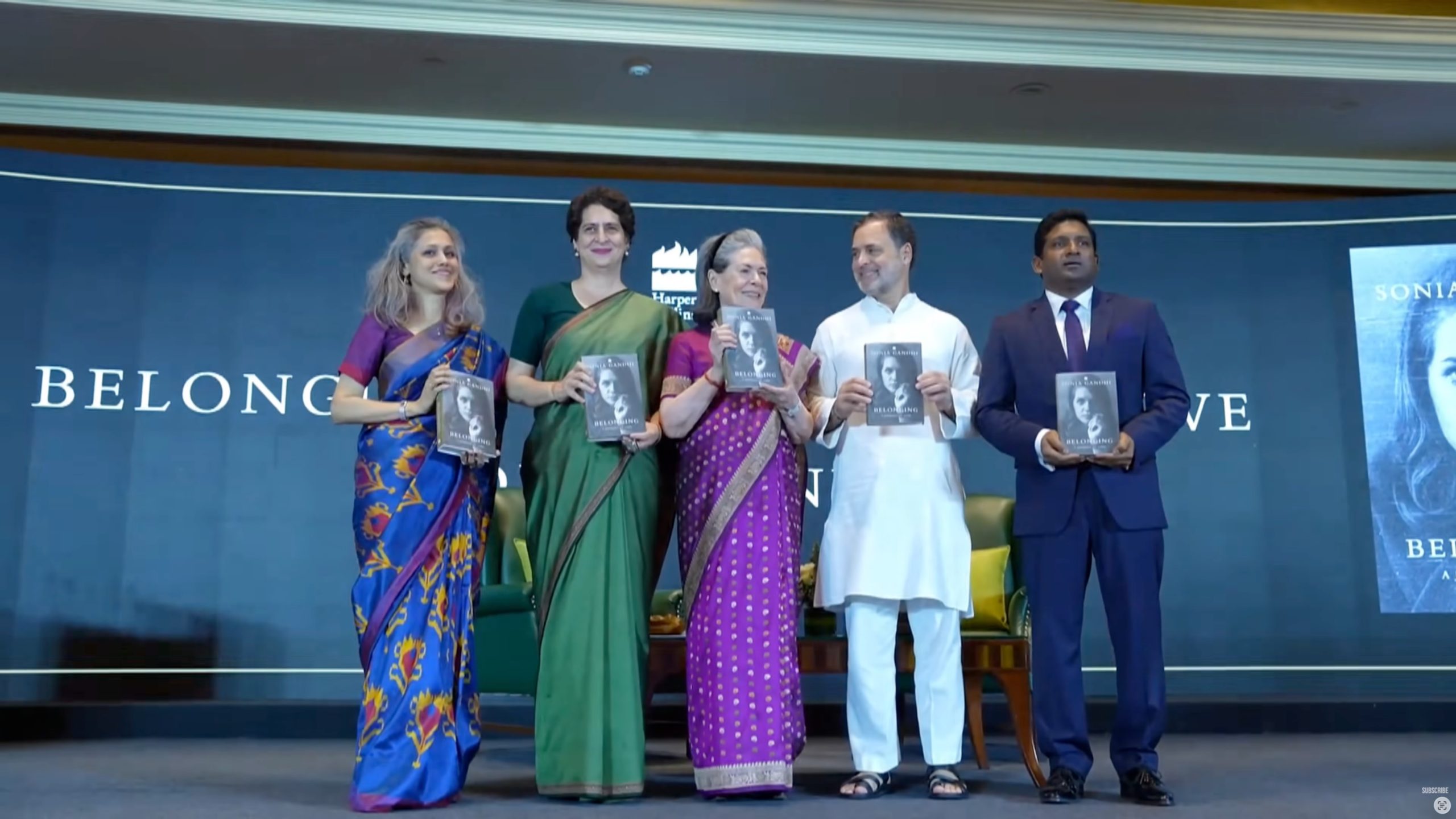
The title is exact. The book is about belonging to a family. The country is, as she says in her preface, “a kind of framework”: truer words, perhaps, than she intended.