



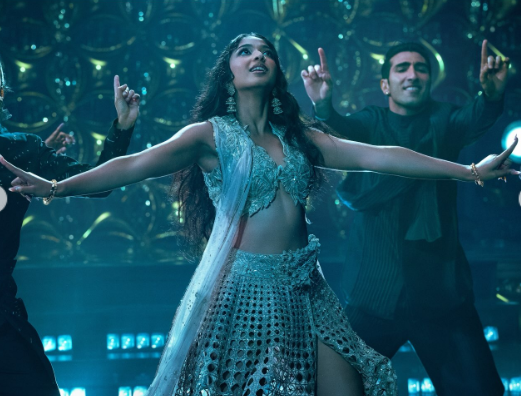
For the past 30 years, Hollywood has seen the momentous rise of South Asian talent, whether it be actors, comedians, filmmakers, producers and writers. Yet, despite such exposure and growth, a Bollywood dance themed college movie, involving South Asians in America, never existed – an idea that seems like a no-brainer given the popularity and commonality of collegiate South Asian dance competitions. Luckily for audiences, popular comedian Hasan Minhaj and Prashanth Venkataramanujam came together and wrote a film that many of us did not even know that we really needed – Netflix’s recent release Best of the Best..
The story of the film is quite simple and traces the ups and downs, fun, chaos, camaraderie and drama that exists within the South Asian competitive dance team culture. This is told all under the backdrop of a story of friendship between two characters – Maya (Maitreyi Ramakrishnan of Never Have I Ever fame) and Anjali (newcomer Priyanka Kedia), whom have been close friends since childhood with dance being a core part of their bond. Through the course of the story, we see their friendship tested and ultimately strengthened as both find romance and purpose through their new life as freshmen at UCLA and participating in the Best of the Best dance competition.
As a South Asian who grew up in the US and experienced the dance culture firsthand during my undergraduate years, I absolutely loved this movie. While I was never on the dance team, the dance culture touched all students – South Asian and beyond. I had friends on the team that I would cheer on each year, while also hearing about the intercollegiate rivalries, the heartbreaks, the rigorous practice hours, the closeness of the teams and any other such incidents that the film captures very accurately. The way in which the subject matter is handled is quite natural and not “filmy” – which is the film’s greatest strength despite a plot that many may feel is predictable.
READ: Ankur Rathee lands his long awaited lead role in Netflix’s ‘Best of the Best’ (October 2, 2026)
The beauty of the film also lies in its characterizations and tone. The manner in which Maya and Anjali’s characters are written, and the way in which their friendship is portrayed, is sweet. While they have their conflicts, they are able to resolve them without the script taking things into melodrama – testament to how strongly both are connected to each other. The romantic angle – Maya’s relationship with the character Arjun (Chaneil Kular) and Anjali’s with dance team captain Ronak (Ankur Rathee) – comes across organically and, thankfully, is not cheesy as often dance movies show. Needless to say, the main four leads are dynamite actors and it is a real treat to watch young South Asian actors perform so superbly early on in their careers. The rest of the characters on the dance teams, and Hasan Minhaj himself as Professor Hamza, all perform excellently, eliciting laughs and keeping the audience happy through their portrayal of certain archetypes that we have seen on all dance teams. It excites me to see what the entire cast will do next as the success of the movie is bound to open countless doors for them that further break stereotypes.
The writers also keep in mind that just watching people dancing for two hours does not make for an entertaining movie. The dance scenes are balanced well with the story of the film, so viewers get a great dose of the amazing dance sequences, while at the same time not being distracted from the main story’s humor and drama. I assume that most of the cast are actors and not purely trained as dancers, so to see how they have performed in the complex dance sequences is an icing on the cake – they do a fabulous job! The soundtrack of the movie is also foot-tapping and certainly nostalgic for all those whom grew up in the 90s and early 2000s. Additionally, the humor is top notch. Several scenes made me laugh out loud such as the competitive mic fighting between the Indian and Pakistani co-chairs of the South Asian Students Association or the fight between the two “token Caucasian characters on dance teams that know everything about India”.
READ: ‘South Asian culture is not just Indian’: Influencer takes aim at ‘Best of the Best’ critics (September 30, 2026)
The other unique aspect of the movie, which is what really gives it its universal appeal, is that it proudly showcases the South Asian identity without trying to purposely keep emphasizing that attribute. Of course, while the film does touch upon the usual conflict of desis going head to head over their parents on academics and other superficial areas, the writers recognize that being South Asian is a normal part of the fabric of a multicultural society – and that normalcy of something so beautiful and unique ought to be celebrated with all. I will also point out that another universal aspect of this movie is that because desi collegiate dance teams are so popular, non-South Asians also are aware of how they work and can relate because they likely have at least one South Asian friend who is part of the dance scene. New audiences, whom may not have experienced such dance teams, likely have global exposure to Bollywood music and movies through streaming platforms like Youtube, Netflix and Prime Video, and may be curious to see a story revolving around this major cultural aspect.
Special shoutout must be given to director Lena Khan, who has weaved this incredibly entertaining tapestry together and brought this story to life for audiences all over the world. And credit to Netflix as well for greenlighting this. In a world where most films are dark, it was nice to see a happy movie that puts a smile on your face.
There have been many reviews out there that have been quite critical of the movie due to various reasons – which I have personally found to be nitpicky. For once, let’s all celebrate what this movie represents and what it can do for the South Asian community – let’s not take that moment away and pull such progress down. Go catch Best of the Best on Netflix, now streaming.