




Northern Virginia entrepreneur and philanthropist Sharma envisions the center as an ecosystem where students can turn ideas into businesses and help build a “local Silicon Valley”
George Mason University has renamed the Center for Innovation and Entrepreneurship at its Costello College of Business in honor of Northern Virginia entrepreneur Anil Sharma and his wife, Anupama Sharma, recognizing the couple’s commitment to education, entrepreneurship and expanding opportunities for future generations.
The newly named “Anil and Anupama Sharma Center for Innovation and Entrepreneurship” was formally unveiled with a ribbon-cutting ceremony at George Mason’s Fairfax campus on Oct. 5, bringing together university leaders, government officials, entrepreneurs, business executives and members of the Sharma family.
For Anil Sharma, who came to the United States three decades ago and went on to build 22nd Century Technologies into a company employing thousands, seeing the family name attached to the center was an emotional milestone.
Sharma, born in the Indian state of Haryana and grew up in the city of Chandigarh, said when he and Anupama came to the United States 30 years ago, they could have imagined that they “will be standing here at one of the largest public universities in Virginia and celebrating this center which will be creating opportunities for future entrepreneurs.”
He recalled arriving in the United States as a first-generation immigrant with little more than ambition and the willingness to take risks. America, he said, provided the opportunity to learn, build a business and eventually create thousands of jobs.
His company, 22nd Century Technologies, is one of the largest privately held government contracting firms in the United States.
Anil Sharma’s entrepreneurial journey was featured in the debut episode of The American Bazaar podcast, “Journey to the C-Suite with Krystle Kaul.”
RELATED: George Mason University names Innovation Center after Indian American philanthropists Anil and Anupama Sharma (August 13, 2026)
“I had no family here, no network, no road map, but this country gave me something incredible strong — it gave me an opportunity to learn to build to take the risk and to build something what we have today in 22nd century technologies, with 7000 people,” Sharma said.
Education, Sharma told the gathering, was fundamental to that journey. The first person in his family to graduate from college, he described education as a powerful force for creating opportunity and entrepreneurship as the vehicle for transforming that opportunity into something larger.
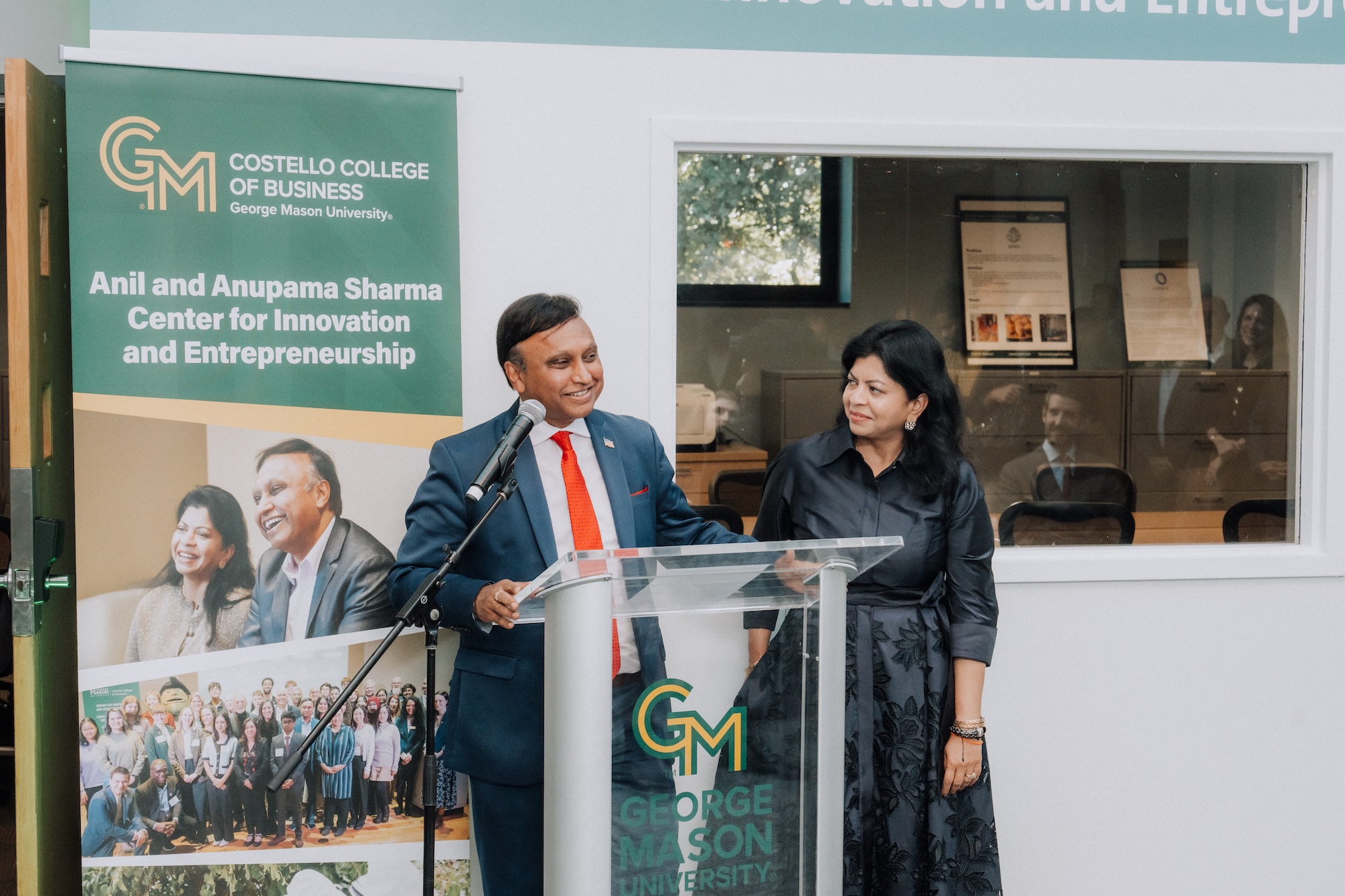
The center, he said, represents more than putting the Sharma family name on a university facility.
“It’s just not putting our name, it’s putting our values. And our values are education, innovation, entrepreneurship and service to the community,” Sharma said.
Those values are tied to an ambitious vision. Sharma said he wants the center to help create what he described as a “local Silicon Valley in Northern Virginia” — an ecosystem where students with promising ideas can find mentors, technology, capital and connections to turn those ideas into businesses.
“Imagine a student walking in it’s centered with the idea, getting the mentorship, getting the technology, getting an ecosystem a capital and converting that idea into the business that’s what we want to build here,” he said.
Sharma also envisions the center as a meeting ground for government, industry, academia and entrepreneurs, particularly around emerging fields such as cybersecurity, quantum computing and biotechnology.
That vision fits into George Mason’s broader strategy as technological change, particularly artificial intelligence, reshapes the workplace, university President Gregory Washington said.
Washington noted that universities are preparing students for a labor market whose future is increasingly difficult to predict. Entrepreneurship provides another pathway — allowing graduates to create opportunities rather than simply compete for existing ones.
“We are going through a once in a generational change in technology and we actually don’t know the net effect that technology is going to have on jobs or on people,” Washington said.
George Mason, he added, is particularly well positioned because of the combination of students, entrepreneurs and the Northern Virginia business community, along with its proximity to the federal government.
“We think we actually have the right mix of entrepreneurs coupled with our students coupled with this community and connected to the largest customer in the world we believe that we are actually well situated for success and our students are going to be well situated for success,” Washington said.
Costello College of Business Dean Ajay Vinz said the Sharma Center will extend beyond its physical location in Fairfax, with a presence at George Mason facilities in Arlington and Mason Korea.
The goal, he said, is to expose students to entrepreneurship as something they practice rather than simply study.
“This is not just about talking about business this is actually doing business,” Vinz said.
The center will encompass a broad spectrum of entrepreneurship, from social ventures to technology companies, and draw on resources from across the university to create a more integrated entrepreneurial ecosystem.
For George Mason Rector Sumeet Shrivastava, the ceremony represented a full-circle moment. A 1994 Mason MBA graduate, Shrivastava said the original Center for Innovation and Entrepreneurship helped draw him back into the university community after years focused on work and raising a family.
He joined the center’s board shortly after its launch in 2014 and said he had watched Mason alumni build successful businesses throughout the region.
“I honestly could not think of a better family than the Sharma family to attach our name to,” Shrivastava said.
He also addressed the Sharmas’ children, describing the gift as an investment whose impact could stretch across generations.
“This is nothing more than a thank you for what you guys are doing to enable this next generation,” he said.
Juan Pablo Segura, assistant secretary of state and former Virginia secretary of commerce and trade, said his time in state government gave him a close-up view of the innovation occurring across Virginia, from cancer therapeutics to technologies aimed at reducing energy consumption in data centers.
He said entrepreneurship is critical to ensuring that emerging technologies become tools for solving real-world problems.
“It’s the tools that going to the hands of the entrepreneurs that are the ones that actually solved the problems in our community,” Segura said.
Earlier, prior to the ribbon-cutting ceremony, Rep. Suhas Subramanyam, D-Va., thanked the Sharma family for its broader involvement in the Northern Virginia community and underscored the importance of small businesses to Virginia’s economy. He said entrepreneurship and innovation were particularly appropriate areas for George Mason to emphasize as Northern Virginia seeks to strengthen its standing as a technology hub.
“There’s no better initiative to put a George Mason as we become the next Silicon Valley that an entrepreneurship and innovation initiative,” Subramanyam said.
For Sharma, however, the ultimate measure of the center’s success will not be the prominence of the family name on the building but what students eventually create inside it.
He credited Anupama Sharma and their children, as well as colleagues and others who supported his entrepreneurial journey, noting the sacrifices that accompanied years of building a business.
Now, he said, the goal is to turn the opportunities his family received into opportunities for others.
“Even if one entrepreneur or one student get to the center and able to convert his idea into business or even if we are able to have few students who can create jobs from the center and then create opportunities for others that will be worth putting your name to the center,” Sharma said.