



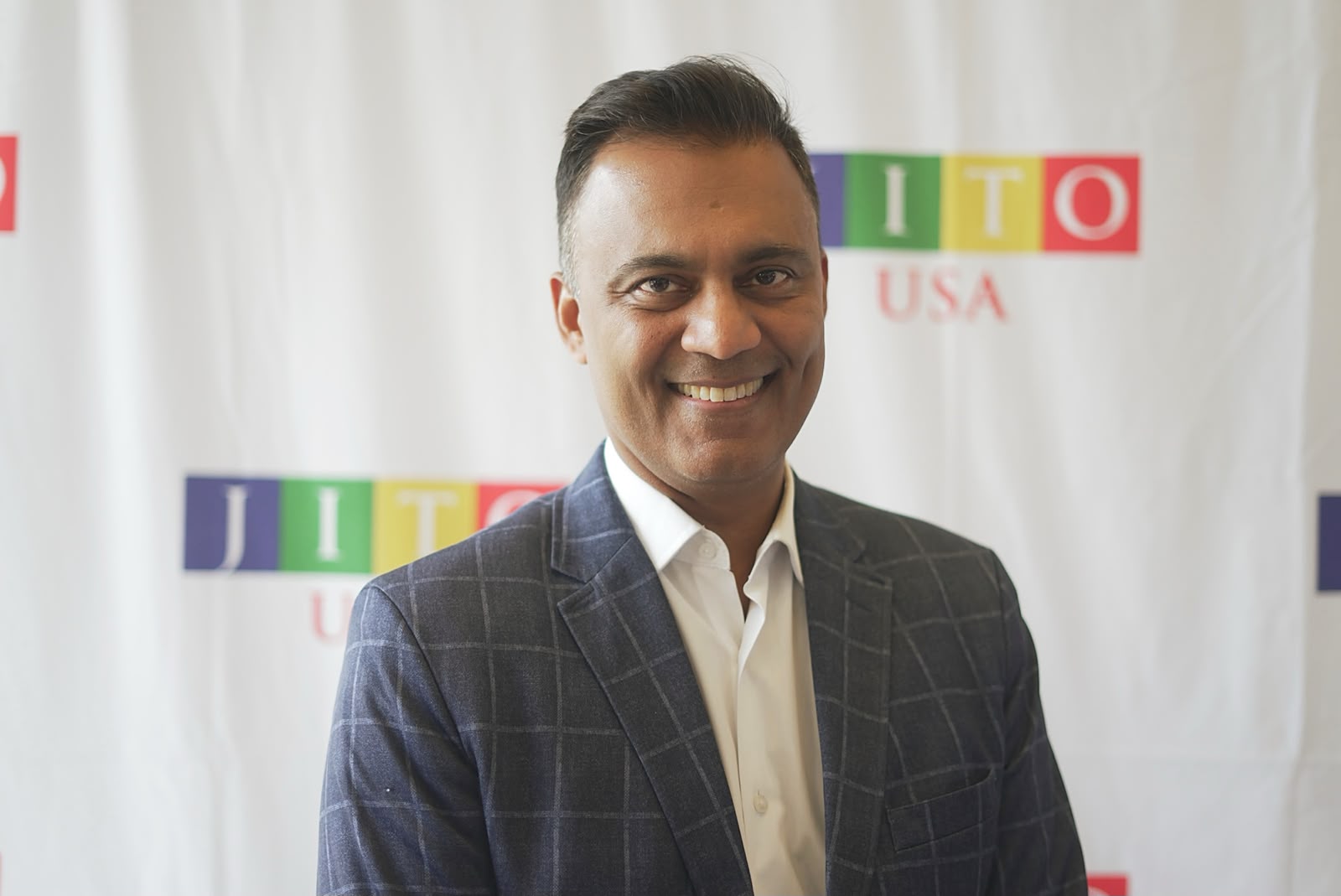
At a packed gathering in New Jersey, the Arizona congressman-elect thanked the community that helped propel him to Congress and outlined his vision for advancing Jain values, combating hate and promoting healthcare, animal welfare and responsible AI.
By Praveen Prasan
The applause was thunderous as Amish Shah walked onto the stage at the Jain Center of New Jersey on Sunday, November 15.
It was the kind of welcome usually reserved for a rock star. But for the nearly 500 people gathered in the sprawling conference hall, Shah was something more: one of their own who had just made history.
Only 12 days earlier, the Indian American physician and former Arizona state legislator had been elected to the U.S. House of Representatives from Arizona’s 1st Congressional District. Along with Pia Dandiya, who won in Florida’s 22nd Congressional District, Shah became one of the first two members of the Jain community elected to the U.S. Congress.
For the Jain community, whose members have long made their mark in business, medicine, technology and philanthropy, the election represented a new milestone in political representation.
And the enthusiasm in the hall was unmistakable.
The occasion was the AI for Business Summit organized by the Jain International Trade Organization (JITO), which brought together entrepreneurs, professionals and industry experts to explore the growing role of artificial intelligence in business.
The conference hall was packed with a predominantly young audience, roughly a quarter of them women. Scores more watched the proceedings through a livestream.
While the day’s agenda focused on emerging technologies and business opportunities, Shah’s appearance added a celebratory dimension to the gathering.
“His presence was very electrifying. It created huge enthusiasm,” Dr. Sushil Jain, chairman of JITO USA, told The American Bazaar.
‘We did it!’
Shah wasted little time acknowledging the magnitude of the moment.
“I am going to cut to the chase. We did it!” he declared as he began his address.
He recalled standing on the very same stage three years earlier, telling Jain community leaders of his ambition to take the next step in his political career.
Having become the first Jain elected to the Arizona legislature, Shah had set his sights on Congress. At the time, it was an ambitious aspiration. Now, he was returning as a congressman-elect.
READ: Jain Americans celebrate historic election of Pia Dandiya, Amish Shah to Congress (November 5, 2026)
There was another reason to celebrate. The community had not elected just one member to Congress, but two.
Shah spoke warmly of Dandiya, whom he had come to know during the election cycle, and of the Jain upbringing they shared. Both had grown up attending Jain temples and absorbing the religious and ethical traditions that would later shape their lives.
For Shah, who grew up in Chicago, the Jain Center of Chicago was an important part of that upbringing.
But the central theme of his opening remarks was gratitude.
He thanked the Jain community for supporting him over several years, recalling the countless phone calls he had made seeking help for his political campaigns.
He joked that community members who had endured those calls should not expect them to stop now that he and Dandiya had been elected.
Behind the humor was a serious acknowledgment of the role community support had played in their victories.
Shah told the gathering that neither he nor Dandiya could have reached Congress without the support of those who believed in them.
A story of immigration, generosity and Coca-Cola
One of the most personal moments of Shah’s address came when he traced his family’s journey to the United States to an unlikely encounter in a crowded Mumbai marketplace.
The story began in Zaveri Bazaar in south Bombay in the late 1950s.
On a sweltering day, a retired American judge named Mark Howard was walking through the market when he began feeling faint.
Two brothers who operated a small diamond shop noticed his distress and brought him inside, where they offered him a can of Coca-Cola.
The gesture sparked a conversation.
The brothers spoke of their desire to establish business connections in the United States. The judge, in turn, discussed changing American attitudes toward immigration and the possibility of opportunities for people from countries such as India.
That encounter, Shah recounted, eventually led to the judge sponsoring a younger sibling of the brothers to study engineering in the United States.
It was a decision that changed the course of Shah’s family history.
Shah credited the encounter, and the generosity shown that day, with making his own American journey possible.
He also drew laughter from the audience with a lighthearted observation about the lasting significance of the soft drink in his family’s story: They still do not drink Pepsi at home.
For Shah, however, the anecdote illustrated something far more profound.
His mother had shared the story with him to teach him about seva, the Jain principle of selfless service, and the importance of extending generosity to others.
It was a lesson he said had guided his own life.
Shah went on to become an emergency physician, practicing at Mayo Clinic in Arizona and working for the National Football League.
He spoke about the many people who had supported him along the way, including teachers, guidance counselors and members of the Jain community.
The only meaningful way to repay that support, he suggested, was to help others.
That philosophy eventually drew him into public service.
Taking Jain values to Capitol Hill
Shah’s speech was not confined to reflections on his personal journey or expressions of gratitude.
He also outlined what he hoped to accomplish in Congress and how his Jain upbringing would inform his approach to public policy.
One principle he emphasized was anekantavada, the Jain philosophy that recognizes the existence of multiple perspectives.
Shah credited the principle with helping him work across party lines during his tenure in the Arizona House of Representatives.
Rather than dismissing political opponents or treating disagreements as moral battles, he said he had sought to understand and respect different viewpoints.
He pointed to his legislative record, saying he had succeeded in getting more bills signed into law than any other Democrat in the Arizona House over a decade.
Shah said he hoped to bring that same bipartisan, practical approach to Washington.
He also sees his new position as an opportunity to introduce more Americans to Jainism.
Despite the community’s achievements in business, medicine and other fields, Jainism remains relatively unfamiliar to many Americans.
Shah said he wanted to use the visibility of congressional office to raise awareness of Jain religious traditions, values and celebrations, including Mahavir Jayanti.
Animal welfare is another priority.
A vegan and longtime advocate of animal protection, Shah said he intended to continue in Congress the advocacy work he had pursued as a state legislator.
He also addressed the rise in anti-Indian hostility, an issue that has increasingly troubled sections of the Indian American community.
Referring to an incident involving a Hindu temple in Illinois, Shah said elected officials had a responsibility to stand against hatred and reassure communities that they were not alone
His remarks reflected a broader concern that the visibility and influence of Indian Americans have not insulated the community from prejudice or hostility.
On economic policy, Shah criticized tariffs that he said were hurting Indian entrepreneurs and called for Congress to reclaim greater authority over trade policy.
AI, human dignity and the future
Although Shah’s appearance was a celebration of a political milestone, he also connected his message to the summit’s central theme: artificial intelligence.
The conference brought together business leaders, entrepreneurs and technology professionals interested in the opportunities and challenges created by rapid advances in AI.
For many attendees, the focus was on how artificial intelligence could transform their businesses, improve productivity and create new opportunities.
RELATED: JITO hosts AI for Business Summit in New Jersey (November 16, 2026)
Shah approached the subject from the perspective of a future lawmaker.
He said he was deeply involved in AI safety and believed the technology should be developed and deployed with human dignity, safety and prosperity as central considerations.
With Congress expected to confront increasingly complex questions about artificial intelligence in the coming years, Shah said he hoped to help shape legislation governing the technology.
He also suggested that Jain ethical principles could provide a useful framework for thinking about AI’s impact on society.
It was a particularly relevant message for an audience gathered to explore the business applications of a technology whose rapid development has raised questions about employment, privacy, public safety and the responsibilities of companies deploying it.
Why he entered politics
Toward the end of his address, Shah returned to a subject close to his professional and personal life: healthcare.
As an emergency physician, he has witnessed firsthand the financial anxiety that can accompany medical emergencies in the United States.
He recounted an encounter with a 39-year-old woman who arrived at his emergency department suffering from a severe allergic reaction.
Her throat was closing, her tongue was swelling and she feared she might die.
The medical team quickly began treatment, administering medications to stabilize her condition.
But even as the woman’s health improved, another fear remained.
She was the primary breadwinner for her family and worried that the emergency room visit would leave her facing an unaffordable medical bill.
Shah recalled that when she asked whether he could assure her she would not receive a $10,000 bill, he could offer no such guarantee.
What made the encounter particularly troubling, he said, was what he subsequently learned about the woman’s employment.
She worked multiple jobs, including driving for Uber. Her primary job was in another emergency department.
For Shah, the encounter illustrated a contradiction in the American healthcare system: A person who worked to care for others could still face financial hardship when she needed emergency medical care herself.
He described the situation as unacceptable in a country with America’s wealth and resources.
He promised to continue advocating for healthcare reform during his time in Congress.
The story brought his address back to the principle of seva that had shaped his upbringing: using one’s opportunities and abilities to help others.
A milestone for the community
For the Jain community gathered in New Jersey, Shah’s appearance represented something larger than an election victory.
Jains have established a substantial presence in American business, technology, healthcare, academia and philanthropy. But representation at the highest levels of elected government had remained limited.
The election of Shah and Dandiya marked a new chapter in that history.
“We are immensely proud that he and Florida’s Congresswoman-elect Pia Dandiya have achieved this new milestone and was able to break the grass ceiling,” said JITO USA Chairman Dr. Sushil Jain.
For Jain, a former Consultant to the White House and the U.S. Capitol, the significance of the election extended well beyond the political success of two individuals.
“We are looking to his leadership to see that principles of Jain values will reach the mainstream.”
For JITO USA, an organization that emphasizes entrepreneurship, economic empowerment, community service and professional networking, their success also illustrated the possibilities of collective action.
The audience that assembled for a day of discussions about artificial intelligence had witnessed a different kind of transformation: the emergence of a new generation of political leadership from within the community.
Shah ended his remarks by thanking the people who had supported him and expressing hope that he and Dandiya could help introduce Jain values to a wider American audience.
For those in the packed hall, it had been an occasion to celebrate a historic first. For Shah, it was also an opportunity to acknowledge the community that had helped him reach Congress and explain what he intended to do with that responsibility.
The applause that greeted him captured the excitement of the moment.
But as his speech made clear, the next chapter would be about what he and Dandiya could accomplish in Washington.