




HYDERABAD, India — When Nina Davuluri became the first South Asian woman to win the Miss America title in 2013, the significance of the moment was quickly overshadowed by another question: Was she too dark to be considered beautiful in India?

More than a decade later, Davuluri is still asking versions of that question. This time, she is asking it through film, and in the country where the question was first asked about her.
On Oct. 7, her documentary “COMPLEXion” was screened in India for the first time, at Goethe-Zentrum Hyderabad. Getting it there was not easy.
“Some of the responses I received about the film were, ‘Oh, colorism doesn’t really exist here,'” Davuluri said in an exclusive interview with The American Bazaar ahead of the screening. “And I know that to not be true, because the film was filmed here.”
India is not a distant subject for her.
“I grew up coming here every summer. My grandparents raised me in Vijayawada for two years,” she said. “I feel deeply connected to my culture, and I celebrate it.”
READ: AI won’t fix education on its own. Chaula Gupta explains what schools need (September 19, 2026)
The pushback, she said, only meant there was more work to do.
“As a filmmaker, as an activist, you don’t just give up when someone says no, otherwise you would never keep going,” she said. “I’m used to more no’s than yeses. … The choice to keep going was a very easy one, because I knew I was right.”
Before the lights went down, she said she was “happy, honored, excited,” and curious about who would show up and where the conversation would go.
“I think it’s going to resonate quite a bit,” she said.
In the interview and at the screening, Davuluri spoke about the ways skin color can shape how people are treated, how beauty is defined and how people learn to see themselves. She also spoke about where she believes change has to begin: at home.
“If I do not practice what I preach, I cannot come out here and do this,” she said during the panel discussion that followed the film. “I cannot sit here and say this if I do not have the hard conversations in my own home.”
The documentary, released in 2023, examines colorism and the global pressure to have lighter skin. It looks at skin-lightening practices, workplace discrimination, relationships, marriage and the historical roots of the preference for lighter skin.
“Do you have a cream that will make me lighter?”
For Davuluri, the subject is personal.
She was born in Syracuse, New York, and spent part of her childhood in Oklahoma before moving to St. Joseph, Michigan. Her parents are from Vijayawada, Andhra Pradesh, and she grew up traveling to India and learning Indian classical dance.
Her first encounter with colorism came long before pageantry: “way before,” she told The American Bazaar. Summers in India meant a steady stream of skin-whitening cream ads, with Fair & Lovely as what she called “the hero product.”

Then, at 8, she developed a patch of eczema during a summer visit.
“My uncle took me to the dermatologist, and the dermatologist looked at it and said, ‘Oh, apply this cream, it should get better.’ And I couldn’t have cared less,” she said. “I said, ‘Do you have a cream that will make me lighter?’ And I was 8, right?”
That moment, she said, is part of why she made the film.
“I knew I felt that way at 8 years old, but I couldn’t put into words why,” she said. Answering the question of why “we believe that,” she said, was an important one for her.
“Colorism is racism’s sister”
When she won the Miss America crown, Davuluri faced both racism and colorism.
“I did receive a lot of racist and xenophobic comments after I won. I was called a terrorist. I was called Miss 7-Eleven,” she told The American Bazaar.
Davuluri, who says she has always viewed herself as “first and foremost American,” said the win was also celebrated by South Asians around the world. But the celebration had a shadow.
“And then there’s this other side of the conversation, right? Is Miss America too dark to be Miss India? Would I have ever won?” she said.
READ: ‘Go back to India’ to online threats: South Asian Americans face rising hostility as anti-immigrant sentiment grows (September 6, 2026)
She sees the two forms of bias as related.
“Colorism is racism’s sister,” she said. “They are definitely connected.”
Winning Miss America did not erase the messages Davuluri had absorbed about what her skin was supposed to look like. It gave her a larger platform to challenge them.
The girls who are learning to dislike their skin
One of the most striking parts of “COMPLEXion” is its attention to young girls.
Davuluri spoke with girls from different parts of India, including girls at an orphanage in Kolkata, about skin color and beauty. She was once one of them, an 8-year-old asking a dermatologist to make her lighter. She said she was grateful to have those conversations because no one had them with her when she was growing up.
The stories complicate a common assumption about skin-lightening products: that they are primarily an issue among women from poorer communities.
Davuluri found that girls from different socioeconomic backgrounds had been exposed to the same messages: that lighter skin was more beautiful, more desirable or more likely to bring social approval.
The products may change. The advertisements may change. The language may change.
The message remains familiar.
Be lighter.
Be prettier.
Be more desirable.
And perhaps, the documentary asks, be more successful.
Davuluri hopes to change that last association. She wants her own complexion to be associated not with a limitation, but with success.
That idea runs through “COMPLEXion.” The problem is not simply that people use skin-lightening products. It is that many people have been taught to believe they need to change themselves in the first place.
From Bollywood to the beauty aisle
In India, the preference for fair skin is hardly confined to skin care.
Bollywood and regional film industries, including Tollywood, have long shaped ideas about beauty and desirability. The bias also shows up in the makeup aisle.
“Growing up, it was hard to find my shade. And I think it’s still hard,” Davuluri told The American Bazaar.
On a trip to a Sephora store in Mumbai in January, she said, she expected to find her shade at every brand. Only about two brands carried it.
“I was still not represented in a country that I am from,” she said. She added that she finds more inclusive shade ranges when shopping in the United States.
The consequences extend well beyond appearance.
“COMPLEXion” examines how colorism can influence workplace perceptions, relationships and marriage. It also looks at matrimonial websites, where skin tone can become one of the criteria used to evaluate a potential partner.
For women in particular, the pressure can be difficult to separate from the idea of marriageability. A darker complexion can become something families worry about, something women are encouraged to “correct” and something prospective partners are taught to judge.
Asked why colorism runs so deep in South Asian communities, Davuluri said there is no single answer.
“It’s family, it’s colonialism, it’s casteism, it’s white supremacy, it’s beauty standards,” she said. “There are so many threads to pull at that it’s not a simple answer. I think it’s all of it combined. And then also, what are we saying to ourselves?”
“It’s just how she is”
Davuluri said the people in her film are not strangers to the audiences who watch it.
“You know these people. These people are your friends, your neighbors, yourselves,” she said at the screening. “You see so much of yourselves in them, and that’s how I felt filming it.”
Her own turning point came through one of her best friends.
“She had just had a baby, and her mom came over and said, ‘Oh, don’t put the baby out in the sun. [They’re] going to get too dark,'” Davuluri said. “And I said, ‘Oh my gosh, what did you say to that?’ And she said, ‘Well, what am I going to say? It’s just how she is.'”
Davuluri does not see comments like that as cruelty.
“It is not coming from a malicious place,” she said. “I do think it’s coming from a parent wanting the best for their child.”
But she believes her generation is in a position to stop those comments from being passed down.
“We sit in such a unique seat, where we have this opportunity to actually bridge the gap between our grandparents, our parents and the next generation,” she said.
She told her friend that if she did not speak up to her mother now, her daughter would grow up hearing the same comments.
“You have to make a decision to say, ‘I do not want this to continue in my home,'” Davuluri said. “The onus is on us, unfortunately, but in a positive way, we have the opportunity.”
“Why do you think that, Auntie?”
Davuluri said she tries not to raise a problem without offering some kind of solution. Her own approach starts with curiosity.
She recalled a gathering at her aunt’s home. One of the visiting aunties remarked over tea that someone “used to be so much more fair” when they were younger and had gotten darker.
“I was obviously about to say something, but there’s a kind way to introduce it,” Davuluri said. “I was like, ‘Oh, why do you think that, Auntie? Why do you feel that way? Tell me more.'”
“It’s sensitive and it’s hard,” she said. Asking a question, she added, “is usually a more thoughtful entry point that I found for myself.”
This time, she didn’t need to. Her aunt, who appears in the film and whom Davuluri describes as being like a godmother to her, spoke first.
“[She] said, ‘Oh, we can’t say things like that anymore, because Nina’s really sensitive to it,'” Davuluri said. “And I was like, I am happy to be the sensitive one in our family if this is the result.”
A question of respect
For Davuluri, the stakes go beyond self-esteem.
She works with Sakhi for South Asian Survivors, a New York-based organization that addresses gender-based violence in South Asian communities. Davuluri said skin color is one of the factors in domestic violence against South Asian women, and that women with darker skin are more likely to experience it.
That is why she frames the conversation at home as one about respect, not appearance.
“It’s not even a beauty standard,” she said. “It is respect, coming from a human standpoint: This is who I am. This is how I came on this earth.”
She encouraged people to approach these conversations from an “I feel” standpoint, and even to simply say: I want to feel respected.
“What has beauty cost?”
The title “COMPLEXion” is deliberately double-edged. It points to complexion, the physical color of someone’s skin, but also to the complicated emotions and social pressures attached to it.
At the center of Davuluri’s work is a larger question: What has beauty cost?
For generations of South Asians, the answer has been difficult to escape. It can appear in advertisements, family conversations, film, social media, marriage discussions and casual comments about someone’s complexion.
Dark-skinned people can be given nicknames they did not ask for. Children can learn early that “fair” is a compliment and “dark” is an insult.
Davuluri’s documentary asks what happens when those messages become so ordinary that people stop recognizing them as discrimination.
Changing an ideology, not banning a product
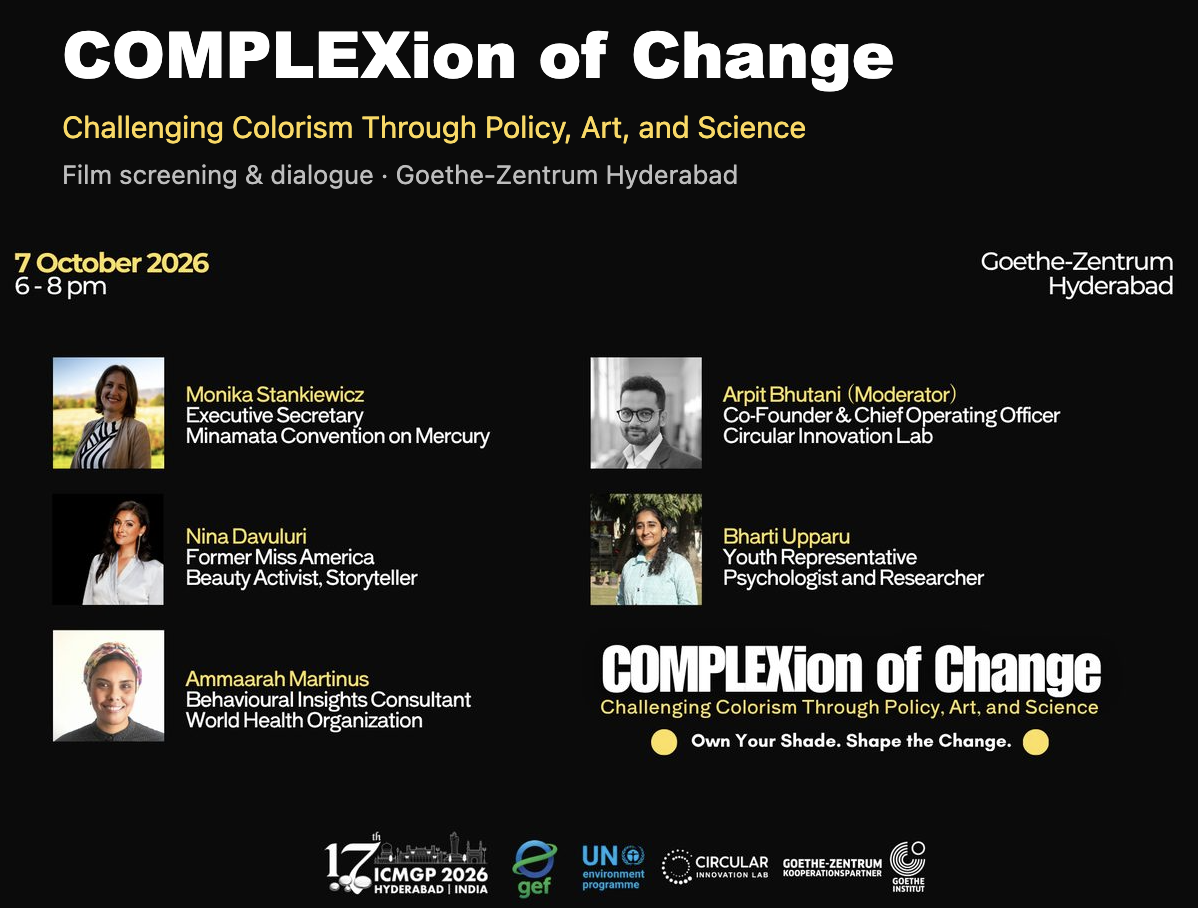
The Hyderabad screening was part of “COMPLEXion of Change: Challenging Colorism Through Policy, Art and Science,” a film screening and dialogue organized by the U.N. Environment Programme’s Global Mercury Partnership, Circular Innovation Lab and Goethe-Zentrum Hyderabad. The panel included:
- Monika Stankiewicz, executive secretary of the Minamata Convention on Mercury
- Ammaarah Martinus, a behavioral insights consultant with the World Health Organization
- Bharti Upparu, a psychologist and researcher who served as youth representative
Arpit Bhutani, co-founder and chief operating officer of Circular Innovation Lab, moderated.
The event connected the film’s discussion of skin-lightening practices with another concern: mercury-containing cosmetics. Mercury is toxic, and the Minamata Convention, a global environmental treaty, seeks to reduce mercury pollution and protect human health and the environment.
Davuluri’s partnership with UNEP grew out of the agency’s awareness work on mercury as a global pollutant, which includes a track on toxic beauty.
“The majority of beauty products that have mercury in them are skin-whitening and lightening products,” she told The American Bazaar. The agency reached out after seeing her film. “I’ve been waiting for this moment, to be able to work with them in the right capacity.”
READ: The $4,200 IVF option: What Indian Americans may overlook when leaving the US for fertility care (September 16, 2026)
The issue was not only whether people should feel better about having darker skin. It was also about what people are willing to put on their bodies when they have been taught that their natural skin is not good enough, and about the industries that can profit from that insecurity.
Still, Davuluri does not believe bans are the answer.
“I’m not about banning a product. People are going to find more harmful ways to achieve this standard,” she said during the panel. “That’s not what matters. It’s how you change an ideology, and that is through marketing and storytelling.”
In 2020, major beauty companies announced that they would drop words such as “fair,” “white” and “light” from their skincare marketing.
“I do feel like even here, we’ve seen a little bit of that shift,” Davuluri said. “It’s slowly starting to happen.”
L’Oréal later invited her to join an advisory board, where she said she has had “very nuanced conversations about inclusive marketing.”
“I’m so grateful to have a seat at that table, to be involved in that room and to have representation there,” she said.
But she acknowledged that marketing alone will not end colorism.
“There are a lot of factors that have to work together. It’s business, it’s policy, it’s politics, it’s environmental,” she said. “So many things have to come together to really create change, and I think that takes generations.”
“The time for being sweet and nice is over”
Not everyone at the event favored a gentle approach.
“I don’t think we should advocate for being polite, because honestly, politeness gets us nowhere. […] we’re fighting a country where women’s safety itself is an issue. Women get raped and people walk away scot-free. Colorism is somewhere at the back. […] It’s not even, like, discussed anywhere else. We’re fighting different battles. So I think the time for [women] being sweet and nice is over,” said Indian actress Varalaxmi Sarathkumar, who voiced her support for Davuluri and her advocacy as a member of the audience.
Davuluri acknowledged that speaking up comes at a cost.
“[Say it] out loud and recognize that you are going to upset people along the way, but those aren’t the people that we care about for change,” she said.
Martinus closed the discussion by urging people not to discriminate based on skin color and to look beyond appearance to who people are.
The next chapter: “Killing Miss America”
Davuluri’s next project turns the lens on herself.
Her memoir, “Killing Miss America,” is set for release in 2027. She told The American Bazaar it covers her upbringing, her mental health journey, her family, and “what it means to be South Asian, what it means to be American and what it means to come from a background of many cultures.”
“Everything I’ve done so far, I’ve been in it, but it hasn’t necessarily always been about me deeply,” she said. “This is fully me.”
The book ends with her relationship with her now-husband, which she said she has not yet talked about publicly.
“It does have a happy ending. I’m happy to say that not all memoirs do,” she said. “We have to go through a lot to get there, but we’ll get there.”
For Davuluri, the most important part of her work may be what happens after the film ends.
A young girl watches a documentary. She hears someone say that dark skin is not something to apologize for. She sees a woman who was once told she was too dark become Miss America.
And perhaps, the next time someone tells her she would be prettier if she were lighter, she questions it.
That is the change Davuluri appears to be chasing: not simply a different beauty campaign, but a different definition of beauty itself.
The conversation that began with a crown has become something much larger. It is about the girls who are still learning what beauty means. It is about the women who have spent years trying to change something that was never wrong. And it is about whether the next generation can grow up without having to choose between being comfortable in their own skin and being considered beautiful.
Because the question is no longer whether Nina Davuluri was too dark to be Miss India.
The question is why being dark was ever considered a reason she could not be.