



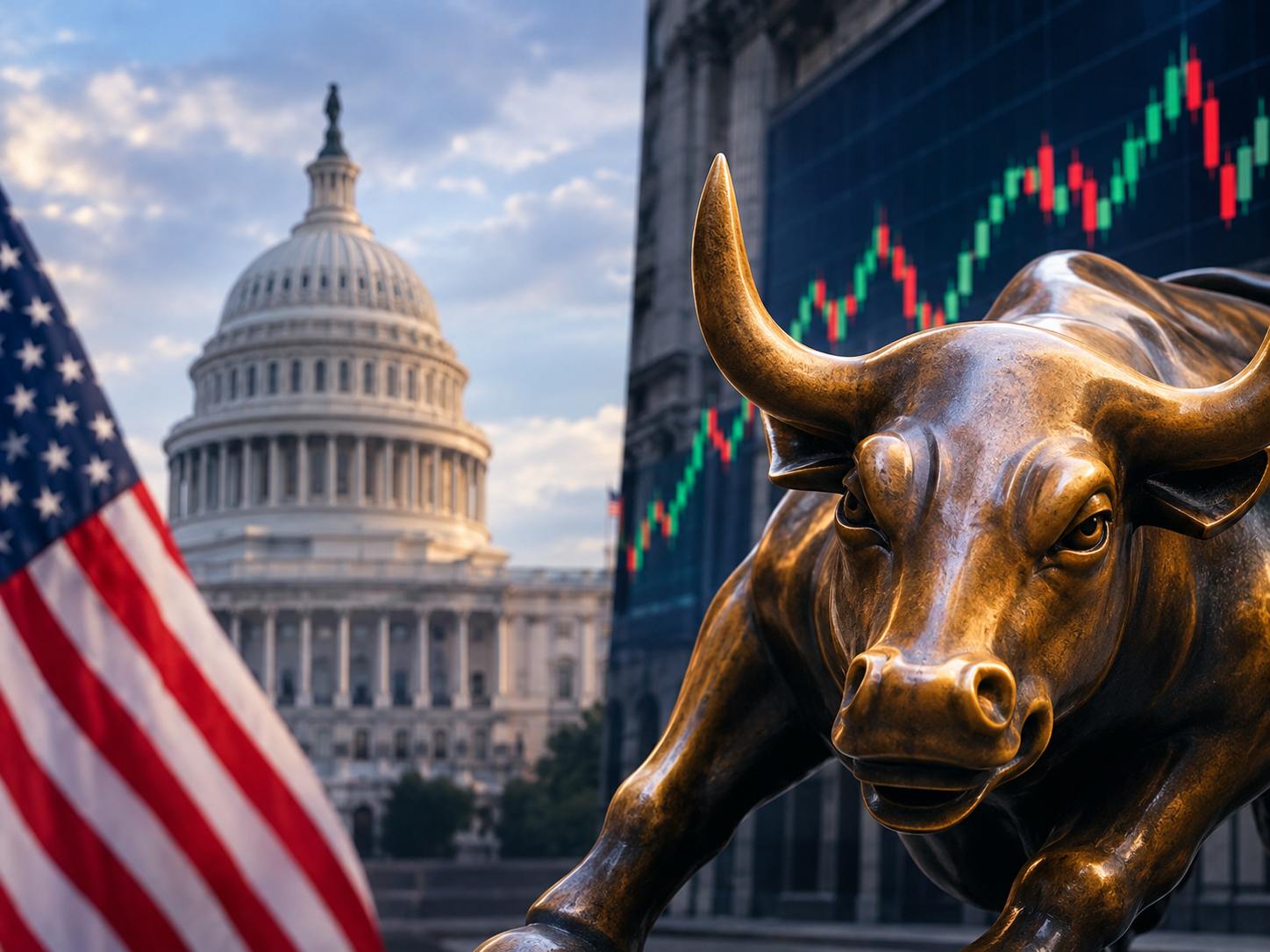
Every election season brings the same question: will the market crash once the votes are counted? This year, I think it is the wrong question. The midterms on November 3 will matter less for stocks than four forces that do not care who wins: the bond market, oil, the Federal Reserve, and the financing machine behind the AI boom.
A market and an economy telling different stories
The S&P 500 closed at 7,666 on October 1, up nearly 12 percent for the year. Yet the bond market has just finished its worst quarter this century, with the 10-year Treasury yield approaching 5 percent, a 24-year high. The Dow fell 4.3 percent in September while the Nasdaq rose. Leadership is narrow: technology and energy are each up roughly 37 percent this year, while much of the rest of the market is struggling.
Main Street tells a different story. Employers added just 29,000 jobs in September, and unemployment ticked up to 4.2 percent. Inflation ran at 3.4 percent in August, driven by the Iran war and the disruption of the Strait of Hormuz: gasoline is up about 27 percent from a year ago and fuel oil up 52 percent. Gas now averages around $4.49 a gallon.
The University of Michigan’s consumer sentiment index fell to 48.1, the second-lowest reading in its 74-year history. Mortgage rates sit near 7 percent, leaving housing frozen. And the Fed raised rates in September for the first time in three years.
A stock market rising into that backdrop is not irrational, but it is leaning on very few pillars.
What is holding the market up
The first pillar is AI spending, and the second is the way that spending is financed. Nvidia has committed more than $40 billion to AI equity investments this year, including $30 billion into OpenAI, which in turn buys Nvidia chips. Bloomberg tallied more than $750 billion in Nvidia deals in July, including talks to backstop as much as $250 billion for an OpenAI data center.
Critics call this circular financing and compare it to the vendor financing of the dot-com era. Nvidia argues that demand is real and that OpenAI pays the leases. The revenue is indeed real: $96.2 billion in a single quarter, up 106 percent. The question is what happens if a customer funded partly by its own supplier cannot pay.
Share buybacks are the quieter support. They do not create money, but they shrink the share count, lift earnings per share, and provide a steady buyer. They are also among the first things companies cut when conditions worsen, which removes that support exactly when it is needed.
Three scenarios after November 3
1. Relief, then a narrow grind higher. The election removes one source of uncertainty, and stocks have historically tended to do better in the months after midterms. If the September CPI report on October 14 is tame and the Fed holds on October 28 (traders put the odds near 80 percent after the weak jobs report), yields could ease and the market could finish the year at or near record highs. This is the most likely outcome, in my view, but it is a fragile one, because leadership would remain narrow.
2. Choppy and range-bound. Oil near $100 and a 10-year yield near 5 percent act as a ceiling on valuations. Money rotates between sectors, the index goes nowhere, and individual stocks do the damage. For many investors this would feel like a bear market without the headline.
3. A break lower. The triggers are not political. They are a decisive move in the 10-year yield above 5 percent, an oil spike toward the $140 to $150 range that one analyst identifies as the level where consumer pain builds rapidly, or a crack in AI financing: a failed funding round, a customer unable to meet its obligations, or earnings that disappoint after expectations this high. In that case the narrow leadership that carried the market becomes its weak point, and a correction of 15 to 20 percent would be plausible.
READ: Akhlaq Siddiq | The greatest con in American financial history has a ticker symbol: SPCX (June 24, 2026)
Does the election result matter?
At the margin, yes. A divided Congress would likely mean gridlock on spending and tariffs, which markets generally tolerate. But with yields near 5 percent, the size of the federal deficit is no longer a background issue, and investors will watch any fiscal fight closely, whoever controls what.
The view from South Asia
For readers of this column with a stake in India, the transmission channels are clear. Higher US yields and a stronger dollar tend to pull capital out of emerging markets. India imports most of its crude oil, so oil near $100 pressures the rupee and domestic inflation. A sharp US selloff would not stay in New York.
What to watch
- October 12: Q3 earnings season begins with the big banks.
- October 14: September CPI.
- October 28: Federal Reserve decision.
- November 3: Midterm elections.
- November 6: October jobs report.
Throughout: the 10-year yield at 5 percent, and oil near $100.
The election is a date on the calendar, not a catalyst. The market’s fate in November and December will be decided by yields, oil, the Fed, and whether the AI financing loop holds. Investors who size their positions so that a 15 to 20 percent decline would not force them to sell will be fine under any of these scenarios.
This column is analysis and opinion, not investment advice.