



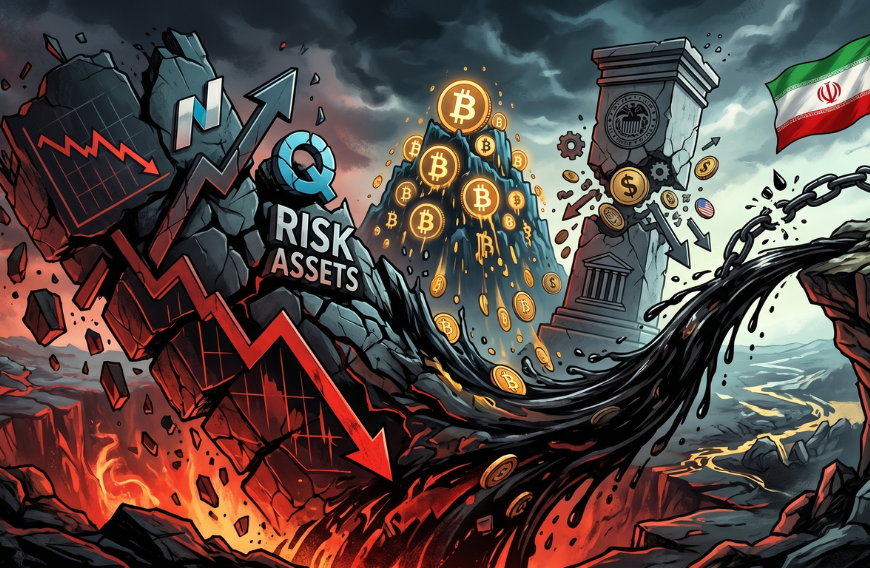
When sanctions lift on oil, few think to check their stock portfolio. They should.
The chain nobody taught in business school
There is a question circulating in trading rooms today that sounds deceptively simple: Is Bitcoin taking the Nasdaq down? The instinctive answer from most analysts is no — Bitcoin is too small, too peripheral, too volatile to move a $20 trillion equity index. That answer is wrong. Not because Bitcoin is large enough to drag the Nasdaq directly, but because both assets now share the same nervous system: the marginal risk dollar, the leveraged speculator, and the Fed’s rate expectations. Pull one thread and the whole garment unravels.
But to understand where the thread starts, you have to go back further than the crypto exchanges. You have to go to Tehran — and to the moment sanctions on Iranian oil were eased.
Oil, inflation, and the Fed’s frozen hand
The U.S.-Iran conflict that broke out on February 28 this year did something that financial markets initially misread. Traders assumed war meant safe-haven flows — into gold, into dollars, away from risk. That happened, briefly. But the more durable effect was structural: sustained conflict kept crude oil prices elevated. Higher oil means higher transportation costs, higher manufacturing costs, higher everything. In an economy already wrestling with sticky inflation, the Iran war became an inflation accelerator.
The Federal Reserve, which had been inching toward rate cuts as 2026 began, found its hands tied. Some officials began openly discussing rate hikes. The market, which had been pricing in relief, had to reprice for tightening — or at minimum, prolonged restrictiveness. When the cost of money stays high, the assets most vulnerable are exactly those that thrived on cheap liquidity: high-growth tech stocks and Bitcoin.
READ: Akhlaq Siddiq | The greatest con in American financial history has a ticker symbol: SPCX (June 24, 2026)
Here is the cruel irony. The very geopolitical conflict that pushed oil higher indirectly became the executioner of the crypto rally. Sanctions, oil, inflation, the Fed — they form a chain. And at the end of that chain, someone’s leveraged Bitcoin position gets liquidated.
Bitcoin as a Leveraged Tech Proxy — Not a Hedge
Bitcoin entered 2026 with a powerful mythology: digital gold, inflation hedge, uncorrelated asset. That mythology is now empirically dead. Bitcoin today trades with an approximately 0.8 correlation to the Nasdaq-100. More specifically, it trades with what analysts call a bearish skew — falling harder on Nasdaq down days than it rises on Nasdaq up days. The worst of both worlds: no upside capture, full downside exposure.
From its October 2025 all-time high of approximately $126,200, Bitcoin has surrendered roughly half its value. The path lower has tracked the same rate fears, the same liquidity squeeze, and the same AI valuation anxiety dragging the Nasdaq. Today, Bitcoin is probing the psychologically critical $60,000 level. Below that floor, the chart offers very little structural support.
The reason for this co-movement is not mysterious. The marginal buyer of Bitcoin in 2025 and 2026 is the same investor chasing AI stocks: a risk-appetite-driven participant who wants high-beta exposure and deploys capital across both asset classes simultaneously. When sentiment turns, that investor sells both. Not sequentially — simultaneously.
The Margin Call Contagion: How crypto panic bleeds into stocks
Here is where the analysis becomes urgent for anyone holding equity positions. The transmission mechanism from crypto panic to stock market weakness is real, documented, and currently active.
READ: Akhlaq Siddiq | India’s neutrality crisis: How optics, alliances, and regional shifts are rewriting New Delhi’s image (June 21, 2026)
It works like this. Bitcoin drops through a technical level. Leveraged long positions — traders who borrowed to amplify their crypto bets — receive margin calls. To meet those calls, they must sell liquid assets quickly. Sometimes that means selling Bitcoin at a loss. But often, especially for sophisticated traders and institutions, it means selling stock positions. Nasdaq names. AI stocks. Growth equities. Whatever can be converted to cash fastest.
On June 3 alone, $1.86 billion in crypto positions were forcibly liquidated in a single 24-hour window — the largest such cascade since February 2026. Each liquidation pushed prices lower, triggering the next wave of margin calls, in the classic self-reinforcing spiral. This forced selling does not stay contained within crypto. It radiates outward.
Strategy — the company formerly known as MicroStrategy — sits at the epicenter of this contagion risk. Holding nearly 850,000 Bitcoin on its balance sheet and funding those purchases through preferred share issuance, Strategy has become a kind of Bitcoin bank. When Bitcoin falls, Strategy’s balance sheet weakens, its preferred stock wobbles, and institutions holding MSTR shares across ETFs and portfolios face their own mark-to-market pressure. Today, MSTR fell to its lowest level since early 2024. The contagion chain is not theoretical. It is live.
The SpaceX factor: A new drain on risk capital
There is one additional variable that deserves attention, and it connects directly to a column I wrote earlier this year on SpaceX’s financing strategy. The massive SpaceX bond issuance and the anticipation of its eventual IPO have introduced a new competitor for risk capital. Sophisticated investors who might otherwise be allocating to Bitcoin or high-growth Nasdaq names are now evaluating SpaceX paper — investment-grade bonds with equity-like upside optionality.
In a world of unlimited liquidity, this would not matter. In a world where the Fed has kept rates elevated and every dollar of risk capital is rationed, a new $20 billion-plus instrument absorbing institutional attention is not neutral. It is a drain. The debate in trading circles about whether SpaceX IPO demand is pulling liquidity away from crypto markets is not fringe analysis — it reflects a genuine structural shift in where risk appetite is being allocated.
What the market is actually telling us
Stepping back, the picture that emerges is not one of isolated volatility. It is a synchronized de-risking driven by a coherent macro narrative: oil-driven inflation has kept the Fed hawkish, hawkishness has crushed liquidity, crushed liquidity has forced leverage out of the system, and leveraged positions — in crypto first, in equities second — are being unwound in sequence.
READ: Akhlaq Siddiq | The plan that was made before the oath (June 13, 2026)
Prediction markets now assign an 80% probability that Bitcoin will fall below $60,000 in 2026. A 52% probability that it reaches $50,000. The $60,000 level is not merely psychological — it represents the approximate production cost for smaller Bitcoin miners, meaning a sustained break below it begins washing out the marginal producer and reduces new supply at exactly the moment institutional demand has also retreated.
Gold and silver, which should theoretically benefit as inflation hedges, are also falling — down over 1% today, with gold approaching $4,000 from above and silver holding near $60. The debasement trade that dominated 2025 has faded. What we are left with is a world where cash, or near-cash, is the only asset not under pressure.
The view from here
Markets are sending a message that policy is too tight for the leverage that built up during 2024 and 2025. The Fed cannot cut because oil — driven by geopolitical conflict — keeps inflation sticky. And until the Fed can credibly pivot, every risk asset, from Nvidia to Bitcoin to emerging market equities, remains vulnerable to the next margin call cascade.
The investor who asks “Is Bitcoin taking the Nasdaq down?” is asking the wrong question. The right question is: who is the common seller? The answer is the leveraged risk taker who bought both, funded by the same cheap money that is now being recalled. When that seller appears, asset class labels cease to matter. Everything falls together.
Tehran set this in motion. The Fed kept the fuse lit. Bitcoin is simply where the first explosion is visible. The shock wave, as always, travels further than anyone expects.