



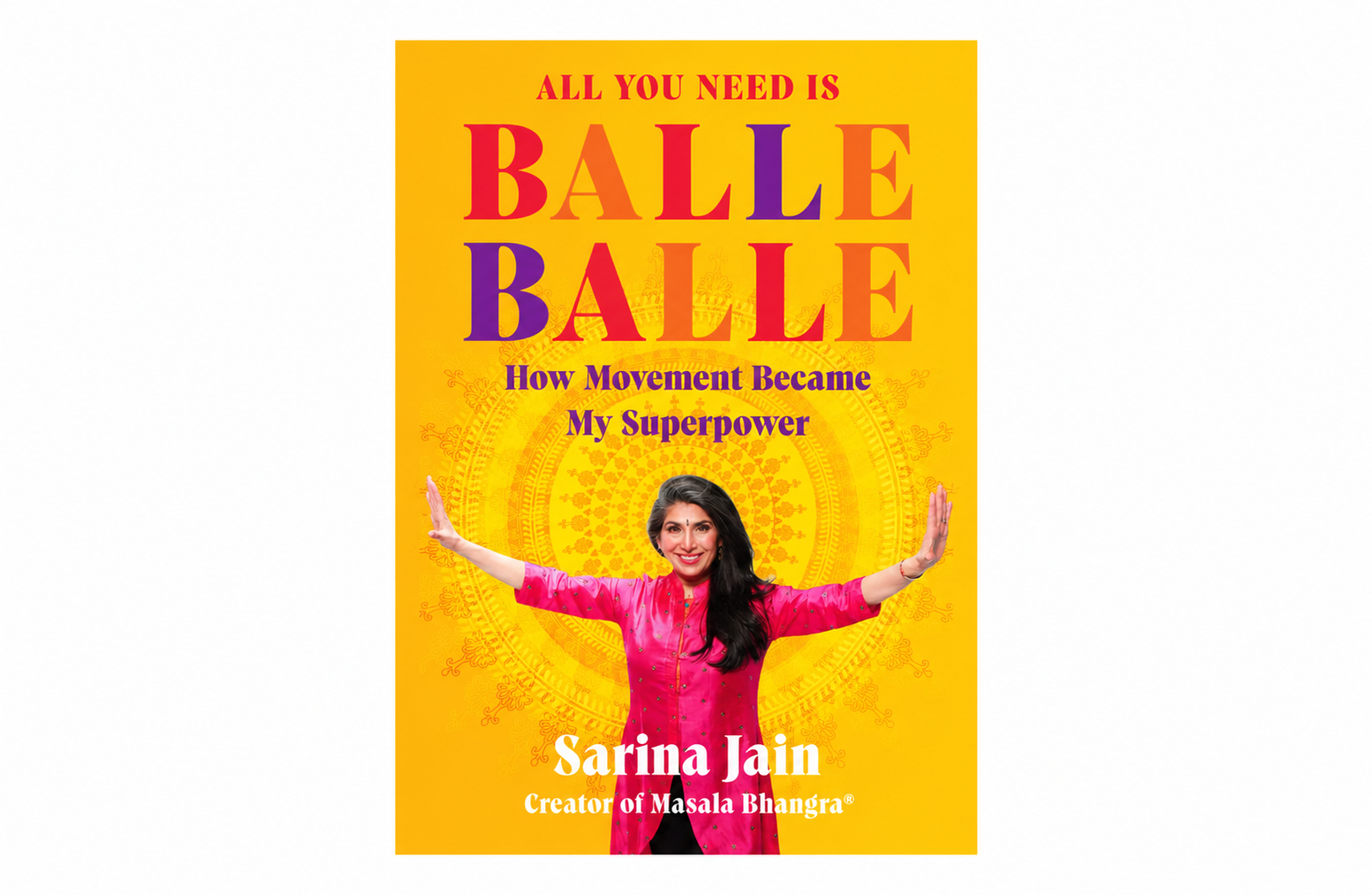
The fitness pioneer reflects on more than 25 years of Masala Bhangra, the challenges of building her brand and her new book, “All You Need Is Balle Balle: How Movement Became My Superpower,” set to release in the U.S. on Oct. 13.
For Sarina Jain, Masala Bhangra began as a way to bring Indian dance into the American fitness world. More than 25 years later, it has become a defining part of her professional journey, connecting people across cultures through music, movement and a shared love of dance.
Born into an Indian family with ancestral roots in Kolkata, Jain was raised in the United States and built her career around bringing Indian culture to a wider audience through fitness. Her new book, “All You Need Is Balle Balle: How Movement Became My Superpower,” set for release in the U.S. on Oct. 13, explores that journey — from growing up in an Indian American household to building a fitness brand from scratch and learning to move forward through difficult moments.
But the journey behind Masala Bhangra has not always been easy. Jain has faced professional setbacks, criticism and the challenges of building a career in an industry where she often felt like an outsider. Through her book, she shares the experiences that shaped her personally and professionally, including how movement became a source of strength during some of the most difficult periods of her life.
In an exclusive interview with The American Bazaar, Jain spoke about how her upbringing influenced Masala Bhangra, why she adapted Indian dance for American fitness audiences and how movement helped her navigate grief, professional challenges and questions of identity.
“I believe Masala Bhangra shaped me. You can say it both ways,” Jain said, reflecting on the relationship between her identity and the fitness program she created.
Jain grew up in the United States in a family that maintained close ties to Indian culture. Her parents, who immigrated to the U.S. in the 1970s, made a conscious effort to expose her and her sister to Indian traditions from an early age. At home, the family spoke Hindi and followed cultural practices that contrasted with the more informal American environment Jain experienced at school.
The contrast shaped how she understood her identity and eventually influenced the way she introduced Indian music and dance to a broader audience.
READ: ‘Trump is a gift that keeps giving’: Arun Kumar on his new book Trumpiana (October 7, 2026)
“Somehow, that upbringing of both cultures really shaped at least who I am today,” she said.
Today, as a mother of two, Jain hopes to pass that cultural understanding to her daughters while encouraging them to develop their own identities.
She wants them to respect themselves, the people around them and their elders, while also learning to stand their ground.
That balance between preserving cultural roots and adapting to a different environment is also reflected in Masala Bhangra.
Bringing Indian dance into American fitness
Jain describes Masala Bhangra as an Indian dance workout built around American fitness principles. The program combines Bhangra-inspired movements with elements of Bollywood dance and the structure of an aerobics class.
Rather than presenting the workout as a traditional Bhangra performance, she deliberately adapted the movements to make them accessible to people unfamiliar with Indian dance.
“I’ve modernized it just enough,” she said.
For Jain, accessibility was essential to introducing the workout to people outside the Indian community. She wanted participants to enjoy Indian music, learn the movements and leave a class feeling that they had accomplished something without being overwhelmed.
“If I was to do very traditional Bhangra, I would not be able to attract people, first and foremost,” she said.
Her approach was to create an entry point into Indian dance rather than expect every participant to understand its traditions from the outset. Those who wanted to explore Bhangra more deeply could do so after discovering it through her classes.
The response has also given her a way to see the cultural impact of her work.
Jain recalled how rewarding it is when students attend Indian weddings and confidently perform dance moves they learned in her classes. Receiving compliments from members of the Indian diaspora, who recognize the movements and appreciate how well her students perform them, has been particularly meaningful.
“That warms my heart to know that I’ve instilled culture into people,” she said.
Over the years, Masala Bhangra has expanded beyond the United States. Jain said she has taught in different countries and has instructors in 10 countries, extending the program’s reach well beyond the community in which it began.
Yet she said building the brand has involved much more than teaching classes and creating choreography.

The challenges behind building Masala Bhangra
Jain’s new book offers a more personal account of what it took to establish her career. She said people sometimes see the success of Masala Bhangra without understanding the setbacks, criticism and persistence behind it.
“There’s been a lot of ups and downs, there’s been a lot of love that’s come my way, there’s been a lot of hate that’s come my way,” she said.
She recalled how college students used her early workout videos to warm up their dance teams, find inspiration for formations and routines, or simply stay in shape. At the same time, she encountered people who challenged her approach to Indian dance and fitness.
READ: From Afghanistan to America: Hamayun Khan’s mission to give Afghan youth a new future (October 6, 2026)
Some of those critics eventually began doing similar workouts themselves, she said, albeit in traditional Indian clothing.
The experience forms part of a larger struggle she explores in the book: building a career in an American fitness industry that she described as a “white man world of fitness.”
Jain built Masala Bhangra without being hired by an organization to create the workout. She developed the program, created its instructor manual and drew on her own experience to establish a distinct fitness offering.
“No one hired me to do Masala Bhangra. No one hired me to create an Indian dance workout. No one hired me to create the instructor manual,” she said. “This is all something that I have put together, you know, based on my own experience.”
For Jain, the book is an opportunity to show readers that pursuing a passion can be fulfilling even when the path is uncertain.
She also shares personal experiences beyond her professional life, including growing up while trying to balance parental expectations with friendships, navigating cultural pressures around marriage and deciding to wait until she felt ready to choose a partner.
The book, she said, draws on the experiences and lessons she accumulated over several years rather than presenting a straightforward account of professional achievements.
How movement became her superpower
One of the most personal parts of Jain’s story is the connection between movement and grief.
She said Masala Bhangra emerged from a period of intense emotion following the death of her father, who died of a massive cardiac arrest at the age of 47.
His death was devastating for Jain, her mother and her sister. Even years later, she said, she continues to miss him and wishes he could have been present to celebrate her achievements and spend time with her children.
Looking back, Jain said movement became a way to manage difficult experiences and find the clarity to move forward.
“Every single time I was hit with a roadblock, I would go and move,” she said.
She does not suggest that exercise makes problems disappear. Instead, movement helped her calm down, think through a difficult situation and consider how to respond.
That experience became central to the message of her book and its subtitle, “How Movement Became My Superpower.”
Jain believes movement can help people develop confidence and support their mental well-being. For her, it is not limited to a particular dance style or fitness routine. It can include lifting weights, exercising or finding other ways to remain physically active.
“This is the way of life. This is what I fully, fundamentally believe, that movement is the way of life,” she said.
The idea also informs the advice she hopes readers will take from her book. She wants people who are struggling, questioning their identity or considering a new direction to give themselves permission to try something different.
“Step out of your comfort zone and try it,” she said.
From a garage to a book
Jain began writing the book in 2020. She initially developed a synopsis and outlined chapters tracing Masala Bhangra’s beginnings in her garage, its growth and her experiences teaching internationally.
But the publishing process brought its own obstacles. After trying to find a literary agent, she encountered another setback when an arrangement did not work out.
Rather than abandon the project, she returned to her notes and continued developing the story.
By then, she had years of experience building a brand independently and wanted readers to understand both the struggles and the fulfillment that came with it.
Between 2020 and 2025, she continued gathering stories from her life, eventually deciding that she had to stop adding to the manuscript and share it with readers.
Jain said she kept the writing straightforward, avoiding complicated language so that people from different backgrounds could connect with the experiences she describes.
She hopes the book will resonate not only with people familiar with Masala Bhangra but also with readers who have never taken a class or explored Indian dance.
Her message is simple: be proud of who you are, embrace your background, try new things and keep moving.
For readers growing up between cultures, she hopes the book will offer reassurance that different parts of their identity can coexist. She also encourages people to recognize that families are often doing their best, even when different generations approach life differently.
Why all you need is Balle Balle
The book’s title captures the celebratory spirit Jain has tried to bring to her classes.
“Balle Balle” is an expression of excitement and celebration familiar to many in the Punjabi community and the broader South Asian diaspora. For Jain, however, its significance extends beyond its cultural roots.
She has watched students of different ages, backgrounds and body types adopt the expression and shout it out during classes and large events.
The moment is especially meaningful because the phrase has become a shared expression among people who may not have grown up with Indian culture.
Jain said she has taught large gatherings of thousands of people and regularly sees New Yorkers join her weekly dance events in the city. Depending on the week, she said, gatherings can attract anywhere from a few dozen people to around 100 participants.
Seeing people embrace an expression she grew up around has been a source of pride.
“Who would have ever thought to take that expression and just share it with the world?” she said.
For Jain, the title also reflects the larger purpose of her work. Masala Bhangra has introduced people to Indian music and movement, but it has also created a space where participants can try something unfamiliar, connect with others and celebrate their own progress.
That spirit of exploration carries into her personal life. Jain said she encourages her daughters to try new activities, foods and experiences rather than assume they already know what they like. She believes the same willingness to explore is important for adults, too.
Her own marriage, she said, taught her something about moving beyond expectations. She spoke about waiting to find the right partner rather than marrying simply to meet a cultural timeline, and about the importance of maintaining individuality while building a life together.
Those experiences reinforce the three lessons she hopes readers will remember when they finish the book: embrace who you are, step outside your comfort zone and keep moving.
For Jain, Masala Bhangra has grown from an Indian dance workout into something that connects cultural identity with physical activity and personal confidence. Her book tells the story behind that evolution, including the grief, criticism and persistence that shaped her along the way.
After more than 25 years of building Masala Bhangra, she wants readers to see that the journey was not simply about creating a fitness brand. It was also about finding a way to move through life’s uncertainties while remaining connected to who she is.
And if the words “Balle Balle” can encourage someone to celebrate a new experience, take a first class or discover a new source of joy, Jain believes they have already served a purpose.