



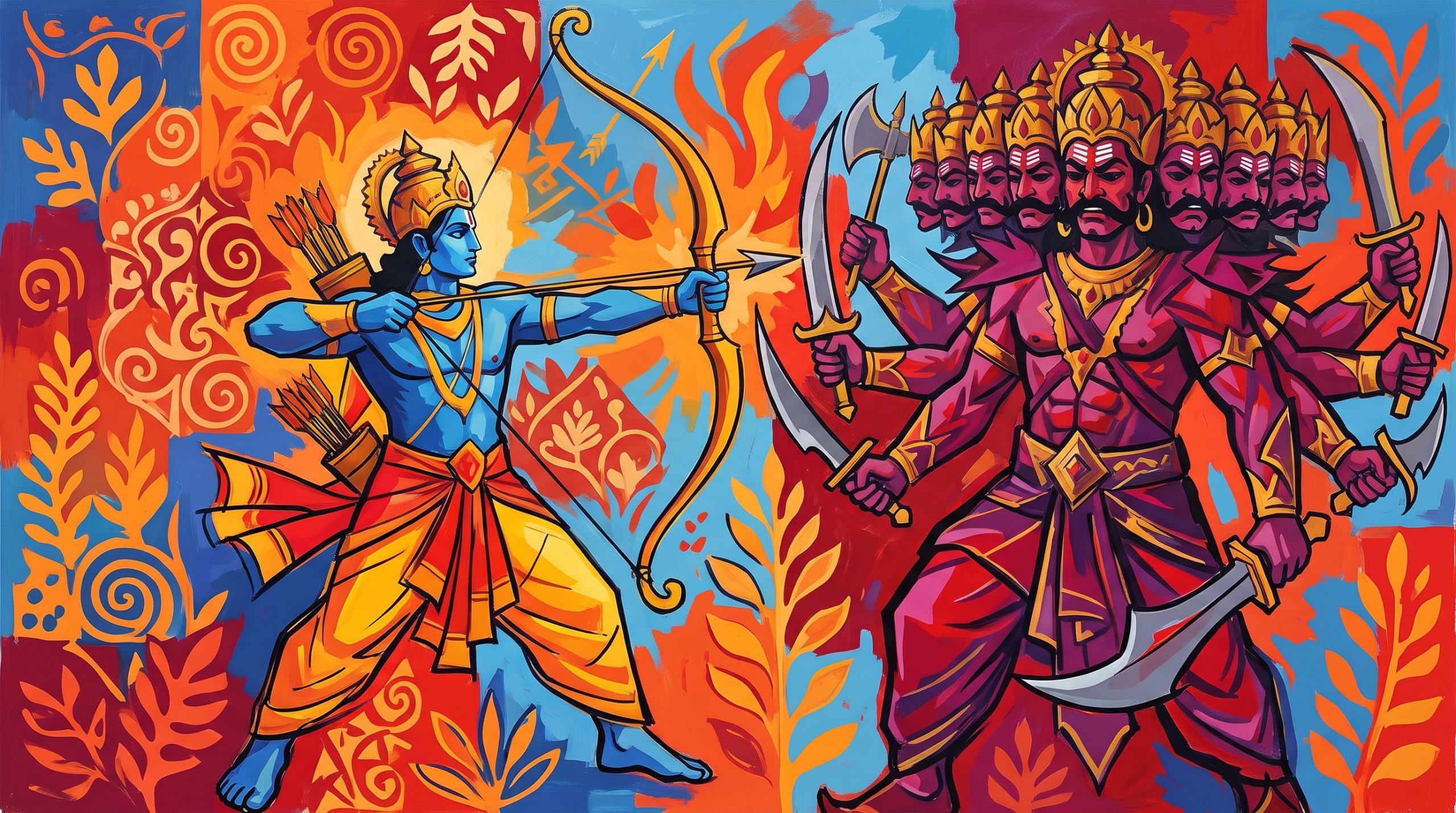
There is an electric enthusiasm surrounding the Ramayana with the release of the blockbuster movie this week.
Its larger-than-life characters, dramatic battles, elaborate visual productions, music and epic scale have captured the imagination of millions. The story of Rama’s exile, Sita’s abduction, Lakshman’s loyalty, Hanuman’s devotion and Ravana’s eventual annihilation is being retold with a renewed sense of cultural pride.
For the Indian community, this resurgence is an opportunity to reconnect with one of the most enduring narratives of our civilization. But in celebrating the spectacle, we are missing something far more important.
The Ramayana was never just a story about good defeating evil. It was an exploration of human character, the choices we make, the responsibilities we carry and the virtues that determine who we become. Its relevance is not in how spectacularly its battles can be recreated, but in how deeply its lessons can be incorporated into our lives.
And that is where we are missing an opportunity, particularly when it comes to the next generations we are raising.
The dramatic circumstances surrounding Rama ‘s and Cole from Ayodhya are central to the narrative, but the deeper lesson is about responsibility, humility and the ability to accept circumstances without abandoning one’s principles.
READ: Sreedhar Potarazu | Valmiki: The sage who teaches us that we are not defined by our past (October 27, 2026)
Rama does not measure his worth by his position, privilege or entitlement to the throne. He accepts a difficult reality and places his responsibility to his father and his word above personal ambition. In a world increasingly defined by entitlement, grievance and the pursuit of individual recognition, what does it mean to teach our children that character is often revealed not by what we receive, but by how we respond when something we believe is rightfully ours is taken away?
Rama’s virtue is incomprehensible to many today.
There is also a lesson in gratitude. Rama’s life in exile is not defined entirely by what he has lost. His relationships, his experiences and his ability to find meaning in circumstances far removed from the comforts of the palace remind us that gratitude is not a consequence of prosperity.
It is a way of seeing the world. We live in a culture that measures achievement through material possessions, professional titles and social standing. We teach our children to aspire, compete and succeed, but how often do we teach them to appreciate what they already have, acknowledge those who made their opportunities possible and recognize that privilege carries responsibility? The irony is that for present day society the simple words of please and thank you are a challenge.
Sita’s abduction is perhaps one of the most dramatic episodes in the epic. Yet reducing her story to an act of victimization misses the complexity of her character. Sita represents resilience, dignity and an extraordinary sense of self. Her circumstances challenge her, but they do not define her. Her story also invites us to confront difficult questions about trust, judgment, vulnerability and the expectations society places on women.
We should be willing to discuss these complexities with the next generation rather than simply reproduce the narrative as an unquestioned sequence of events. A civilization’s strength is not measured by how faithfully it repeats its stories, but by its willingness to examine what those stories mean.
Lakshmana represents yet another virtue that seems increasingly difficult to practice: loyalty grounded in responsibility. His decision to accompany Rama into exile is not about personal gain or recognition. It is about standing beside someone when circumstances become difficult. No matter how what.
But loyalty should also invite a broader conversation about the difference between commitment and unquestioning obedience. We need individuals who can stand by others without surrendering their capacity to think, question and exercise independent judgment. But also being able to rise above circumstances to see the broader perspective
Then there is Hanuman, arguably one of the most extraordinary representations of humility in the entire epic. His strength, intelligence, courage and extraordinary abilities are never separated from his devotion and sense of purpose. He does not seek recognition for what he accomplishes. His greatness lies in his willingness to use his abilities in the service of something larger than himself.
In an age when visibility is often mistaken for value and personal branding has become almost synonymous with achievement, Hanuman offers a very different definition of greatness. It is not how much attention we attract, but how much good we accomplish with the abilities we possess.
Even Ravana deserves a more thoughtful examination than the familiar imagery of a ten headed demon being destroyed. His knowledge, scholarship, power and accomplishments make his downfall all the more instructive.
The tragedy of Ravana is not simply that he is evil. It is that extraordinary intelligence and capability, when disconnected from humility, objectivity and respect for others, can become instruments of destruction. Knowledge does not necessarily produce wisdom.. And success does not necessarily produce good character. Perhaps this is one of the most relevant lessons for a generation that increasingly equates intelligence, wealth and influence with human accomplishment.
The battles with demons, therefore, are not merely physical confrontations between opposing forces.
They are actually representations of the struggles within human beings. Arrogance, dishonesty, jealousy, greed, insecurity and the inability to acknowledge our own limitations are not mythical creatures. They exist in our homes, workplaces, institutions and communities. The most difficult battles are often the ones we fight against our own rationalizations.
What makes the Ramayana enduring is its ability to offer a framework for understanding human behavior across generations.
Gratitude allows us to recognize what we have received. Objectivity allows us to see circumstances without distorting them to serve our interests. Open mindedness allows us to consider perspectives different from our own. Honesty demands that we confront the truth, even when it is inconvenient. Humility reminds us that our accomplishments do not make us infallible. Willingness enables us to accept difficult responsibilities, and accountability requires us to own the consequences of our choices.
Read more by Sreedhar Potarazu
These are not exclusively Indian values. They are human values. Yet the Indian community has an extraordinary cultural inheritance through which to introduce and reinforce them. If we seize this opportunity
There is an irony in the way we celebrate the Ramayana. We take immense pride in a story that has survived thousands of years, yet we rarely ask whether the values it represents have survived in our own conduct.
More importantly, are we demonstrating these virtues ourselves?
It is difficult to teach humility while pursuing status at every opportunity. It is difficult to teach honesty while rationalizing our own compromises. It is difficult to teach open mindedness when we dismiss opinions that challenge our beliefs. And it is difficult to teach responsibility when we are more interested in assigning blame than accepting accountability.
The next generation will not necessarily become better human beings simply because they have watched the Ramayana, memorized its verses or participated in its celebrations. They will become better human beings when they see its principles reflected in the behavior of the people around them.
Perhaps that is the real opportunity before the Indian community. We have an opportunity to move beyond cultural preservation as an exercise in nostalgia and turn it into an exercise in human development. We should encourage our children to question, interpret and debate the Ramayana, to understand its characters beyond their familiar portrayals and to recognize that its lessons are relevant to the dilemmas they face today. We should be able to discuss its moral complexities without diminishing its cultural significance.
It does not matter not how many times we tell the story of Rama. It is whether, after thousands of years of telling it, we have become any more like the human beings its characters ask us to be.
The Ramayana does not need more spectacle to remain relevant. It needs more reflection. Its greatest legacy will not be measured by the grandeur of its productions or the number of people who gather to watch them. It will be measured by whether its values find their way into our everyday decisions, our relationships, our institutions and the way we raise our children.
Perhaps the greatest tribute we can pay to the Ramayana is not to tell the story one more time, but to finally begin living its lessons.