



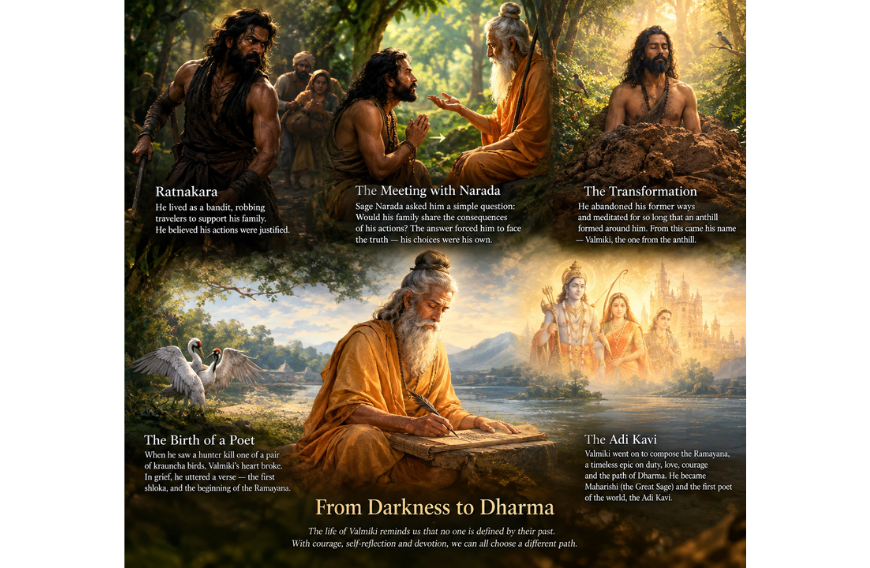
October 25 marked Valmiki Jayanti, the birth anniversary of Maharishi Valmiki, revered as the Adi Kavi, or the first poet, for composing the Ramayana, one of the most enduring works of Indian civilization. His story carries particular significance today, as a new cinematic retelling of the Ramayana approaches audiences around the world next week
Beyond the spectacle of the epic and the familiar story of Lord Rama, Valmiki’s life invites us to consider a more personal question: What does it mean to live according to Dharma, and can a person truly change the course of their life?
The answer begins not with the sage we remember, but with the man he is said to have been before he became a poet.
According to popular retellings of Valmiki’s life, he was once known as Ratnakara, a man who lived by robbing travelers. Some traditions describe him as a forest bandit who justified his actions by claiming he was supporting his family as an earlier version of Robin Hood. His transformation began when he encountered the sage Narada.
Rather than simply condemning Ratnakara, Narada asked him to consider whether the family members for whom he committed these acts would share responsibility for the consequences of his actions. Ratnakara went home and asked them. In the traditional story, they acknowledged their relationship with him but did not accept responsibility for his wrongdoing. The realization forced him to confront a truth he had avoided: the choices he made were his own.
This encounter became the turning point of his life. Ratnakara abandoned his former ways and undertook intense meditation. In one widely told version, he remained absorbed in meditation for so long that an anthill formed around him. The Sanskrit word for anthill is valmika, and the name Valmiki is traditionally associated with this transformation.
READ: Sreedhar Potarazu | Navaratri Day 9: From inner transformation to victory (October 19, 2026)
The story is a powerful reminder that redemption begins when we stop transferring responsibility for our actions to others. Circumstances may explain why we make certain choices, but they do not automatically excuse those choices. Ratnakara’s transformation began when he accepted that distinction.
Valmiki’s significance, however, extends far beyond his personal redemption. He became the Adi Kavi, the first poet, and the traditional author of the Ramayana, a work that has shaped India’s moral imagination for generations.
According to the Ramayana tradition, Valmiki witnessed a hunter kill one of a pair of krauncha birds while they were together. Moved by the surviving bird’s grief, he uttered a verse expressing his anguish and condemnation of the act. The verse emerged spontaneously in a structured poetic form, marking the birth of the shloka as the tradition understands it. Valmiki would go on to compose the story of Rama, whose life offered generations of readers a way to reflect on duty, justice, sacrifice, loyalty and the difficult choices that define human character.
The connection between Valmiki’s transformation and the Ramayana is especially important. A man who, according to tradition, once lived outside the moral order became the voice through which one of Hinduism’s great explorations of Dharma was transmitted. His life suggests that moral authority need not come from an unblemished past. It can emerge from the courage to recognize one’s failures and pursue a different path.
Dharma is often translated as duty, righteousness or moral order, but none of these words fully captures its meaning. Dharma requires us to consider what is right in a particular circumstance, how our actions affect others, and what responsibilities we owe to our families, communities and society. It is not simply obedience to a rule, nor is it the convenient justification of whatever serves our interests.
The Ramayana makes these questions difficult precisely because Dharma is rarely presented as an easy choice. Rama accepts exile to honor his father’s promise. Bharata refuses to treat his brother’s absence as an opportunity to claim the throne for himself. Sita demonstrates extraordinary resolve through adversity. Lakshmana accepts the demands of loyalty and service. Their stories ask us to examine the relationship between personal desire and responsibility to others.
Yet the epic also reminds us that moral decisions can involve competing obligations and painful consequences. Dharma requires reflection, humility and a willingness to place something greater than immediate self-interest at the center of our choices.
Valmiki’s own story adds another dimension to this understanding. If Dharma is about how we conduct ourselves, it must also include what we do after we have failed. A society that speaks about righteousness but refuses to allow anyone to change risks confusing accountability with permanent condemnation. A person should be held responsible for past actions, but responsibility should also include the possibility of making amends, demonstrating changed conduct and contributing meaningfully to society.
This distinction matters in our own time. We often reduce people to their worst decisions, allowing a single chapter of their lives to define everything that follows. Public judgment can become permanent even when a person has acknowledged wrongdoing and worked to change. Valmiki’s story challenges us to ask whether we believe in transformation only as an abstract principle or whether we are willing to recognize it when it occurs in real life.
READ: Sreedhar Potarazu | Navratri Day 8: The wisdom of restoring inner clarity (October 18, 2026)
Moving beyond the past does not mean denying it. Ratnakara’s transformation began with an uncomfortable confrontation with his own conduct. Redemption required a change in direction, not merely a change in name. The lesson is not that wrongdoing has no consequences, but that the past need not dictate every future choice.
As audiences prepare to encounter the Ramayana once again through cinema, it is worth looking beyond the visual grandeur of its characters and battles. The enduring value of the epic lies in the questions it leaves with us.
How do we act when duty conflicts with desire? How do we treat those who depend on us? Can we acknowledge our mistakes without allowing shame to become our identity? And can we extend to others the possibility of change that we hope will be available to ourselves?
Valmiki Jayanti offers a reminder that the human capacity for change is itself worthy of reverence. The sage’s legacy is not only that he composed the Ramayana, but that his life became a testament to the possibility of transformation.
We cannot rewrite the past, but we can decide what we do with the life that remains before us. Dharma begins in that decision, in the willingness to take responsibility for our actions, to learn from our failures and to conduct ourselves with greater wisdom and compassion.
Perhaps that is the most enduring lesson of Valmiki. The measure of a human being is not simply where the journey began, but the direction in which it ultimately leads.