



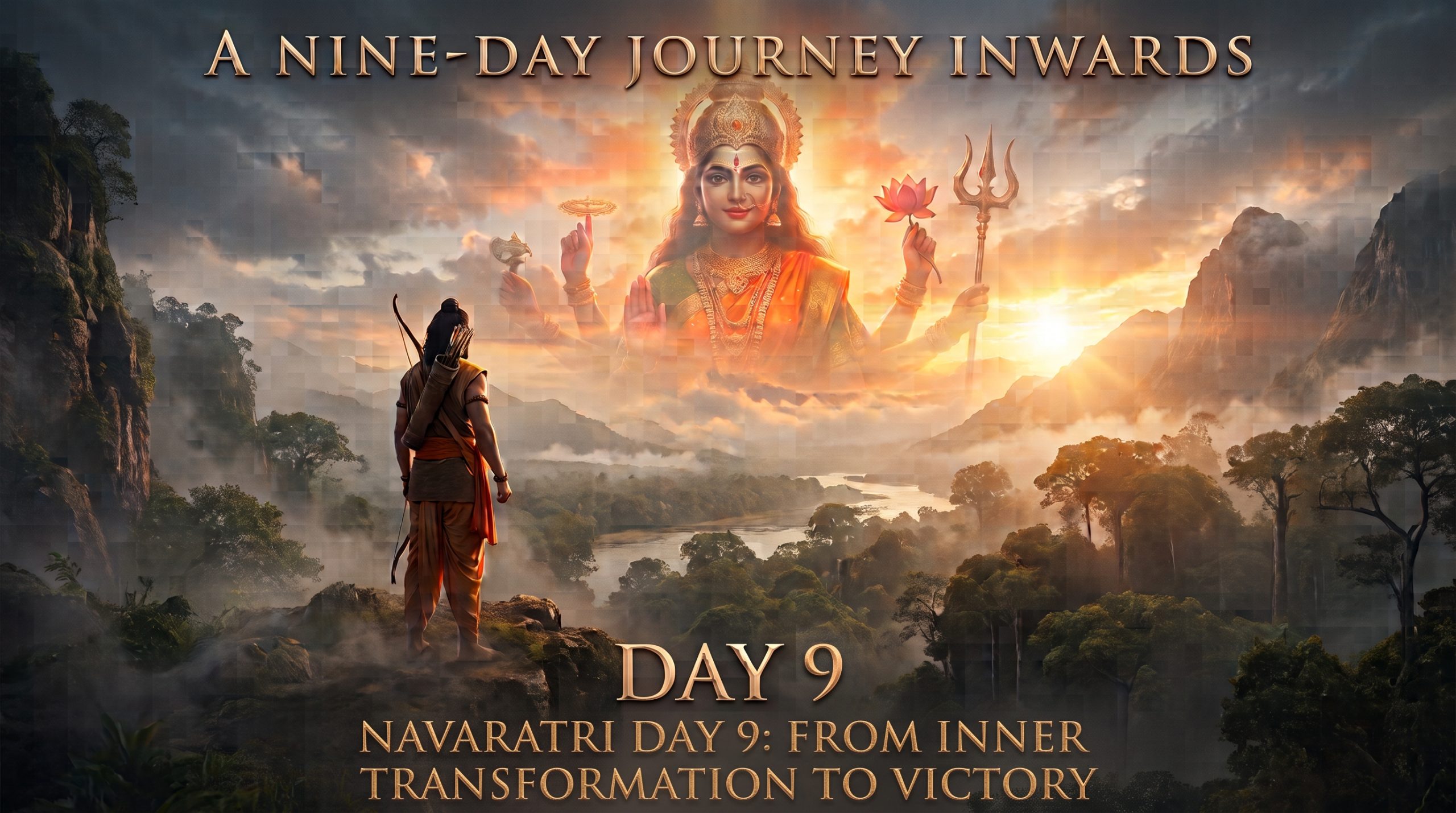
Over the past eight days of Navaratri, we have explored the qualities represented by the nine forms of the divine feminine: the courage to begin, perseverance guided by intention, the responsibility to protect others, creativity that connects ideas, the wisdom to nurture without controlling, the strength to stand up for what is right, the willingness to face our fears, and the restoration of inner clarity. On the ninth day, we honor Goddess Siddhidatri, whose name means the giver of siddhis, or spiritual attainments. She represents the culmination of this journey, inviting us to consider what it means to bring our learning, abilities, and understanding together into a more complete way of living.
In Hindu tradition, Siddhidatri is revered as the goddess who bestows spiritual accomplishments and fulfillment. She is often depicted seated on a lotus, a symbol of spiritual unfolding, with attributes that represent divine power and wisdom. She reminds us that attainment, whether spiritual or worldly, must be understood in the context of what we have become through the journey. Knowledge alone does not guarantee wisdom, just as achievement alone does not guarantee good judgment. The question is whether what we have learned has changed how we understand ourselves, how we treat others, and how we use our abilities.
Professional recognition and financial security are worthy goals, but they do not necessarily make us more discerning or more fulfilled. We can become highly accomplished in one area of life while neglecting the qualities that sustain meaningful relationships and responsible decisions. Siddhidatri invites us to look beyond the achievement itself and examine the understanding that gives it meaning.
Consider how the lessons of the previous eight days come together. Courage without perseverance may lead us to begin but not continue. Perseverance without intention can become stubbornness. Creativity without responsibility can produce solutions without considering their consequences. Care without respect for another person’s independence can become control. Conviction without humility can become arrogance, while the ability to face our fears and release resentment can help restore the clarity needed to make better choices. Each quality is valuable, but none is sufficient in isolation. Wisdom emerges when we learn to recognize which quality a situation requires and how to balance it with the others.
READ: Navratri Day 8: The wisdom of restoring inner clarity (October 18, 2026)
The Ramayana offers a powerful illustration through Rama’s journey. His exile, the loss of Sita, the alliance with Sugriva, Hanuman’s search, and the eventual confrontation with Ravana are not simply separate episodes of hardship and triumph. Together, they reveal the importance of judgment, loyalty, patience, cooperation, and responsibility. Rama’s eventual victory depends on the contributions of many individuals, each bringing different abilities to a common purpose. The journey reminds us that meaningful accomplishment requires the ability to understand circumstances, work with others, and remain guided by principles even when the path becomes difficult.
This brings us to Vijayadashami, the tenth day that follows Navaratri. The festival celebrates victory, most notably through two great narratives in Hindu tradition: Goddess Durga’s defeat of Mahishasura and Rama’s victory over Ravana. Although the stories differ, both celebrate the restoration of dharma, the principle of right order and responsible conduct. In one, the Goddess confronts a destructive force that threatens the world; in the other, Rama confronts Ravana’s abuse of power. Their victories remind us that power without responsibility ultimately becomes destructive.
Yet Vijayadashami also invites a more personal reflection. It is easy to celebrate the defeat of a demon in a story. It is harder to recognize the habits and impulses within ourselves that undermine our judgment. Pride can prevent us from admitting a mistake. Fear can keep us from making a necessary change. Resentment can turn a painful experience into a permanent grievance. The desire to control can damage the very relationships we hope to protect. These are not equivalent to the demons of Hindu mythology, but the stories can help us reflect on the consequences of allowing destructive tendencies to govern our choices.
In parts of South India, the day is also associated with learning, the honoring of tools and instruments, and the beginning of new endeavors. These observances offer a common reminder: the culmination of a period of reflection should lead to renewed engagement with the world. We honor knowledge by applying it, skill by using it responsibly, and spiritual understanding by allowing it to shape our actions.
READ: Navaratri Day 7: The strength to face our fears (October 17, 2026)
For younger generations navigating rapid technological change, social pressures, and an abundance of information, this lesson is especially relevant. Access to knowledge has never been greater, but access alone does not tell us what deserves our attention or how to act on what we know. The ability to gather information must be accompanied by discernment, the willingness to question our assumptions, and an understanding of the consequences of our choices.
As the nine days of Navaratri conclude, Siddhidatri reminds us that the journey inward is not an escape from the world. It is preparation for participating in it with greater understanding. Vijayadashami then marks the transition from reflection to action. The victories celebrated in the epics become meaningful in our own lives when we carry their lessons into our relationships, our work, and our responsibilities to others.
The true culmination of Navaratri is not that we have completed nine days of observance. It is that we emerge with a clearer understanding of the qualities we need to cultivate and a renewed willingness to put them into practice. The journey does not end on the tenth day. It begins again whenever we choose to act with greater wisdom than we did before.
The true victory is not merely overcoming what stands before us, but becoming the person capable of choosing what is right.