



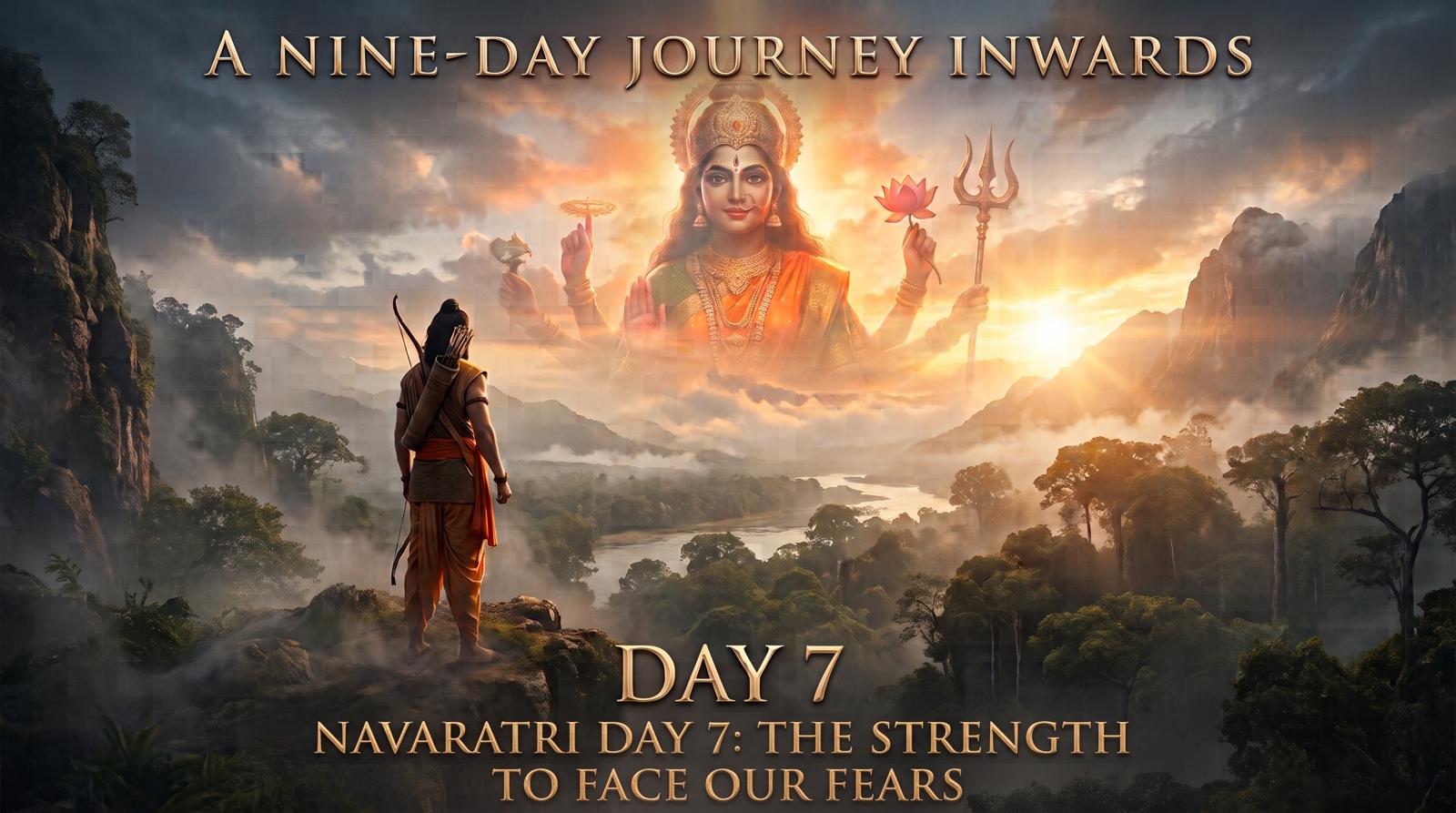
On the seventh day of Navaratri ,we honor Goddess Kalaratri, one of the most formidable manifestations of Durga. Her dark appearance, disheveled hair, and fierce expression may seem frightening, yet she is revered as a protector who destroys evil and removes fear. Her symbolism offers a lesson of what sometimes appears frightening is precisely what we must confront to move forward.
The name Kalaratri is often interpreted in relation to kala, meaning time or darkness, and ratri, meaning night. She is associated with the darkness that precedes transformation, the uncertainty we encounter when familiar ways of thinking no longer provide answers. Her fierce form reminds us that the path toward understanding does not always feel reassuring. There are moments when growth requires us to face what we would rather avoid.
Fear is a natural part of being human. It warns us of danger and can prevent reckless decisions. But fear can also become a force that narrows our world. We avoid difficult conversations because we fear rejection. We remain in familiar circumstances because uncertainty feels worse than dissatisfaction. We defend beliefs we have outgrown because acknowledging that we were mistaken threatens our sense of identity. In each case, fear does more than make us uncomfortable. It begins to make decisions on our behalf.
The challenge is not to eliminate fear, but to understand it. We must learn to distinguish between a genuine warning and the discomfort that accompanies change. A difficult truth does not become less true because we find it unsettling. An uncertain outcome does not necessarily make a decision wrong. Sometimes the fear we experience tells us less about the danger before us than about how much we stand to lose by changing.
The Ramayana offers a striking example through Hanuman’s search for Sita in Lanka. After crossing the ocean, Hanuman faces an unfamiliar kingdom, searches through a hostile environment, and must find Sita without knowing exactly where she is being held. His mission demands more than physical strength. He must manage uncertainty, assess what he encounters, and resist acting impulsively. When he finally finds Sita in the Ashoka grove, he approaches her carefully, recognizing that his actions could frighten her or compromise his mission. His success depends on his ability to remain clear-minded in circumstances that could easily overwhelm him.
READ: Navaratri Day 6: The strength to stand up for what is right (October 16, 2026)
Hanuman’s example shows us that facing fear does not mean charging blindly into danger. It means remaining attentive when uncertainty makes it tempting to react without thinking. We may not control the circumstances we encounter, but we can work to control how we respond to them. The ability to pause, observe, and act with discernment is often more valuable than the appearance of fearlessness.
For young people growing up in an environment of constant comparison, this lesson has particular relevance. Social media can magnify the fear of being left behind, excluded, or judged. The pressure to present a successful life can make admitting uncertainty seem like weakness. Yet the willingness to say “I do not know,” to ask for help, or to change direction after discovering that a choice was mistaken is a sign of maturity. It takes a clear understanding of ourselves to recognize when fear is protecting us and when it is holding us back.
Kalaratri also invites us to confront the darkness within ourselves. It is often easier to identify fear, prejudice, or insecurity in others than to acknowledge these qualities in our own behavior. We may avoid examining our motives because doing so could challenge the image we have constructed of ourselves. But self-awareness begins when we become willing to see what is present rather than what we wish were present. We cannot address a problem we refuse to acknowledge.
When we acknowledge fear without allowing it to dictate our choices, we create the possibility of responding with greater wisdom. When we accept that we may be wrong, we make room for learning. When we face uncertainty without demanding immediate reassurance, we become better equipped to navigate change.
READ: Navaratri Day 5: The wisdom to nurture without controlling(October 15, 2026)
The seventh day of Navaratri reminds us that darkness is not always something to escape. Sometimes it is the place where we discover what we have been unwilling to see. Kalaratri’s fierce presence symbolizes the strength to confront that darkness without surrendering our judgment to it. The goal is not to become fearless, but to ensure that fear does not become the final authority over our lives.
Fear may show us where the darkness lies, but it need not decide whether we take the next step.